 Getly
Getly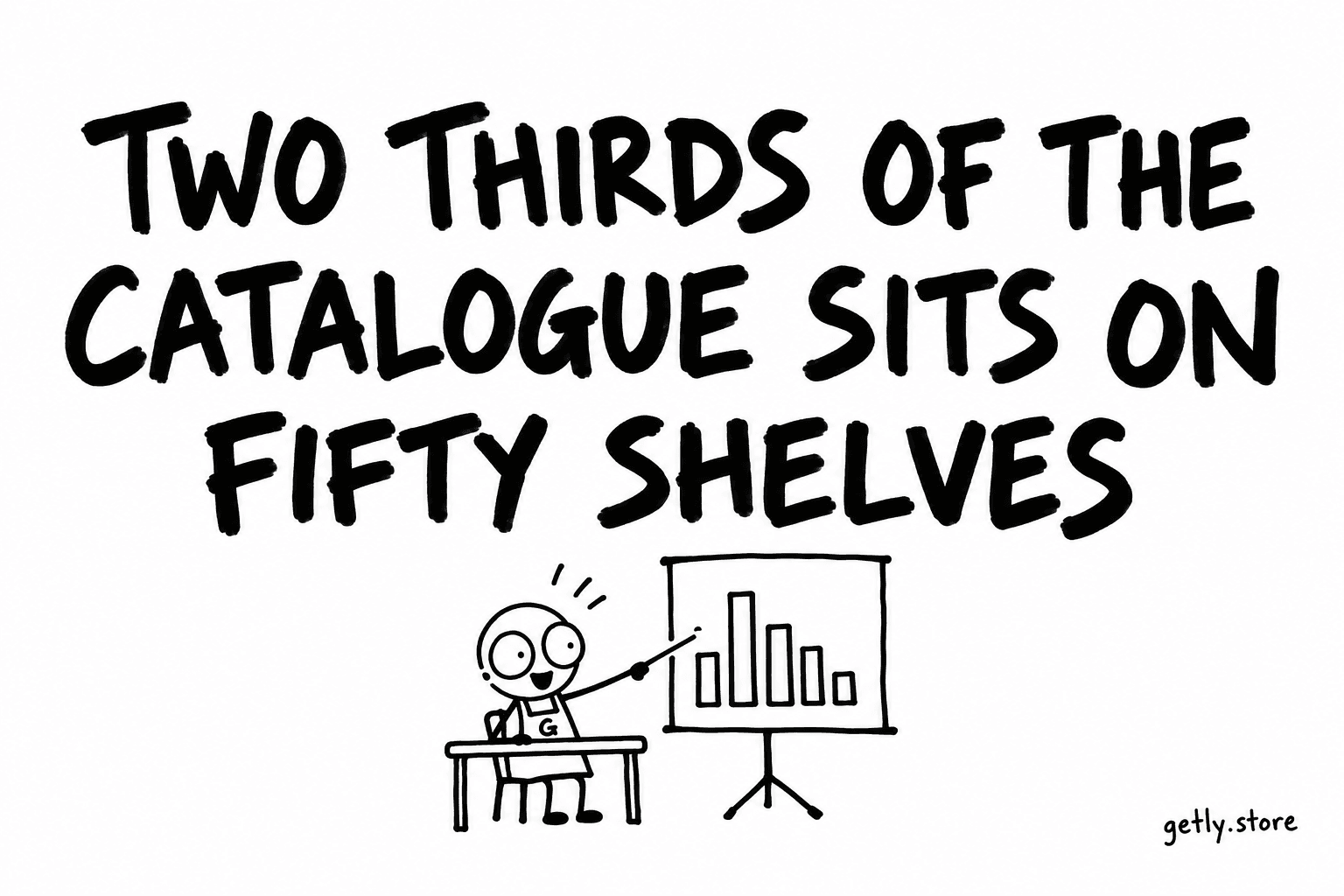
A marketplace category tree looks flat from the menu. Every shelf gets one line, one link, the same font. Underneath, the shelves are nothing like each other in size, and where a listing sits changes what it is up against.
Measured on 26 September 2026, the active Getly catalogue held 7,143 listings across 437 leaf categories with at least one listing each. The ten biggest shelves hold 31.6% of all listings. The fifty biggest hold 66.5%. The remaining shelves, well over three hundred of them, share the last third.
The biggest shelves
Ranked by active listings on the same date:
| Shelf | Active listings |
|---|---|
| PBR Materials | 535 |
| E-books | 408 |
| Backgrounds & Wallpapers | 280 |
| Animals & Wildlife | 188 |
| Guides & Tutorials | 154 |
| Business & Money | 150 |
| Children's Books | 143 |
| Android App Templates | 140 |
| Coloring Books | 132 |
| Excel Templates | 125 |
| Illustrations | 124 |
| Self-Help | 111 |
The top shelf alone holds more listings than most sellers will ever scroll through. A shelf near the bottom of the ranking might hold one or two.
Big shelves are not all crowded in the same way
The raw listing count hides how many shops stand behind it, and that matters more than the count. Two examples from the same measurement:
- Animals & Wildlife, 188 listings, is held by three shops. Its paid listings have a median price of $4.00, and the 25th and 75th percentile are both $4.00 too: one price, repeated.
- Children's Books, 143 listings, is spread across many shops, with a median paid price of $4.99 and a middle half between $3.00 and $8.00.
A seller entering the first shelf is not competing with a crowd. They are standing next to three catalogues that fill the shelf with near-identical listings at one price. A seller entering the second is one of many voices, each with a slightly different offer. Both shelves are "big", and they call for different moves: on a shelf dominated by one repeated price, a listing that is clearly different in content and presentation has room to be noticed; on a many-voice shelf, precision in the title and the contents list is what separates one listing from its neighbours.
The shelves also differ in price level, so the neighbourhood you land in sets the frame buyers compare you against. Backgrounds & Wallpapers has a median paid price of $1.99, Excel Templates $12.99, Illustrations $15.00, all measured on the same date.
What a small shelf gives you, and what it does not
It is tempting to read the long tail as empty space waiting to be filled. Part of that is right: on a shelf with a handful of listings, a new one is visible, and a buyer who browses that shelf sees it among few others.
But a small shelf is small for one of two reasons, and they are opposite:
- Nobody has made the product yet, but buyers look for it. That is an opening.
- Few buyers look for it, so few sellers bothered. That is a quiet room.
The listing count alone cannot tell these apart. This is a correlation question with no answer in the count: a shelf's size says what sellers did, not what buyers want. The check you can run is to look at demand signals rather than supply. Getly's sell opportunities page ranks categories by attention per listing and only shows a category when it clears a minimum level of views, so it points at shelves where buyers look more than sellers supply.
The wrong answer: move to where it is quiet
The category is a description of what the product is, not a marketing lever. A PBR material filed under a small, unrelated shelf to escape the crowd will be seen by fewer of the people who want PBR materials, not more, and buyers who land on the wrong shelf will not buy something that does not belong there. The right category is the one a buyer would look in first.
Where there is a real choice is between a broad shelf and a more specific one that also fits. A material that is clearly for a single use can sit on the most precise shelf that describes it, instead of the widest one. The narrow shelf is not a trick; it is the more accurate description, and accuracy happens to put you among fewer, closer neighbours.
What to do today
Open your listings and, for each one, look at the category it sits in and one level around it. Ask two questions: is there a more specific shelf that describes this product better, and who else is on the shelf I chose? Visit the shelf as a buyer would and scroll it. If you are standing next to one repeated price, make your listing's contents and cover clearly different. If you are one of many, sharpen the title and add a contents list. Then check the opportunities page before you create your next product rather than after.