 Getly
Getly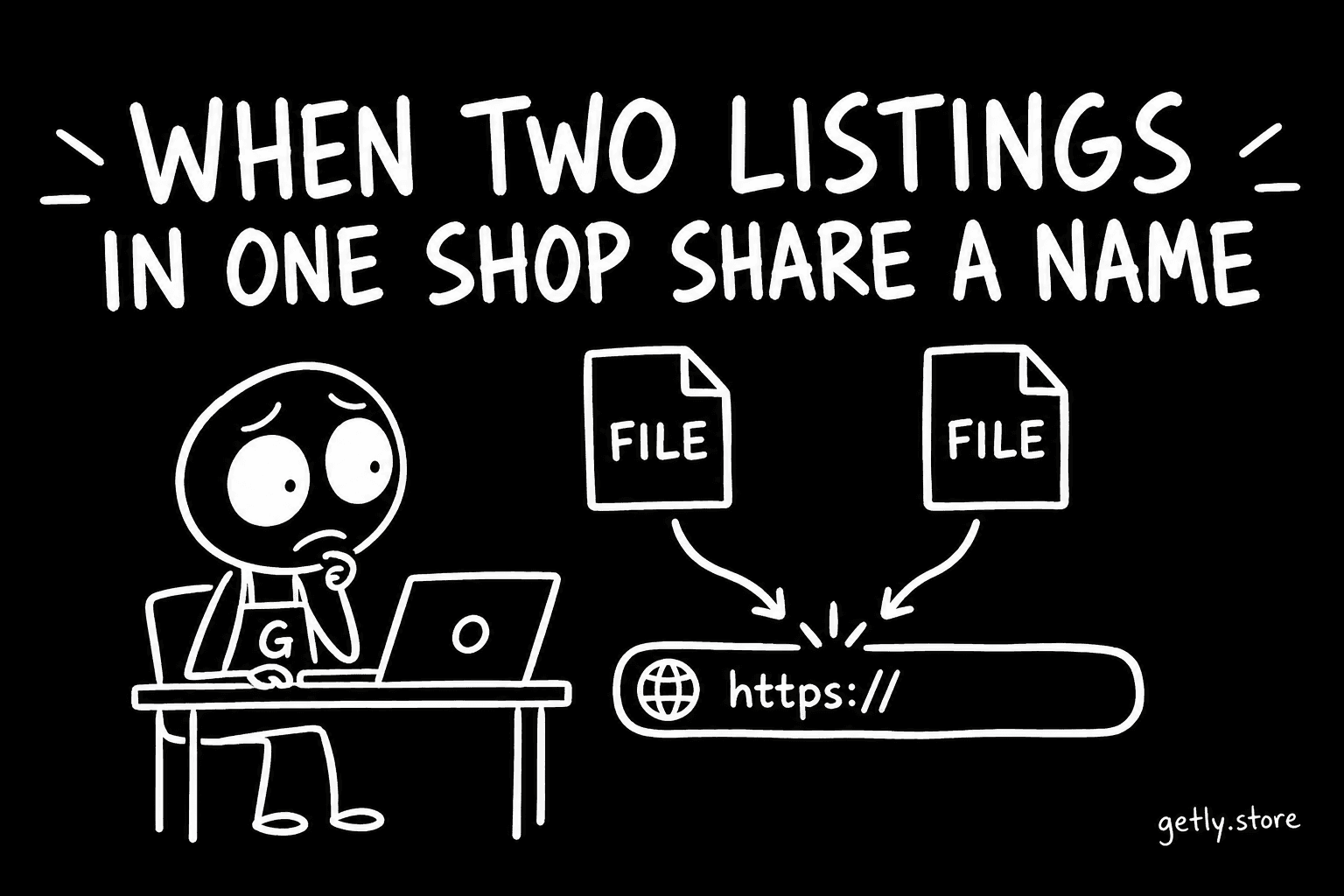
Measured 19 September 2026, 504 active listings — 7.73% — carry a title that is character-for-character identical to at least one other listing in the same shop. They fall into 186 groups.
Loosen the test to the first 25 characters, which is about what a product card shows before it truncates, and the number roughly doubles: 834 listings, 12.79%, across 214 groups. The largest single group holds 46 listings.
Nothing here is a mistake. Each of those 46 is a real, distinct piece of work. The buyer simply cannot tell which one they are looking at.
The URL inherits the collision
A slug is generated from the title, and only 2.81% of listings have a slug that diverges from it. Renaming is something almost nobody does after publishing.
So the collision is not confined to the shop page. It is in the address that gets pasted into a message, the address that appears in a search result, and the address a buyer looks at three weeks later trying to work out which of the two things they bought. A title that repeats produces a link that repeats.
How much room a title actually has
The median active title is 35 characters long. The tenth percentile is 14 and the ninetieth is 79; the longest in the catalogue runs to 499.
Those two facts together are the whole problem. For a median title, the first 25 characters are most of what exists. For a 79-character title, they are the first third — and the first third is where sellers put the thing that is the same across their entire shelf.
The decoration is well established. 21.78% of titles use " - " as a separator, 10.71% use brackets and 7.26% a pipe. 5.89% begin with a digit, 3.73% are entirely upper case, 1.23% carry an emoji, and 20.17% contain non-ASCII characters.
Read that as a list of ways to make a title louder. None of them makes it more distinct, because they are applied to every listing in the series equally. A pipe does not separate you from your own neighbour.
Put the distinguishing word first
The fix is the same one every time, and it costs one edit per listing: whatever is different about this item goes before whatever is shared.
"Brick, red weathered — PBR" beats "PBR Material Pack Vol. 12 — Brick Red Weathered". Both titles contain the same information. Only the first one survives being cut at 25 characters, and only the first one is legible in a column of its own siblings.
The series name, the volume number and the format are the parts your buyer already knows by the time they are looking at your shop page. They are the worst possible use of the opening.
Where the fix stops working
At a group of 46, rewriting the individual titles is not enough, and it is worth saying so plainly rather than pretending the advice scales.
Forty-six items sharing an opening is a naming scheme, not a set of typos, and a naming scheme has to be fixed at the level of the scheme. Three honest ways out:
- Name the axis instead of the index. If the difference between volumes is the subject, the subject is the title. "Vol. 12" tells a buyer nothing they can act on.
- Collapse the series into a bundle and keep a handful of individually named entry points. One listing of 46 files is easier to choose than 46 listings of one.
- Accept the repetition and carry the difference in the image. This is the weakest option, because the image does not travel into the URL, the search result or the message someone sends a colleague — but it is better than 46 identical strings.
A title is the only part of a listing that has to work in five places at once: the card, the shop page, the search result, the link and the receipt. It is also the field most people fill in last.