 Getly
Getly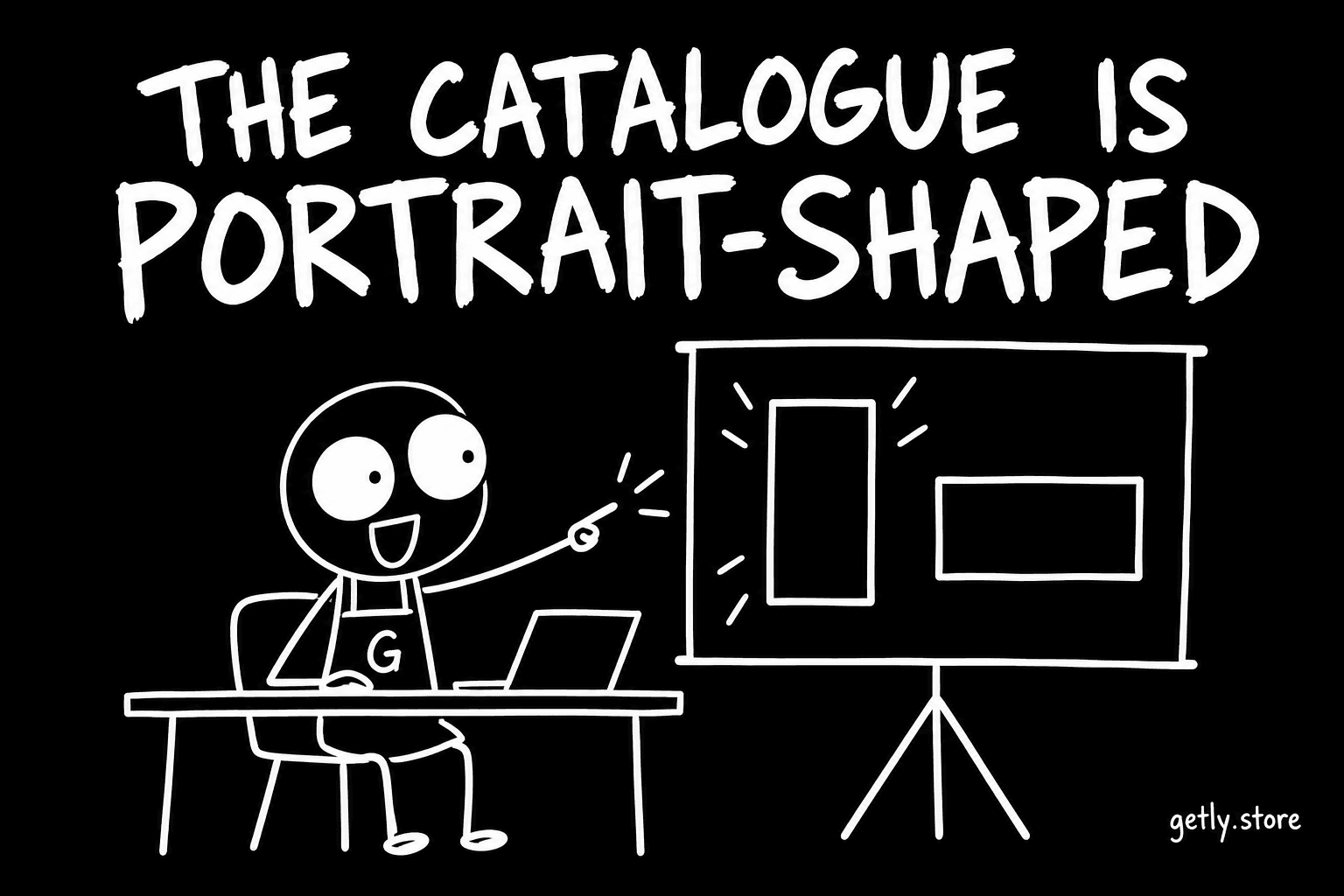
We parsed 2,727 of the images delivered with listings on 19 September 2026 and measured two things about each one: its shape, and its size in pixels. Both came back different from what a product page is built for.
Portrait wins, and the exact ratios say why
By orientation:
- portrait — 1,229 (45.07%)
- landscape — 1,039 (38.10%)
- square — 459 (16.83%)
By exact aspect ratio, where the image lands on one:
- 1:1 — 442
- 16:9 — 437
- 2:3 — 223
- 3:2 — 135
- 4:3 — 116
1:1 and 16:9 are almost tied at the top, and they are the two ratios no camera produces by default. One is a social template, the other is a video frame. Below them, 2:3 beats 3:2 by a factor of 1.65 — the same ratio, turned on its side, chosen upright more often than not. The catalogue is shaped by the tools that made its images, and those tools are phone-shaped.
The median cover is 1.57 megapixels
The median delivered image is 1,254 × 1,369, which is 1.57 megapixels. Around it:
- under 1 megapixel — 444 (16.28%)
- 4K-wide or larger — 184 (6.75%)
- largest single image — 160 megapixels, roughly a hundred times the median
1.57 megapixels is perfectly fine in a grid, where a card is a few hundred pixels across. It is soft on a laptop opening the product page at full width, and it is visibly soft for the 16.28% sitting under a megapixel — soft in the way that reads as an unfinished product rather than a compressed file. The top of the range is no better: a 160-megapixel image is a long wait for a decoration.
The most common image size is a default
The exact pixel dimensions that repeat most often:
- 1254 × 1254 — 167
- 1376 × 768 — 147
- 1024 × 1536 — 119
- 1122 × 1402 — 97
- 941 × 1672 — 86
- 1536 × 1024 — 85
- 2560 × 1440 — 58
Look at what those actually are. 1024 × 1536 and 1536 × 1024 are generator output sizes. 1254 × 1254 and 1122 × 1402 are template canvases. 2560 × 1440 is a screen. Not one of the seven is a dimension somebody picked for a product page — every one of them is the size something handed them.
That is the finding, and it is more useful than the orientation split. The most common exact dimension in the catalogue is a default that nobody overruled, which also explains the median. 1.57 megapixels is not a compromise anyone negotiated. It is where the tools land when you accept what they offer.
The five-image spike is the shape of the form
How many images a listing carries: 54.29% carry exactly one. From there the count falls away through two, three and four — and then jumps back up at exactly five, where 710 listings sit, 10.89% of the catalogue. At six it collapses to 25.
The uploader caps at five. So the spike is not a preference and not a finding about presentation; it is the upper edge of a form with people pressed against it. The honest version of the number is that a tenth of the catalogue wanted as many images as it was allowed, and slightly more than half uploaded one and stopped.
What to change
If your cover is under a megapixel, replace it. That is 16.28% of images, and it is the only item here that gets noticed without being looked for.
Overrule the default once. Whatever made your image handed you its canvas, not yours. Exporting at roughly twice the width your card displays at costs nothing, survives a retina screen, and stops the page looking softer than the work.
Do not chase 160 megapixels either. Past about 4K wide nothing more is visible and the wait gets longer — 6.75% of the catalogue is already up there, paying for pixels nobody sees.
If you uploaded one image, upload a second. Half the catalogue stops at one. The cheapest second image is not another hero shot; it is the thing actually being asked for, which is what the product looks like in use.