 Getly
Getly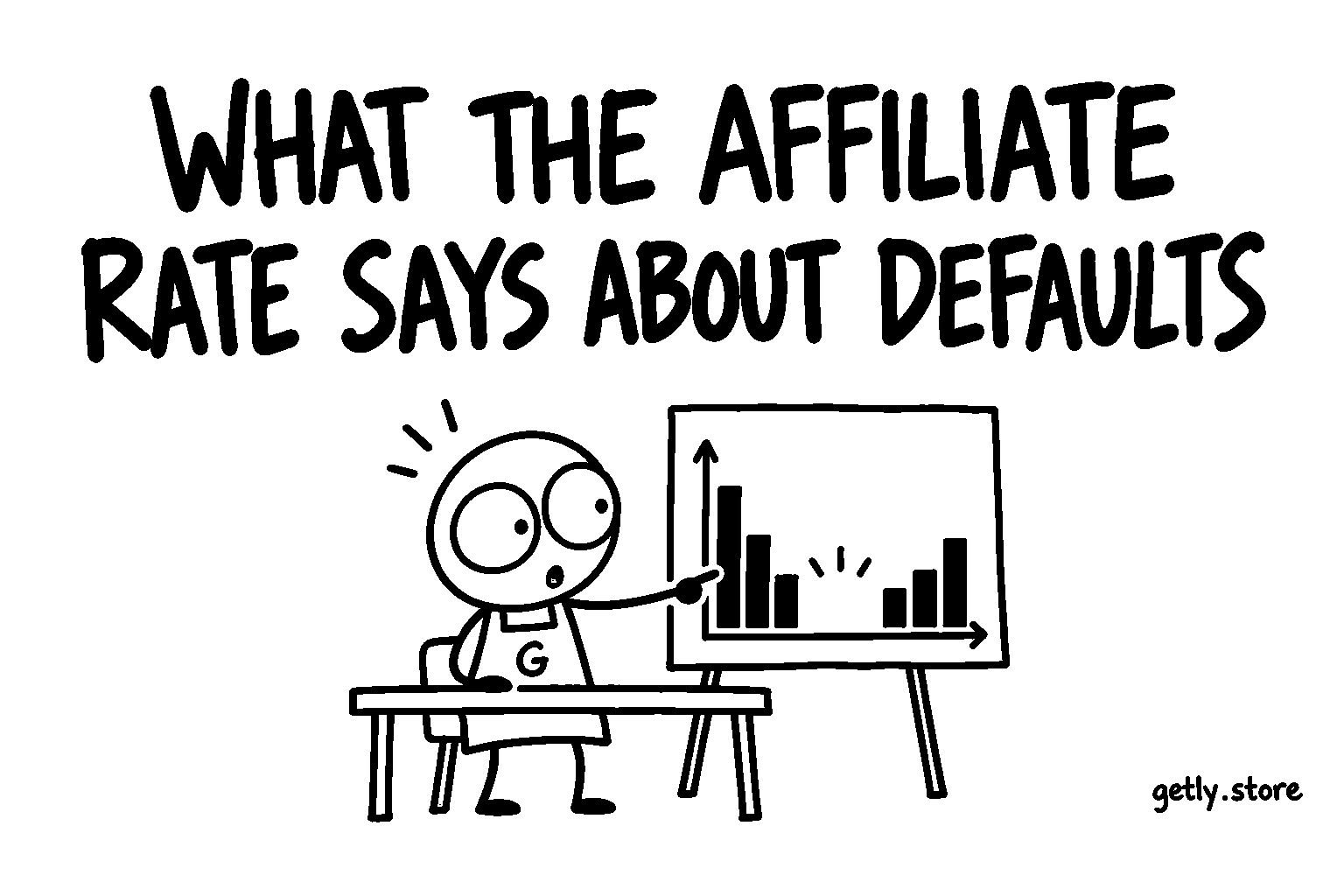
Any listing on Getly can carry an affiliate program, and the form that creates one arrives with a rate already filled in. Measured 19 September 2026, 4,894 of the 6,519 active listings — 75.07% — had a program attached, and 96.32% of those were switched on.
How many use it is the dull half. The useful half is what the rates look like once you sort them.
The distribution has a hole where tuning would be
Commission rates across live affiliate programs:
- 15% — 3,683 listings, 75.26%. This is the value the form arrives with.
- 10% — 476 listings, 9.73%
- 50% — 177 listings, 3.62%
- 20% — 104 listings
- 30% — 79 listings
- 5% — 65 listings
- 40% — 60 listings
- 1% — 47 listings
Median 15, mean 16.21, maximum 60.
The top line is unsurprising: three quarters of programs sit on the default. The shape underneath it is not. The second-largest cluster is not 16% and not 14% — it is 50%, a number you reach by deciding "half", not by adjusting. Between 11% and 14% there is effectively nothing. Between 16% and 19% there is effectively nothing either.
That is the signature of a field that gets accepted whole or replaced whole. Almost nobody nudges it. They either leave the form as they found it, or they overwrite it with a completely different idea of what an affiliate is worth — and then stop, because "half" needs no further thought.
The tag field behaves the same way
48.20% of active listings carry exactly ten tags. Not nine, not eleven — ten, on nearly half the catalogue. The dashboard form stops accepting new tags at ten, so the distribution has a wall at the cap and a spike against it.
The counter-example proves it. 90 listings carry more than ten tags, and 98.89% of those arrived through the API, which has no cap. The behaviour did not change when the seller changed; the form did.
And so does the image uploader
54.29% of listings carry exactly one image. From there the counts fall away as you would expect — and then jump back up at exactly five, where 10.89% sit. Five is the uploader's limit.
Three fields, three unrelated parts of the product, one shape each time: a mass at the default, a mass at the cap, and very little in between.
What follows from it
A default is a decision, and it is made by the product. Whoever wrote 15 into that form set the commission on three quarters of the affiliate programs in the catalogue. That is not a criticism of the number — 15 is a reasonable number — it is an observation about where the decision actually happened.
A cap reads as a recommendation. Half the catalogue uses exactly ten tags not because ten is right for a font pack and also right for a 3D scene, but because ten is where the field stopped. The same goes for five images.
If you are filling the form, the cheapest edit available to you is the one nobody makes. A rate of 25% on one product in a catalogue where the competition is uniformly at 15% is visible to every affiliate browsing for something to promote. So is a seventh tag chosen for the subject rather than the medium. Neither takes longer than a minute, and both move you out of the pile that the default built.
None of this says the defaults are wrong. It says they are doing the deciding, and that three quarters of the time nobody checks.