 Getly
Getly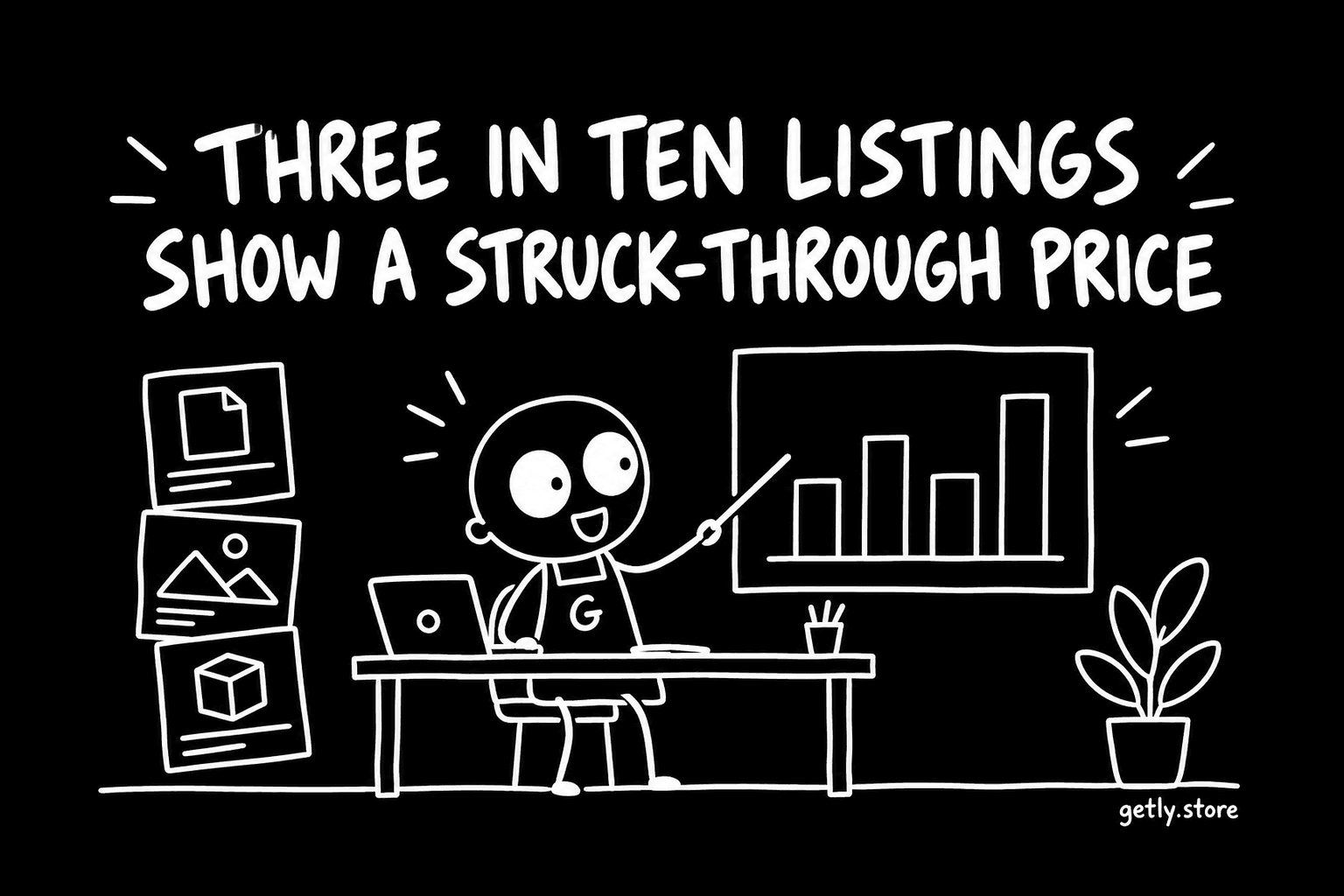
A compare-at price is the second number on a listing: the one with a line through it. On 19 September 2026, 1,880 of 6,388 paid listings in the Getly catalogue carried one — 29.43%, or close enough to three in ten.
How many is not the interesting part. Where the second number comes from is.
The median claim is 40.8% off
Among the listings that show one, the median claimed discount is 40.8%. The median pair is a $14.99 anchor against an $8.00 asking price.
Two round numbers, and the gap between them lands almost exactly on the figure a shopper has been trained to recognise since long before the internet. By itself that proves nothing: a real 40% cut looks identical on the page to an invented one. It is still worth knowing that the median listing arrived at the most familiar possible number.
The $10–30 band uses it most
Split by what the listing actually asks:
- under $3 — 27.51% carry a compare-at price
- $3 to $10 — 27.00%
- $10 to $30 — 36.30%
- over $30 — 29.02%
The spread is real but narrow, and the peak sits where you would expect it. The $10–30 band is where a buyer stops clicking and starts comparing, so that is the band where an anchor has work to do. Below $3 the decision is fast enough that there is nothing for it to do. Above $30 the share comes back down, which reads like listings at that level leaning on the merit of the work instead.
The anchor comes from the same short list as the price
Here is the measurement that makes the rest of it readable. In the same catalogue, the twenty most common exact prices cover 61.83% of all paid listings, and 51.60% of paid listings end in .00.
So asking prices are drawn from a very short list of round, familiar numbers — $5.00, $9.99, $12.00 and their neighbours. And the compare-at prices are drawn from the same short list, one or two rungs further up. A $14.99 anchor above an $8.00 price is not a memory of what the product used to cost. It is the next familiar number, picked the same way the asking price was picked.
That is the tell, and it is a statistical one rather than an accusation about any individual listing. A price that genuinely fell would leave odd residue behind it: $23.40, $17.50, whatever the old number happened to be. Anchors that cluster on the same round figures as current prices were not remembered. They were chosen.
When the second number is true
The practice is not the problem, so it is worth being precise about when it is straightforwardly legitimate.
The listing genuinely sold at that price. You launched at $24, you have since moved to $14, and the line through $24 is a fact about your own history that you could show someone.
The bundle genuinely costs more apart. Four items at $9 each, offered together for $24 — the $36 is not a claim about the past, it is arithmetic anyone can verify by opening four tabs.
The discount is time-boxed and the box closes. A price that is lower until Sunday and higher on Monday is a discount. The ending is the part that makes it one.
What a permanent 40% off actually does
Take someone who sees $14.99 struck through, $8.00 beside it, and does not buy that day. A week later they come back: same $14.99, same $8.00, same badge. Nothing about the listing changed, and exactly one thing about them did — they now know the $14.99 was never a price. Every other claim on that page gets read through the new information.
The cost is not the sale that did not happen that week. The cost is that a permanent discount converts the one urgency signal your listing has into decoration, and you cannot get it back on the day you actually need it: the launch, the bundle, the genuine end-of-year cut. You will be making a true statement on a page that has already taught the reader to discount it.
The alternative is unglamorous and it is one line of work. Price the thing at what it is worth, leave the second number off, and keep the struck-through price for the weeks when it describes something that happened. It will still be there when it means something.