 Getly
Getly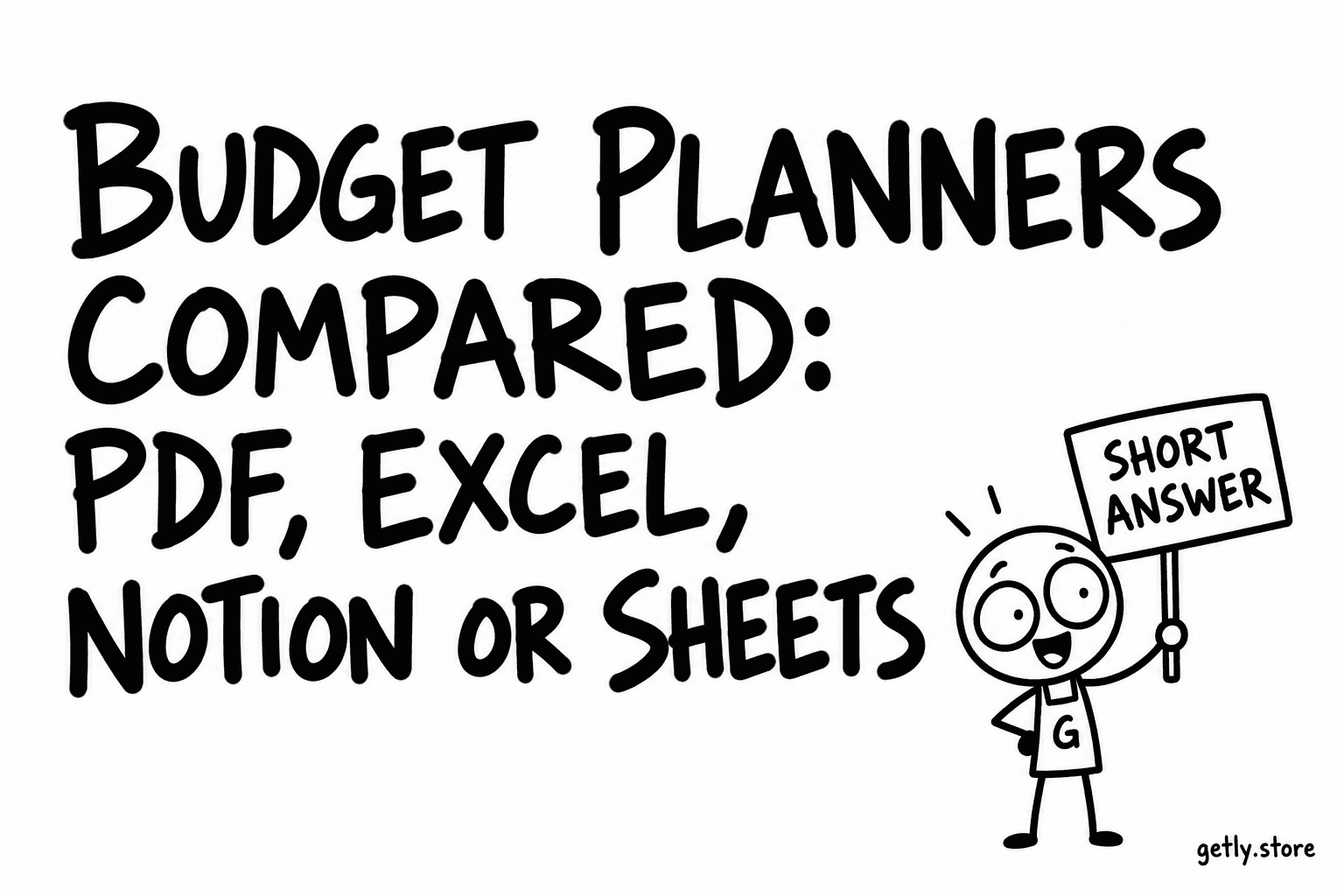
A budget planner is only useful if you keep using it, and whether you keep using it depends mostly on the format. A printed page that sits on the fridge, a spreadsheet that adds up your month, a Notion page linked to your notes and a Google Sheet shared with a partner are four different habits. The template is secondary.
This piece starts with the practical question, which format suits which way of handling money, and then shows what budget planner listings on Getly actually deliver and charge. We measured three shelves on 26 September 2026: Budget Planners & Trackers, Digital Planners and Spreadsheets & Calculators, together 158 active listings.
The short answer
| Format | Best for | Adds up for you | Shares easily |
|---|---|---|---|
| PDF, printable | People who like writing things down and reviewing on paper | No | Only as a copy |
| PDF, for tablets | Handwriting with a stylus in apps such as GoodNotes | No | Only as a copy |
| Excel | Detailed tracking, offline work, charts and formulas | Yes | As a file |
| Google Sheets | Couples and households sharing one budget in real time | Yes | Yes, live |
| Notion | People who already plan their life in Notion | Partly | Yes, live |
If you want the numbers to add themselves up, choose a spreadsheet. If you want to sit down once a week and look at your month by hand, a PDF is often the better tool, precisely because it makes you write each figure. If two people spend from the same money, pick something both can open at the same time.
PDF planners: printable or for a tablet
A PDF budget planner comes in two versions that are easy to confuse. A printable planner is designed for paper: check the page size (A4 or US Letter), whether it prints well in black and white, and whether it is undated so you can reuse it every month. A tablet planner is designed for handwriting apps: it usually has hyperlinked tabs that jump between months and categories, and it should say which apps it was tested in.
On the three Getly shelves, 28.5% of listings mention printing, A4 or US Letter, and 11.4% mention GoodNotes, Notability or hyperlinks. PDF is the most common delivery: 36.7% of listings ship a PDF without any spreadsheet file.
The limitation is simple: a PDF does not calculate. That is fine for a monthly overview or a savings tracker you colour in, and frustrating for anyone who wants totals and averages.
Excel: the most complete, and the most portable
An Excel workbook (.xlsx) is the most capable of the four. Formulas total categories, compare budget against actual spending, and draw charts. It works offline, and an .xlsx file also opens in Google Sheets, Apple Numbers and LibreOffice, so it is the safest choice if you are not sure which program you will use. The catch: advanced features such as macros may not run outside Excel, so a listing should say whether the workbook depends on them.
31.0% of listings on these shelves ship a spreadsheet file, and 46.8% mention Excel somewhere in the title or description. For a wider choice, the separate Excel Templates shelf holds 125 active listings.
Google Sheets: the one to share
A Google Sheets template is usually delivered as a link that makes a copy in your own Google account. Its strength is sharing: two people can enter expenses from their phones and see the same totals at once, which is exactly what a household budget needs. Its weakness is that it lives in an account and needs a connection to edit comfortably.
29.1% of listings on the three shelves mention Google Sheets. Most of them also ship an .xlsx file, which is a good habit: the buyer gets a copy link and a file they can keep. 6.3% of listings mention Google Sheets without shipping a spreadsheet file at all, so check what the download actually contains. The Google Sheets Templates shelf is smaller, 19 active listings.
Notion: good if you already live there
A Notion budget template is a page you duplicate into your own workspace. It can link expenses to goals, notes and calendars, which is its real advantage for someone who already runs their life in Notion. For someone who does not, it is a new tool to learn before the budget even starts, and its calculations are more limited than a spreadsheet's.
Notion barely appears on the three budget shelves: 0.6% of listings mention it. Notion templates live on their own shelves on Getly, such as Notion Templates, 24 active listings across all Notion shelves.
What each format costs on Getly
Median paid prices, measured 26 September 2026 on the three budget shelves, grouped by what the download actually contains:
| What the listing ships | Share of listings | Median price | Middle half |
|---|---|---|---|
| PDF, no spreadsheet | 36.7% | $5.00 | $2.99 to $9.99 |
| Spreadsheet file (.xlsx and similar) | 31.0% | $12.99 | $11.00 to $12.99 |
| Archive only (contents not measured) | 19.0% | $12.99 | $7.24 to $14.42 |
By shelf, the median paid price is $11.00 on Budget Planners & Trackers, $5.99 on Digital Planners and $12.99 on Spreadsheets & Calculators. On the separate shelves, Excel Templates and the Notion shelves both sit at a median of $12.99, and Google Sheets Templates at $9.00.
The pattern is consistent: a template that calculates costs roughly two and a half times as much as one you fill in by hand. That reflects more work behind it, formulas, checks, charts, and it is also what a buyer should expect to get for the difference.
Before you buy: five checks
- Which file is in the download? Look for the format list in the description or the images, not only the title.
- Which currency and date format? A template built for dollars and US dates may need adjusting.
- Dated or undated? A dated 2026 planner stops being useful in January.
- Does it need a specific app? Macros, a particular tablet app, or a Notion account.
- What is the licence? For personal budgeting it rarely matters, but if you want to use a template with clients, check it. On these three shelves, 38.6% of listings leave the licence field empty.
For sellers: ship two formats, say which
The most useful thing a budget template seller can do is remove the format question. Ship the .xlsx file and, if you offer it, a Google Sheets copy link in a short PDF; template links from Google Sheets and Notion are accepted as delivery on Getly, while a bare link to a file-hosting service is not. Put the formats, currency and page size in the first line of the description. Our guide on selling PDF planners covers the printable side in more detail. Listing is free, and you keep 80% of each sale by default; see the pricing page.