 Getly
Getly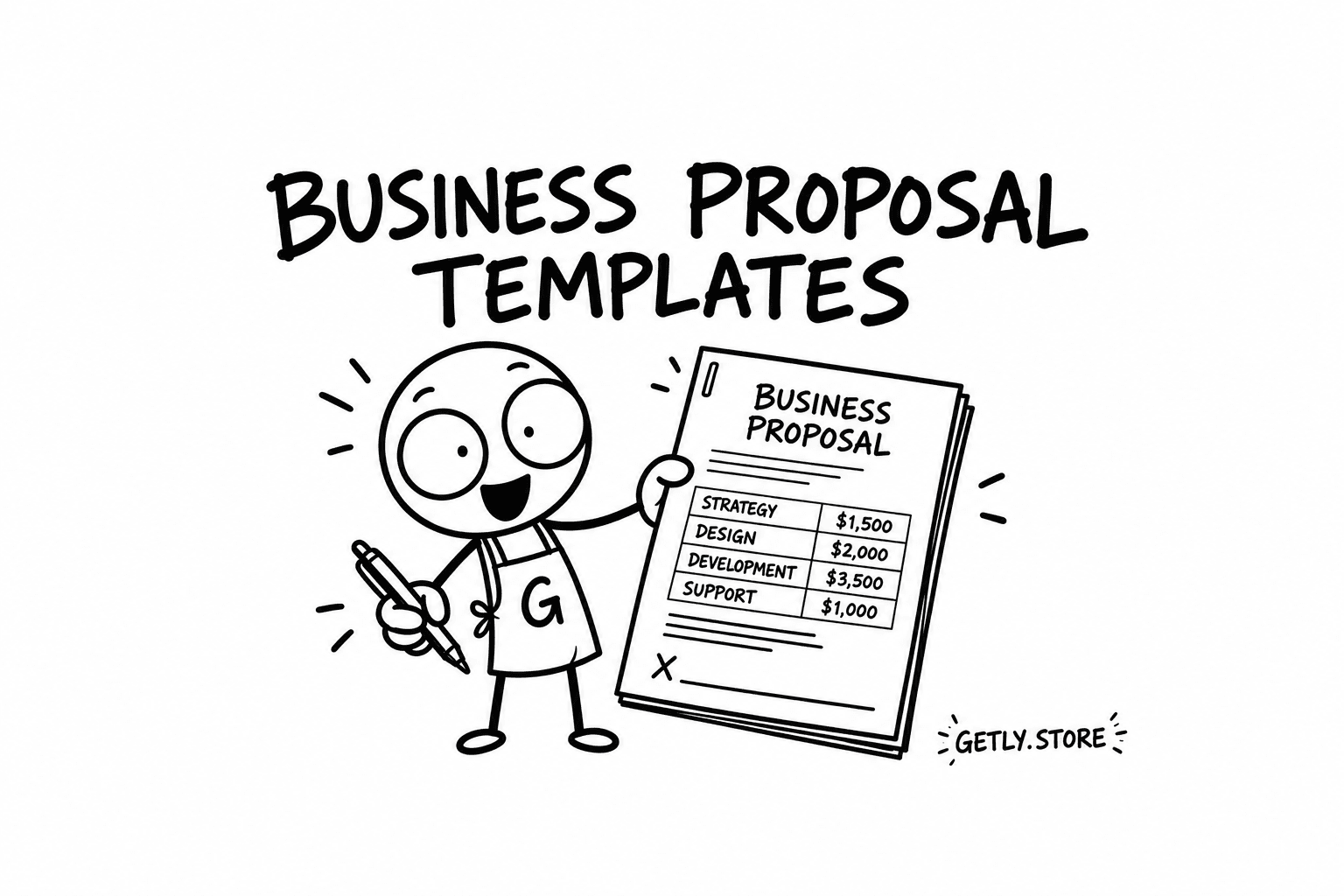
A proposal is the document a client reads right before deciding whether to pay you. It does not need to be long, and it does not need to be beautiful in the way a portfolio is. It needs to make the decision easy: here is what you need, here is what I will deliver, here is when, here is what it costs, and here is how we start. A good template gives you that structure so you are not rebuilding it at midnight before a deadline. A bad one gives you a pretty cover and twelve pages of filler you will delete.
This guide is for freelancers and small agencies picking a business proposal template, and for anyone weighing a freelance proposal template against writing their own. At the end there is a short part for people who make and sell templates.
The sections a winning proposal actually has
Most proposals that win work follow the same order, because it follows the order of the client's questions. When you look at a template, check that each of these exists as a real, editable section and not as one decorative page.
- Cover. Client name, project name, your name or studio, date, and a version number. The version number matters more than people think: when a client asks for changes, "v2" stops both of you from discussing the wrong file.
- Summary. Three to five sentences a busy decision maker can read alone. What problem, what you propose, what it costs in total, when it is done. Many clients read only this and the price.
- The problem, in their words. Restate what you heard on the call. This is the section that shows you listened. A template should leave space for it and not fill it with generic text about "digital transformation".
- Scope. What is included, and just as important, what is not. An explicit "out of scope" list prevents most of the arguments that happen three weeks into a project.
- Deliverables. The concrete things the client receives: files, pages, a report, a number of revisions, a handover call. Each one should be countable.
- Timeline. Phases with dates or durations, and the points where you need something from the client (content, feedback, access). Client delays are the most common reason a schedule slips, so name the dependencies.
- Pricing options. Ideally two or three packages, discussed below. Show what each includes, not just a number.
- Terms. Payment schedule, revision policy, what happens if the project pauses, ownership of the work. Short and plain.
- Next step and signature. One clear action: sign here, pay the deposit, book the kickoff call. A proposal that ends without a next step leaves the client to invent one, and often they invent "think about it".
Optional sections that earn their place: a short case study close to the client's situation, a "why us" block of three points (not a page of adjectives), and an FAQ that answers the objections you hear every time. A template with all of these as modular pages you can drop is better than one where they are welded together.
Formats: why an editable source matters
The format decides whether the template saves you time on every proposal or only on the first one. The most important question is simple: can you edit the text and the layout in a tool you already use?
| Format | Editability | Who it suits |
|---|---|---|
| Word (.docx) / Google Docs | Full text and layout editing; tracked changes and comments work | Consultants, agencies sending proposals often, anyone who reuses sections |
| Canva | Easy visual editing in the browser; layout stays polished | Designers, creators, solo freelancers who want a visual pitch fast |
| InDesign (.indd / .idml) | Full control over typography and layout; needs the software and skill | Design studios and branding agencies where the proposal is a portfolio piece |
| Notion | Easy to duplicate and edit; shared as a link, exports to PDF | Developers, product consultants, clients who prefer a live page |
| PDF only | Little or none; changing text means fighting the file | Almost nobody, unless it is a filled-in example next to an editable source |
A PDF-only template is a trap. It looks finished in the preview, which is exactly why it sells, but the first time you need to change a price, add a phase or rename a deliverable, you discover there is nothing to edit. Some sellers include a PDF as a sample of the finished result, which is useful, as long as the source file sits next to it. Before you buy, check the listing for the source format by name. "Fully editable" with no format named is not an answer.
On Getly, the proposal templates in the Business Proposal Templates category arrive mostly as .zip archives (10 of the 14 active ones on 2 October 2026), with the remaining 4 delivered as .pdf. A .zip usually means the source files plus fonts or extras, but it is still worth reading the description to see which formats are inside, and treating a lone PDF with the caution above.
Two smaller format checks: fonts and page size. If the template uses a paid font that is not included, your copy will substitute a default and the layout will shift. If it is set to A4 and your clients are in the US, you want Letter as well, or at least a layout that survives the change.
Customise it so it does not look like a template
Clients see templates every week. They do not mind that you used one; they mind when it shows. A few habits close the gap.
- Delete before you add. Remove every section that does not serve this client. A tight eight-page proposal reads as confident; a twenty-page one with an empty "Our Awards" page reads as copied.
- Replace all stock imagery. Use screenshots of your real work, a photo of your actual team, or nothing. Stock handshakes are the fastest signal of a template.
- Put your brand on it once, properly. Swap the template's colours and fonts for yours in the styles or brand kit, not page by page, so every new section matches automatically.
- Write the problem section from your notes. Use the client's own phrases from the call. It is the one section no template can write for you, and it is the one that wins.
- Kill the placeholder text with a search. Search for "Lorem", "Client Name", "[", "XX" and the template's sample company name before sending. Sending a proposal that says "Prepared for ACME Corp" to someone else is a classic and avoidable loss.
- Keep a master copy. Save your customised version as your own template, separate from the purchased file, and start each new proposal from it. After three or four proposals it becomes genuinely yours.
Pricing tables: good, better, best
The pricing page is where many templates are weakest: a single table row with "Total: $X". Offering two or three options changes the client's question from "should I hire them" to "which package", and it gives you room to sell a larger scope without pushing.
- Good covers the core problem with the minimum deliverables. It should be a real option you are happy to do, not a decoy.
- Better is the package you expect most clients to pick: the core plus the things that make the result noticeably stronger (more revisions, an extra deliverable, a faster timeline).
- Best adds ongoing support, a wider scope or priority access. It anchors the other two and is sometimes chosen by clients who simply want it handled.
Look for a template where the pricing table is built from real table cells you can edit, with rows for what each package includes. Avoid tables that are a flattened image. Also check that there is space for payment terms near the price: deposit percentage, milestones, and due dates. A price without a payment schedule invites the client to propose their own.
Legal caution: a template is not a contract
A proposal describes the deal; it rarely protects you on its own. Treat any purchased template's "terms" page as a starting point, not legal advice, and check it against your situation and your country. At a minimum, make sure your proposal or the contract that follows it covers:
- Payment terms. Deposit before work starts, milestone payments, due dates, late payment handling, and the currency.
- Revisions. How many rounds are included and what an extra round costs. "Unlimited revisions" in a template is a promise you will regret.
- Intellectual property transfer. When ownership of the work passes to the client (usually on full payment), what you keep (your tools, reusable code, the right to show the work in your portfolio), and any third-party assets with their own licences.
- Cancellation and pauses. What the client owes if they stop halfway or go silent for a month.
- Validity. How long the quoted price stands. Thirty days is common; without it, a client can accept a six-month-old quote.
If the project is large, have a lawyer review your terms once and then reuse them. That is cheaper than discovering a gap during a dispute. And check the template's own licence: most allow you to use it for your own client work but not to resell it as a template.
A pre-purchase checklist
- Is the editable source format named in the listing (.docx, Google Docs link, Canva link, .indd/.idml, Notion)?
- Does it include every core section: cover, summary, problem, scope, deliverables, timeline, pricing options, terms, next step and signature?
- Is there an explicit "out of scope" area?
- Is the pricing table editable, with room for two or three packages and payment terms?
- Are the fonts included or free, and is the page size right for your clients?
- Are sections modular, so you can remove pages without breaking the layout?
- Does the preview show real pages, not just a cover mockup?
- Does the licence allow use for your own client proposals?
- Is a filled-in example included, so you can see how the sections are meant to read?
What a proposal template should cost
On Getly, measured on 2 October 2026, the active proposal templates sit in a narrow band: the lower quartile is $7.19, the median $12.99 and the upper quartile $18.50. None of them are free. So roughly half cost between about $7 and $18.50, and a template far above that range should justify it with something concrete, such as several matching documents (proposal, contract, invoice), multiple formats, or a Canva and Word version of the same design.
The useful way to judge price is against your time. If a template saves you two hours of layout and structure on the first proposal, it has paid for itself at almost any freelance rate, as long as it is editable and you will reuse it. A cheap PDF you cannot change is expensive; a mid-priced editable source is cheap. You can compare what is currently listed in the proposal templates category.
For sellers: making a proposal template people keep
If you make templates, the buyer's checklist above is your product spec. A few points matter most.
- Ship the source, name it, and say which tools open it. Put the formats in the title or the first line of the description. A PDF preview is welcome as an extra, never as the product.
- Build it from styles. Paragraph and colour styles let the buyer rebrand the whole document in a minute. That single feature is often what separates a template someone reuses from one they abandon.
- Include a filled-in example and an empty version. The example shows the tone and length each section should have; the empty one is what they start from.
- Use free fonts or include them, and offer A4 and Letter if your audience is international.
- Make the pricing page a real editable table with good/better/best columns and a payment terms block.
- Write honest terms placeholders and say plainly that they are not legal advice.
- Show real pages in the preview images, including the scope and pricing pages, not only the cover.
A proposal template is a small product, but it sits right at the moment someone earns money. Make that moment easier and the template earns its price on the first use.