 Getly
Getly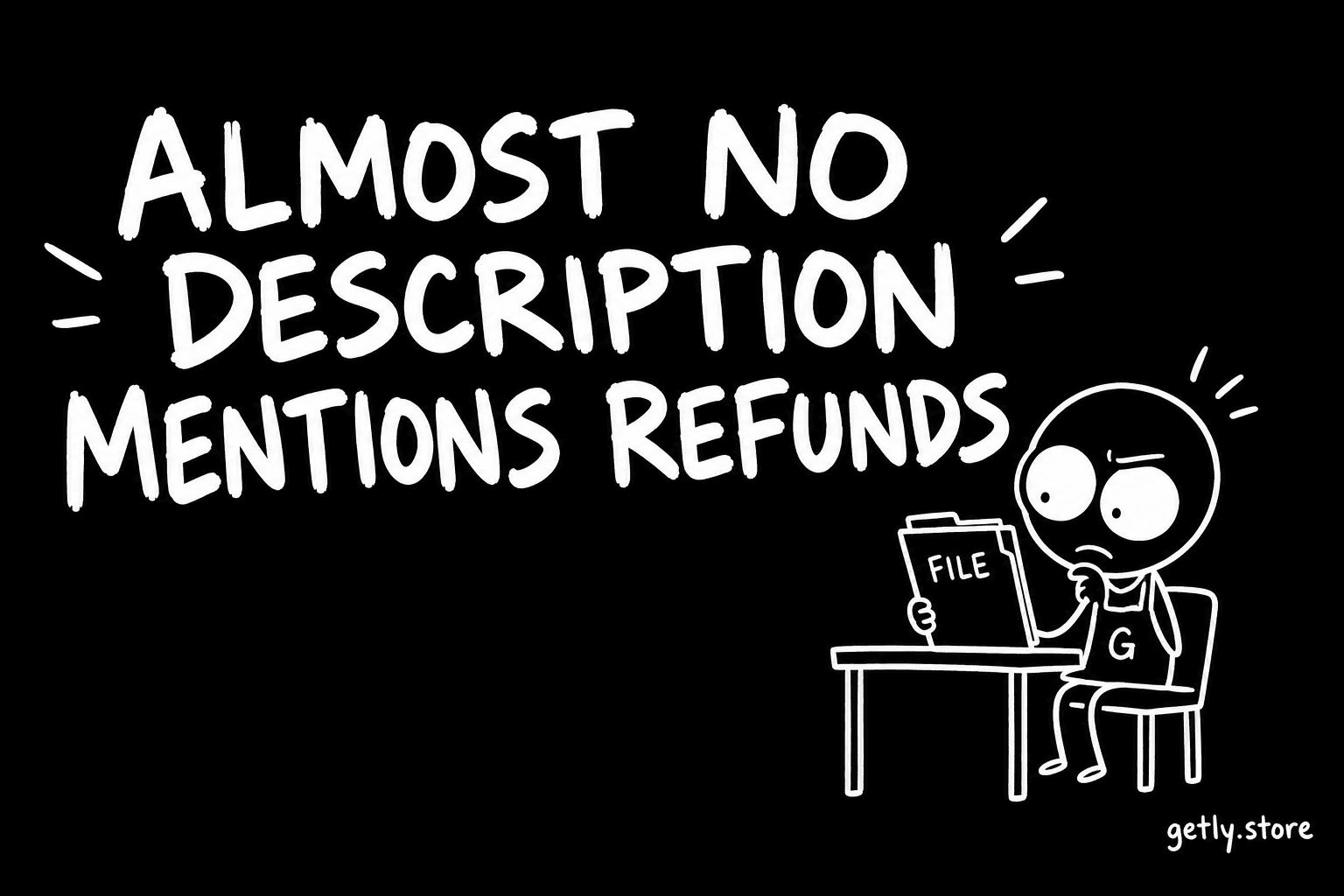
Every listing on Getly comes with a refund policy, whether the description says so or not. The description almost never says so. Measured on 26 September 2026 across the active catalogue of 7,143 listings, only 2.88% of descriptions mention refunds at all.
That is fewer than one listing in thirty. For comparison, the same descriptions mention a licence in 16.16% of cases and spell out what is included in 23.60%. Refunds are the rarest of the ordinary pre-purchase topics, rarer even than an FAQ block (6.99%).
This article is not an argument for writing a long policy into every listing. It is about what the buyer is really asking when they wonder about refunds, and why the answer mostly belongs in other parts of the description.
The policy exists without you writing it
Start with the facts a seller does not control. Every shop on Getly has a refund window of at least 30 days. A buyer who wants their money back asks from their library, and the request is decided by Getly, not by the seller.
That has two consequences for the description. The first is reassuring: a buyer is covered even when your listing is silent. The second is a warning: anything you write about refunds has to agree with that policy. A line like "no refunds on digital goods" or "all sales final" does not change what happens to a request. It only tells the buyer something untrue, on the page they are using to decide whether to trust you.
If your description carries a sentence like that, copied from another marketplace or from an old template, the most useful edit you can make today is to delete it.
What "can I get a refund" usually means
A buyer rarely wants a refund policy for its own sake. The question underneath is almost always one of three others:
- Will it open? The buyer is not sure their software can use the file. Only 9.53% of descriptions mention compatibility, software or requirements.
- Is it what the picture suggests? The buyer wants to know what arrives in the download. 23.60% of descriptions spell out what is included; three in four do not.
- Can I use it for what I have in mind? A client project, a product for resale, a print run. 16.16% of descriptions mention a licence.
Each of these is a place where a buyer can end up disappointed after paying. A clear answer before the purchase does more for them than a promise about what happens after it. That is a reasoning point, not a measured one: we have not compared refund rates between listings that answer these questions and listings that do not. It is worth testing on your own shop.
Delivery is where refunds start
The most avoidable disappointment is a listing that does not contain the product. From 26 September 2026, going forward, a paid listing whose only content promises delivery later by email, WhatsApp, Telegram or Discord, or that is only a link, or that copies another listing's text, goes to review instead of going live.
Delivery promised by email is still allowed when Getly can verify that it is automated: Getly licence keys, your own key pool, or a working sale.completed webhook. If your product is a licence key or an account on your own system, those are the three routes, and saying in the description which one you use answers the "will I actually get it" question in one line.
A demo does the same job from the other side. Any seller can add a free demo to a listing, either a file uploaded to Getly (executables are never hosted by Getly) or an https link to a trial on your own site, and the product page shows a "Try it free" button next to the price. Measured on the same day, only 0.49% of active listings carry one.
One sentence is enough
If you do want to mention refunds, keep it short and true. Something like this works:
"If the file does not match this description or does not open, you can request a refund from your library within the refund window shown at checkout."
It says nothing the platform does not already guarantee, and it places the refund where it belongs: as the backstop to an accurate description, not as the headline. Avoid promising a specific outcome ("guaranteed refund in 24 hours"), because the decision is not yours to make and the timing is not yours to promise.
If your window is longer than 30 days because your product takes longer to evaluate, say that too. A longer window that the buyer never hears about does no work for you.
A check you can run on your own listing
Open your best-selling or most important listing and read the description as a stranger who is about to pay. Then answer these five questions from the text alone:
- Does it name the file formats and the software that opens them?
- Does it list what is in the download, with counts where counts make sense?
- Does it say what the buyer may and may not do with it?
- Does it contain the product itself, or a verified way of delivering it?
- Does anything in it contradict a 30-day refund window?
If the first four are "yes" and the fifth is "no", your listing already answers the refund question better than a policy paragraph would. If any of them fails, fix that first. It takes a few minutes, and it is the part of the page most likely to decide whether a buyer ever needs the refund button at all.