 Getly
Getly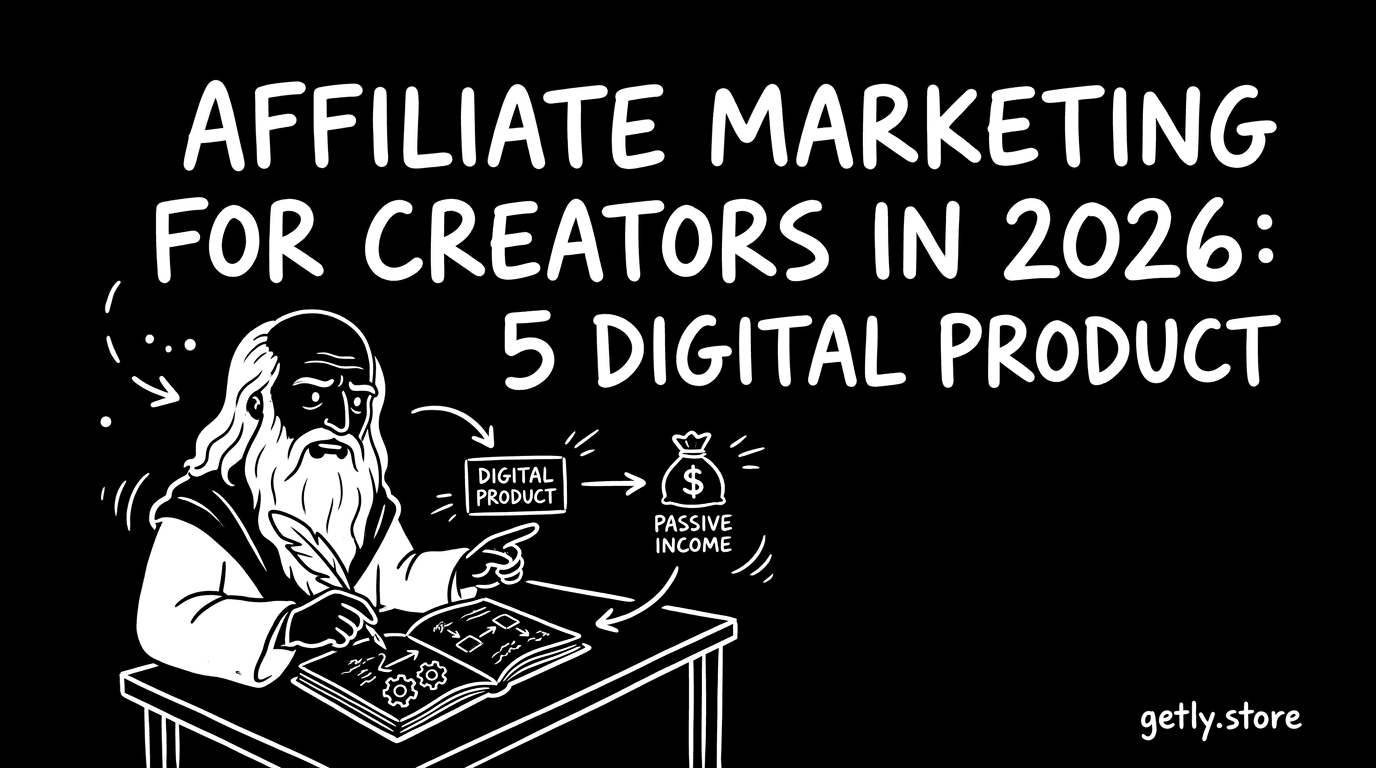
Affiliate marketing turns your content into a distribution channel, then pays you when someone buys. In 2026, digital product affiliate programs reward creators who match intent with the right asset. This guide gives you five promo-ready ideas, plus a practical plan to build passive income digital products around your audience.
Key goal: promote products that solve a specific problem fast. Readers convert when the product looks like the next step, not a random download.
- Pick digital product affiliate programs with clear buyer outcomes and reusable use-cases.
- Build “intent-first” content: tutorials, before-after demos, and workflow breakdowns.
- Promote assets tied to popular tools (motion presets, converters, generators) to reduce buyer effort.
- Use long-tail search plus direct links inside creator funnels to improve conversion consistency.
- On Getly, creators can set per-product affiliate commissions and affiliates get tracked for 90 days.
What is affiliate marketing for creators in 2026?
Affiliate marketing for creators in 2026 means you recommend a digital product, then earn a commission when a purchase happens through your referral. The core shift in 2026 keeps happening across platforms: creators win by producing proof of value, not by dumping links.
For creators, digital products fit affiliate marketing because they deliver instantly and scale without inventory. A buyer downloads a template, preset, converter, generator, or guide and gets results without waiting for shipping or custom production.
How commissions typically work on digital product affiliate programs
On marketplaces like Getly, sellers can set affiliate commissions per product. Getly tracks referrals with a 90-day attribution window, so if someone clicks your link and buys within that window, you earn the credited commission.
Getly also caps the commission rate on the platform side (the seller-set commission applies, up to a cap), and the seller keeps the larger revenue portion of each sale. That matters because affiliate payouts get funded by the same transaction that delivers your audience’s value.
Why “passive income digital products” needs a content engine
Passive income digital products do not mean “publish once and wait forever.” They mean you build a reusable asset map between your audience’s problem and the exact digital product that fixes it.
Your content becomes the engine. A tutorial or walkthrough stays searchable, your pinned resources page stays updated, and your recommendations show up when a buyer still has the same pain point weeks or months later.
Creator win pattern: You promote one product per content theme, then you update that theme as new versions and better workflows appear. That keeps your funnel stable while your audience grows.
How to choose digital product affiliate programs that convert
The best digital product affiliate programs match three things: buyer intent, time-to-value, and repeatable workflows. If your audience can experience a result in minutes, your affiliate links convert with less persuasion.
When you choose what to promote, look past the topic. Evaluate how quickly a buyer gets a visible outcome, how clearly the product reduces steps, and whether the content you can create around it naturally supports the purchase.
Use this selection checklist before you promote any offer
- Fast outcome: Can a buyer get value the same day? Presets, generators, converters, and templates usually beat long courses for intent-driven clicks.
- Workflow fit: Does the product plug into an existing tool stack your audience already uses?
- Low setup friction: Fewer steps means fewer drop-offs between “click” and “download.”
- Clear use cases: Buyers want to know what they can make after buying.
- Recurring need: If creators need the same output repeatedly (multiple videos, variants, or formats), commissions stack over time.
Map your audience segments to product types
Creators usually split into segments: beginners who need a template, intermediate users who want speed, and advanced editors who want automation. Your promos should target the segment that already understands the tool but lacks the shortcut.
For example, if your audience uses motion graphics software, motion presets and XML imports sell faster than generic “how-to” content because the buyer already has the base skill.
Common mistake: Don’t promote a product before you can explain it in plain language. If you can only describe features (“it has AI”), you will lose buyers. Show the “before vs after” and the exact time saved.
What are the best passive income digital product ideas to promote?
The best passive income digital product ideas feel like extensions of the viewer’s daily work. They save time, reduce mistakes, or help the creator generate assets without starting from scratch.
Here are five product idea lanes you can build affiliate promotions around, plus concrete example products you can promote on Getly that match each lane.
Idea #1. AI and automation generators for creators who ship content
If your audience publishes regularly, automation sells because it turns “blank page” time into output. Generators for descriptions, captions, or post assets keep creators moving and reduce the cognitive overhead of writing from scratch.
Promote an AI Product Description Generator to support creators who need listing-ready copy for launches, product pages, and funnel emails. Your content can show a repeatable workflow: input, output, edit, publish.
Getly affiliate link suggestion: AI Product Description Generator - Bulk GPT Tool
Idea #2. Text animation workflows for short-form creators
Short-form creators need fast, reusable motion styles that look professional without complex rigging or multiple passes. Text animation systems give them a visual “signature” and help deliver hooks in the first seconds.
Promote a face-free viral video workflow and show your audience how to create the same style with templates and editing steps. Your demo should include a short clip sequence, not only screenshots.
Getly affiliate link suggestion: Product Title AI Text Animation Mastery: Create Viral Videos Without Showing Your Face
Idea #3. Motion preset packs and XML imports for speed
Preset packs work when your audience repeatedly makes similar edits. An XML import or preset library reduces the “setup tax,” so creators spend time on storytelling instead of rebuilding identical animations.
If your followers already use motion graphics software, preset XML becomes an easy win: “download, import, tweak, ship.” Turn that into a content series where each episode uses the same starting file and creates a different outcome.
Getly affiliate link suggestion: 99+ Alight Motion Preset XML
Idea #4. Asset converters for creators migrating between tools
Creators hate redoing work when their workflow changes. Converters reduce churn: you keep your existing assets and translate them into the new tool’s format.
That makes converters perfect for affiliate marketing because your content can capture a real pain moment: “I built this in Tool A, now I need it in Tool B.” You then show the output working end-to-end.
Getly affiliate link suggestion: Unreal to Unity Material Converter
Idea #5. Specialized correctness products for 3D and technical creators
Technical creators spend hours chasing edge cases. Corrective joint logic, fixes, and niche pipeline files sell when they remove a specific failure mode rather than promising general improvement.
Your best angle here is “bug-to-fix storytelling.” Explain the problem in plain terms, show what breaks, then show the corrected result using the provided file.
Getly affiliate link suggestion: Manny Post Process logic corrective joints - file Maya 2024
Pro tip: Pair one “speed” product (presets, generators) with one “migration” product (converters) and one “fix” product (corrective workflow). This gives your audience a clear progression: start fast, keep moving, then polish pipelines.
How to build creator monetization strategies around your affiliate picks
Creator monetization strategies work best when you treat affiliate offers like productized recommendations. You place the right asset at each stage of the viewer’s journey: learn, try, and improve.
In 2026, audiences ignore generic “link in bio” posts. They respond to structured pathways like mini-tutorials, template breakdowns, and workflow checklists that lead naturally to one recommended purchase.
Create a 3-step affiliate funnel
Use a consistent format so your audience learns your process. Then you can swap the product recommendation without rewriting everything.
- Step 1. Teach the concept: show what good output looks like and why it works.
- Step 2. Show the workflow: use your editing screen, timeline, or export steps.
- Step 3. Offer the shortcut: recommend one product that reduces the time or risk of mistakes.
When you do this, viewers understand the purchase as a shortcut, not as a gamble.
Bundle your content with “proof of output”
For digital product affiliate programs, proof beats persuasion. Deliver a small result set: three examples, two variations, or a quick compilation. Then link the product that produced those outputs.
You can also turn reviews into a playlist. Each video in the playlist can focus on one use case: different niches, different styles, different export settings.
- Build affiliate funnels around “teach, demo, shortcut.”
- Show outputs first, then link the product that created them.
- Use tool-based products to reduce friction for buyers.
- Keep one product per content theme so your message stays focused.
How to write affiliate posts that match buyer intent
Affiliate marketing for creators becomes predictable when your posts match how buyers search. People usually look for outcomes (“create viral videos without showing your face”), tools (“Alight Motion preset XML”), or migrations (“Unreal to Unity material”).
Write captions and scripts that echo those search phrases. Then add one concrete demo and one short list of what the buyer gets after download.
Turn each affiliate post into a checklist
Checklists reduce anxiety. When your audience sees clear steps, they feel safer clicking your affiliate link.
- What you’ll make: a specific end product (video intro, description set, imported preset animation).
- How long it takes: estimate your own workflow time for the demo you show.
- What tools you need: name the software your demo uses.
- What to tweak: call out exactly what the buyer can customize.
- Who it’s for: beginner, intermediate, or advanced creators.
Use “before-after” formatting for higher clicks
In short-form video, show the transformation timeline. For text animation, show the initial title frame and the final hook screen. For converters, show the imported result and one material tweak.
If your product sits close to adult niches, you still need clarity and compliance with platform rules. Keep the content educational and only link where your audience expects that content type. If you decide to promote an NSFW video product, only do it where your channel already signals appropriate audience fit.
Common mistake: Avoid burying the link under generic copy. Put the recommendation right after the demo result, then explain the specific value it adds to the viewer’s workflow.
How Getly affiliate tracking works for creators promoting digital products
On Getly, sellers can set a per-product affiliate commission rate and track conversions using affiliate links. When someone clicks your link and purchases, the attribution window stays active for 90 days.
That structure supports creator monetization strategies because you can publish content today and still earn commissions from buyers who decide later, especially when they need time to finish a project or compare options.
What you should tell your audience about timing
You do not need to over-explain tracking to make it useful. You can simply frame it as “buying through my link helps me keep making tutorials.” If your audience asks about timing, you can reference the 90-day window as a clear, factual detail.
Also, remember that creators earn commissions from the sale, and sellers keep the majority revenue share on each transaction. That makes affiliate offers feel fair to both sides, and it keeps your content recommendations aligned with products that sellers actively maintain.
When to add extra product ideas to your rotation
Once a product converts, expand the cluster. Add adjacent offers that solve the next step: generators for listing copy, presets for faster edits, converters for pipeline migration, and correctness files for technical pipeline stability.
If you want another example for adult niche creators or specific video producers, Getly includes an NSFW video product you can evaluate for audience fit. Only add it if your channel and content positioning already attract that buyer intent.
Affiliate marketing works when your audience feels like you reduced their uncertainty, not when you added a sales pitch.
FAQ about affiliate marketing for creators in 2026
What is affiliate marketing for creators in 2026?
Affiliate marketing for creators in 2026 means you promote a digital product using your affiliate link and earn commission when someone buys through that link. Digital products work especially well because buyers download instantly and get value quickly.
Success depends on aligning your content with buyer intent and showing proof that the product delivers the outcome you claim.
How do digital product affiliate programs track referrals?
On Getly, referral attribution uses a 90-day attribution window. When a buyer clicks your affiliate link and purchases within that window, you receive credited commission for the sale.
Sellers set commission per product, so your payout depends on the specific offer you promote.
Which passive income digital products convert best?
The best converting passive income digital products usually reduce friction: presets, XML imports, converters, generators, and workflow fixes. These items create fast time-to-value for buyers, which improves conversion rates.
Creators also benefit when the product plugs into tools their audience already uses.
How should I pick what to promote as a creator?
Choose products that match a clear use case you can demo in one session. Run the workflow yourself, generate a small before-after example, and confirm you can explain the value in plain language.
Then build a content funnel that follows teach, demo, shortcut.
Can I earn with Getly affiliate marketing as a creator with small audiences?
Yes. Small audiences can convert well if your content targets narrow, high-intent problems. A tutorial for “text animation without showing your face” or “Unreal to Unity material translation” can attract buyers who already want that solution.
Consistency matters more than size because long-tail search and evergreen demos feed your affiliate pipeline over time.
If you want one starting move today: create a short demo post for a tool-adjacent product you understand, then publish one checklist-style caption that points to a single purchase option.
Soft call-to-action: Pick one product idea lane from this list, produce a before-after demo, and test your affiliate link with content that matches the exact problem your audience searches for. You’ll learn faster than by guessing.