 Getly
Getly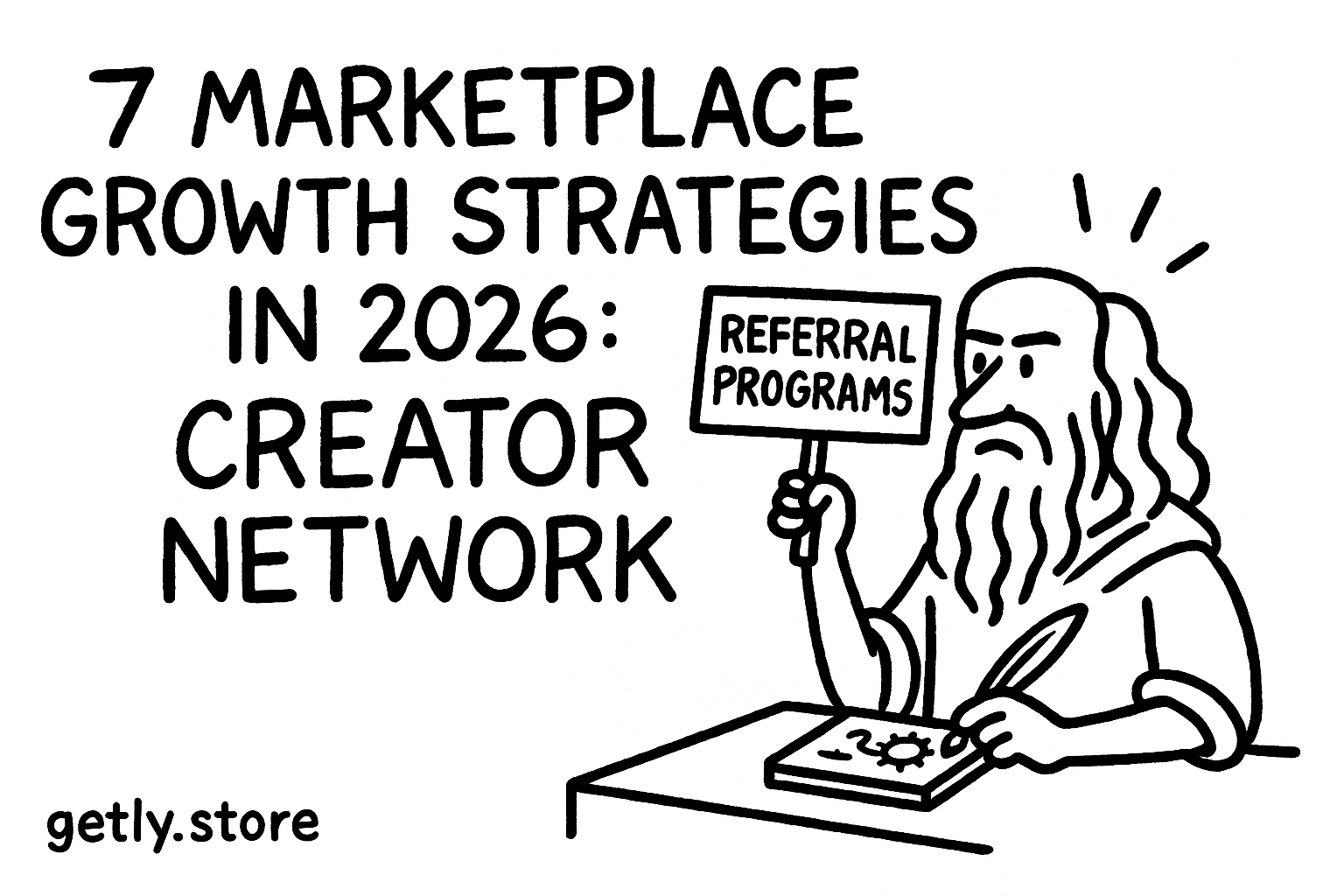
Growing a digital marketplace in 2026 takes more than ads and “more listings.” You need a creator network that brings buyers, keeps retention high, and turns happy customers into promoters. The fastest paths usually combine community momentum with a referral program for creators that feels fair and easy to use.
This article breaks down seven marketplace growth strategies you can launch in 2026. Each one focuses on grow creator community mechanics, community driven marketplace behavior, and referral loops you can measure.
- Design your referral program for creators around clarity, attribution windows, and shareable assets.
- Build creator network building through “micro-partnerships” like collabs, bundles, and community challenges.
- Turn onboarding into retention by offering templates, examples, and fast paths to publish quality products.
- Use community-driven marketplace content (workflows, case studies, audits) to earn search and trust.
- Give creators a reason to promote beyond one-time links: recurring incentives, featured placements, and community recognition.
What is a community driven marketplace growth model in 2026?
A community driven marketplace growth model in 2026 treats creators as a distribution channel, not just product suppliers. You give them tools, scripts, and incentives so they can attract buyers, answer questions, and help others succeed.
In a creator-based model, marketplaces grow when creators build trust faster than ads can. Buyers learn, copy, and buy from people they already follow, while creators recruit other creators through collaborations and referrals.
Start with a creator-to-buyer feedback loop
Build loops where creators publish value before they sell. That value becomes the reason for shares, and shares become referrals. Then the referral turns into either a first purchase or a follow-up purchase after customers test the product and share results.
For digital goods, the feedback loop runs on documentation, examples, and outcomes. When a creator can show “what changed after I used this,” the buyer sees the purchase as low-risk.
Make growth measurable at the referral and community level
Track the journey from a creator’s content to an actual purchase. Attribution matters because creators will only scale what they can measure. Use unique links, clear rules, and dashboards that connect activity to outcomes.
Also track community health. A community driven marketplace fails when creators post and vanish. Track creator onboarding, return activity, and how quickly new buyers get their first win.
Pro tip: Create a “first value” checklist for every creator. If new creators hit it within a week, they promote more confidently and bring in higher-converting referral buyers.
How to use a referral program for creators that converts
A referral program for creators converts when the incentives align with buyer intent and the attribution rules feel predictable. In 2026, the best programs remove ambiguity: explain exactly what gets credited, how long it takes, and how creators can share their links.
Creators also need assets. They will not invent a campaign each week. Provide templates, message scripts, and “proof packs” like short demos, before-and-after screenshots, or sample onboarding emails.
Choose referral mechanics that creators understand instantly
Use a simple structure: a creator shares a unique link, the referral purchase gets credited inside a defined attribution window, and the creator earns from the credited conversion. When you cap complexity, you reduce creator confusion and disputes.
For marketplaces that support it, a longer attribution window often helps creator network building, since buyers may take time to compare options and confirm licensing before checkout.
Optimize referral onboarding with shareable bundles
Make it easy for a creator to send “one good link” instead of five. Bundles work because they reduce decision fatigue. For example, finance creators can share outcome-based packs like: ULTIMATE PREMIUM FINANCE BUNDLE to cover multiple roles and use cases.
When buyers feel like the bundle matches their workflow, the referral conversion rate improves without increasing discounting.
Common mistake: A referral program that only pays creators and ignores content support. Creators will share once, then stop, because the next post requires effort and uncertain outcomes.
Best marketplace growth strategies: build creator network building
The best marketplace growth strategies in 2026 treat creator network building like partnership development. You recruit small clusters of creators in related niches and help them collaborate so each creator’s audience becomes another creator’s buyer pipeline.
Network effects compound when collaboration targets the same problem space. When creators teach the same workflow with different tooling, buyers trust the ecosystem instead of single products.
Run “creator collab drops” by problem, not by product
Organize collaborations around buyer problems, such as budgeting, cost control, or process improvement. Then let each creator contribute one component: template, dashboard, checklist, or guide.
For example, in manufacturing/process improvement circles, creators can connect around structured methodologies like FMEA, A3, 8D, line balancing, and cycle time dashboards. That makes the creator network cohesive, not random.
Use product-led communities to recruit “adjacent” creators
When a creator posts results, invite other creators to remix the approach. You can prompt creators to create complementary assets: audit worksheets, implementation checklists, or reporting dashboards that “plug into” the original template.
On a marketplace with strong category coverage, adjacent creator recruitment becomes easy. You can encourage creators to publish supporting files for popular workflows, increasing depth without increasing confusion.
Here’s a practical set of example product assets that creator communities can build around in process improvement:
- FactoryOS — Advanced FMEA Pro Excel Template
- 🔍 FactoryOS™ A3 Problem Solving & 8D Template
- FactoryOS™ Line Balancing & Cycle Time Dashboard
You can turn these into “collab drop” themes like “Reduce defects with FMEA,” “Standardize problem solving with 8D,” and “Improve flow with line balancing.”
How to grow creator community with onboarding that produces wins
You grow creator community by making early success feel inevitable. In 2026, creator network building fails when new sellers publish incomplete listings, struggle with packaging, or lack examples to guide buyers.
Onboarding should not only teach “how to list.” It should help creators ship something buyers can evaluate quickly and confidently.
Provide a publish-ready blueprint for every product type
Give creators a checklist that reduces risk for the buyer and reduces editing churn for the creator. Your blueprint should cover what buyers need to decide fast: clear description length expectations, preview images, and a downloadable file that actually matches the promise.
Digital marketplaces also win when creators ship consistent licensing language so buyers know what they can do. That trust lowers support load and increases conversions.
Create “first listing” templates to reduce time to first sale
Creators move faster when you provide examples. Build a small library of listing templates by vertical: templates, spreadsheets, CV bundles, and finance dashboards. Then show what “good” looks like in each category.
Example: if you serve freelancer and business workflows, a starter bundle like Badge99 — Freelancer Starter Bundle (CV + Proposal + Invoice) can become the centerpiece of an onboarding track for new creators who want predictable outcomes.
Tip: Add “buyer success prompts” to onboarding. For each product type, tell creators what proof to show: sample outputs, how-to screenshots, and the exact workflow step the buyer will apply on day one.
Community-driven marketplace growth: content that recruits buyers and creators
A community-driven marketplace grows when content acts like a bridge between buyers and creators. In 2026, the highest-performing content formats share workflows, not marketing claims. Creators get discoverable because they teach repeatable steps.
When the community sees real results, creators attract buyers without constant discounting, and buyers become more willing to try new listings from the same ecosystem.
Publish “use case libraries” instead of generic tutorials
Create a structured library of use cases: problem statement, inputs, steps, and expected outputs. Then link each use case to multiple products across the marketplace, including templates and trackers.
For finance workflows, use-case libraries can include budgeting basics, personal cash flow reporting, small business tracking, and client invoice setup. A product like Personal Finance Tracker — Excel & Google Sheets fits naturally into multiple use cases that explain “how to budget,” “how to track categories,” and “how to review month-end totals.”
Turn community posts into creator recruitment
When a buyer posts a screenshot of their improved spreadsheet or dashboard, reply with a creator collaboration offer. Ask them what they needed next and convert that request into a new product opportunity.
This works because creator network building does not require cold outreach. It uses buyer signals as demand proof. Creators join because they can see the market clearly.
Success pattern: Feature community wins as “remix prompts.” Let creators publish add-ons that extend the buyer’s workflow, such as line-balancing dashboards that build on earlier process maps.
What marketplace growth strategies work for retention in 2026?
Retention drives marketplace growth because it feeds repeat referrals and improves buyer trust. In 2026, you should design retention around “next steps,” so buyers keep using products and share them with teammates.
For digital goods, retention improves when buyers can reuse files, templates, and trackers across future projects. A single buyer with ongoing needs becomes an ongoing referrer.
Map “next actions” to product ecosystems
After purchase, guide buyers to complementary assets. Show them what to do with the file immediately, then what to do next month, next quarter, or next project cycle.
In operations or finance workflows, buyers often reuse data. They need dashboards that summarize inputs, so pairing a tracker with a dashboard creates a natural retention path.
Reduce support friction with predictable packaging
Support requests kill community trust when they stay unanswered. Reduce friction by making previews accurate, descriptions clear, and files consistent with the listing promise.
Creators also benefit because support load decreases when buyers can validate files during the first session. Less confusion means more positive reviews, and those reviews help the community decide faster.
How to use marketplace incentives to scale creator participation
You scale creator participation with incentives that feel earned, not random. In 2026, creators respond to predictability: clear performance goals, transparent rewards, and recognition that ties to real buyer outcomes.
Incentives also need a social layer. A creator will share harder when the community sees them succeed, and when their participation creates visible value for others.
Use tiered rewards tied to outcomes, not effort alone
Effort metrics do not capture market fit. Outcome metrics do. Incentivize sales conversions, repeat buyer behavior, and helpful community contributions that reduce buyer uncertainty.
When creators see that quality signals correlate with earnings and visibility, they invest in better listings, better docs, and better onboarding content.
Run community challenges with collaboration rules
Challenges work when they produce assets the marketplace can sell or reuse. Set a theme, require a minimum deliverable (example screenshots, a checklist, or a workbook demo), and allow creators to collaborate in teams.
Then publish the results as a “starter pack” for buyers. Each pack includes multiple creators and gives buyers a complete solution path, which strengthens community driven marketplace behavior.
- Referral program for creators works best when you pair incentives with shareable assets and clear attribution rules.
- Creator network building accelerates when creators collaborate on shared problems, not unrelated products.
- Community content wins when it teaches workflows and shows proof, not generic tips.
- Retention in marketplaces comes from next-step guidance and consistent packaging that reduces support load.
- Outcome-based incentives scale creator participation more reliably than effort-based goals.
FAQ: Referral and creator community growth in 2026
How do I structure a referral program for creators?
Start with unique referral links, a simple payout rule, and an attribution window that matches how buyers actually decide. Add creator-friendly sharing assets, like short scripts and example posts, so the first promotion takes minutes, not hours.
Measure conversions per creator and per campaign so creators can improve what works and stop what does not.
What does community-driven marketplace growth look like day to day?
You will see creators publishing use cases, buyers sharing outcomes, and new creators joining because they recognize demand signals. You will also see fewer “launch-only” posts and more follow-up content that turns products into repeatable workflows.
Daily wins look like community replies, collaboration posts, and product add-ons that expand the ecosystem.
How do creator collabs improve conversion rates?
Collabs improve conversion when they reduce buyer uncertainty. Buyers trust a solution more when multiple creators validate a workflow with different tooling, examples, or implementation steps.
Collabs also generate more discovery because each creator shares to a different audience, creating a wider top-of-funnel.
What incentives keep creators active after the first sale?
Creators stay active when you reward outcomes and support repeatable promotion. Pair incentives with recognition, community milestones, and templates for “what to post next” so creators never face a blank page.
When creators see their effort reliably turns into buyer demand, they build consistency instead of bursts.
How should I choose products for a community challenge?
Choose products that solve a clear, repeatable problem with measurable outcomes. Then add complementary assets so the winner submissions feel like complete ecosystems, not one-off files.
For operations workflows, bundle around FMEA, A3, and dashboard-style reporting. For business and finance workflows, bundle around tracking and presentation formats.
Marketplaces grow fastest when creators build trust through teaching, then convert that trust through a referral loop that feels fair and measurable.
Marketplace growth strategies in 2026 hinge on how well you turn creator participation into a compounding system. If you build the referral loop, the collaboration layer, and the onboarding path that delivers early wins, you create a community driven marketplace that keeps selling even when you pause promotion.
If you want a low-effort next step, pick one creator cluster and one problem theme. Then launch a small referral campaign, collect proof from early buyers, and invite two adjacent creators to produce add-ons for the same workflow.