 Getly
Getly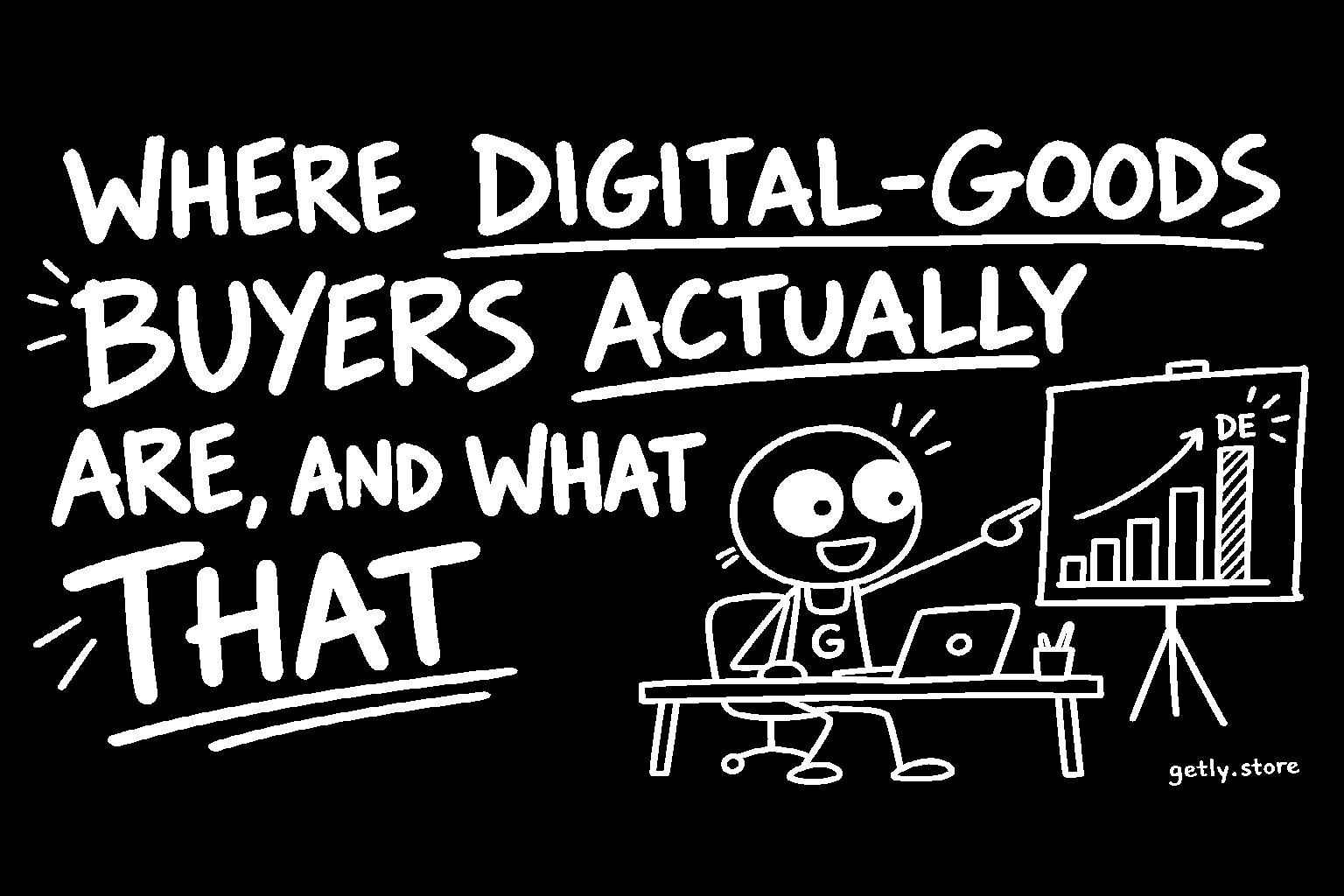
Sellers guess about their audience constantly, and the guess is almost always "everyone, but mostly America". Here is what the orders say. These are completed, paid orders on Getly with a recorded buyer country, as of 29 August 2026.
| Country | Completed orders |
|---|---|
| United States | 81 |
| Germany | 32 |
| India | 23 |
| Libya | 8 |
| Ukraine | 5 |
| France | 5 |
| Australia | 4 |
| Saudi Arabia | 4 |
America leads, as expected. What is not expected is the shape behind it: Germany alone is 40% of the US figure, and the tail is genuinely long - orders arrive from countries that no marketing plan would have named.
The German number is the one to look at
Germany being the clear second market has a practical consequence that most sellers ignore: a German buyer reading an English listing is doing translation work in their head before deciding to spend money.
Getly translates product pages into German and Russian automatically, so the listing itself is handled. What is not handled is what is inside your file. A planner with English month names, a template with English placeholder text, a workbook with English instructions - none of that gets translated, and none of it is visible from the listing.
If a meaningful share of your buyers are not native English speakers, saying plainly what language the file's contents are in is not a limitation to hide. It is information a buyer needs before paying, and its absence is a refund waiting to happen.
The long tail is not noise
Libya at 8 orders looks like a rounding error until you consider what it implies. These are people buying digital goods from a marketplace that does no marketing in their country, in a language that is not theirs, paying in a currency that is not theirs.
Two things follow. First, payment method matters more than sellers assume - a buyer whose card is not accepted internationally simply does not appear in this table, and there is no way to know how many of those there were. Getly settles in stablecoins as well as cards partly for this reason.
Second, a listing written for one national context travels badly. Prices quoted with "$" are fine; references to specific national holidays, tax years, school terms, or paper sizes are not. A US Letter printable is not a defect, but it is a fact a buyer in Germany needs to see before purchase, not after.
What to actually do with this
Three things, in order of how much they cost you.
State the language of the file contents. One line in the description. Free to do, and it prevents the single most avoidable kind of refund request.
State the format and any regional assumption. Paper size for printables, units for anything measured, software version for anything that opens in an application. Again one line, again free.
Consider whether a second version is cheap for you. For some products - a printable in A4 as well as Letter, a template with the placeholder text stripped - a second file costs an hour and doubles the audience that can use it without thinking. For others it is a rewrite, and not worth it. The catalogue cannot tell you which; you can.
A caveat about this data
Buyer country is recorded at checkout, and it was not recorded at all before 1 August 2026 - the field existed for page views but not for purchases, which meant sellers could see where visitors came from and never where the money came from. That has been fixed, but it means the table above is built from recent orders rather than from the platform's whole history.
It is a real sample, not a projection. It is also a small one, and it will look different in six months. We would rather publish a number you can check than a confident forecast you cannot.