 Getly
Getly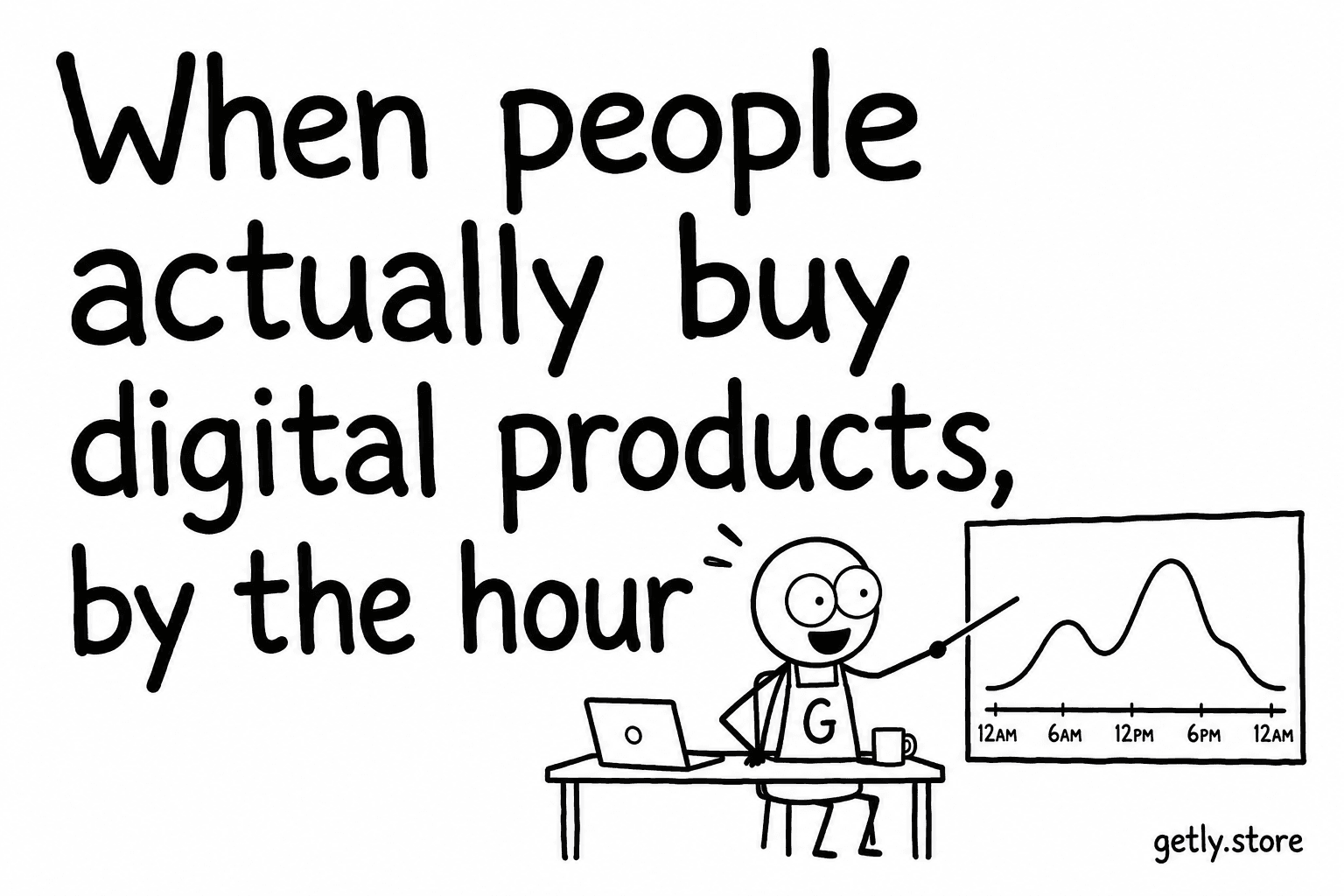
Sellers pick launch times by instinct, usually their own morning. Here is what the orders say. Every completed, non-test order on Getly, grouped by the hour it was placed, UTC:
| Hour (UTC) | Orders |
|---|---|
| 15:00 | 52 |
| 07:00 | 46 |
| 18:00 | 42 |
| 13:00 | 36 |
| 14:00 | 36 |
The shape matters more than the winner
The top hour has 52 orders and the fifth has 36. That is not a spike - it is a broad plateau across the middle of the day, with a second cluster early. Anyone selling you a "best hour to launch" from data shaped like this is overreading it.
What the plateau does tell you is where the audience is. 15:00 UTC is late morning in New York and evening in Europe; 07:00 UTC is morning in Europe and the middle of the working day in South Asia. Both fit the buyer map we measured separately: the United States first at 81 orders, Germany second at 32, India third at 23.
So the two peaks are not two behaviours. They are two continents.
What this actually changes
Very little about when you press publish, and quite a lot about when you do everything else.
A digital product does not sell in the hour it is published - it sells when someone searching for it finds it, which is days or weeks later. Publishing at 15:00 rather than 03:00 buys you nothing on its own.
Where the clock earns its keep is anything with a deadline attached: a discount that expires, a launch announcement, an email to previous buyers. Those depend on being seen within hours, and sending them at 02:00 UTC means your best two windows have already passed before anyone opens it.
The window nobody thinks about
Support. A buyer with a problem at 15:00 UTC is a buyer who might still complete the purchase if they get an answer; the same person at 15:00 with no answer until tomorrow is a refund or a lost sale.
You do not need to sit at a screen all day. You need to know that the middle of the UTC day is when your messages arrive, and to check once in that window rather than once at your own bedtime.
A caveat, because the sample is small
This is built on the platform's completed orders, and there have been 693 of them. A distribution built from hundreds rather than millions will move as the marketplace grows, and the two-continent shape is more robust than any individual hour in the table.
We would rather publish the number you can check than the confident recommendation you cannot. If your own store's buyers cluster somewhere else, your dashboard's geography tab knows before this article does.
What the quiet hours are actually for
The inverse of a purchase peak is a maintenance window, and digital sellers rarely think in those terms because nothing seems to break.
Things do break, quietly. A file replaced with a new version while someone is mid-download. A price changed while a buyer has the page open. A product taken offline for an edit and forgotten there. None of these are catastrophic, and all of them are cheaper at 03:00 UTC than at 15:00.
The same goes for anything that changes what a buyer sees: swapping a cover image, restructuring a bundle, changing a licence type. If you are going to do it, do it when the plateau is empty.
Why launch timing matters less than sellers hope
There is a persistent belief that a launch hour makes or breaks a digital product, borrowed from marketplaces where a first-day ranking spike decides everything. Getly does not rank that way: the order on category pages blends conversion quality, recency-weighted sales, ratings and an AI quality score, and none of those move in the first hour of anything.
What does move in the first hour is whatever you send. If your launch involves an email to previous buyers, a post, or a discount with an end date, that is the piece with a clock on it - and the table above is the clock.
The product itself will be found later, by someone searching for what it does. That search does not care what time you pressed publish.