 Getly
Getly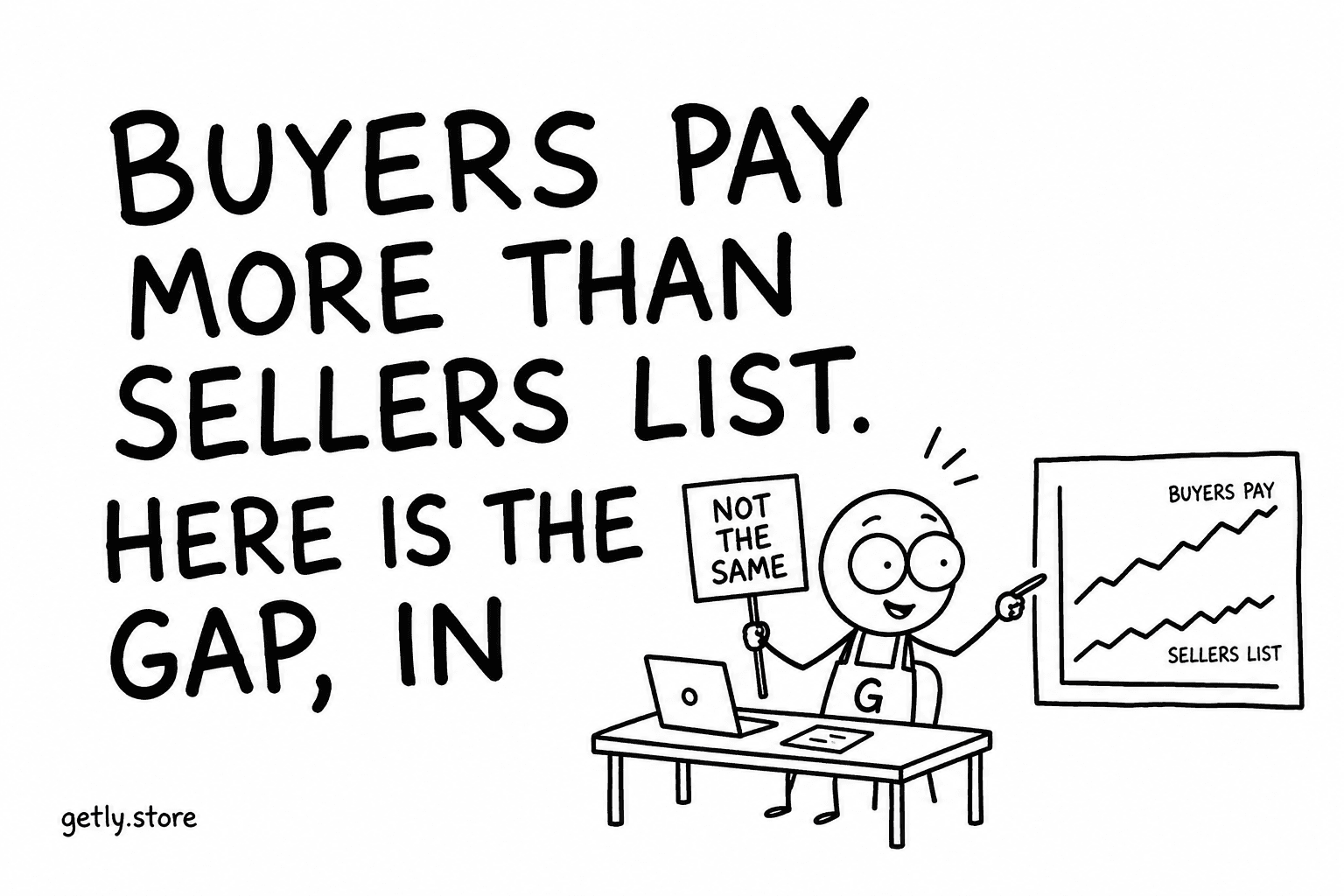
Most pricing advice for digital products is a theory about buyer psychology. This is not that. It is two numbers from the same catalogue on the same day, 29 August 2026.
- Median price of a live paid listing on Getly: $6.51
- Median price of a product that actually sold: $9.99
A 53% gap. The things people buy are priced meaningfully above the middle of what is on offer.
What this does not mean
It does not mean raising your price causes sales. Two numbers cannot show that, and anyone who tells you otherwise from data like this is selling something. Expensive products may sell better because they tend to be bigger pieces of work, or because a seller confident enough to charge $20 also writes a better listing.
What it does rule out is the opposite belief, and that belief is common: that a new seller should price low because low prices are safer. In this catalogue, the low half of the price range is where sales are not happening. Whatever is true about causation, "cheap converts" is not visible here at all.
The distribution fills that in. Across live listings, the 10th percentile is $1.00 and the 90th is $45.00. There is a long, dense floor of very cheap products - 89 listings are free outright - and the sales are not concentrated there.
Category medians, so you can find your own shelf
A single median across a whole marketplace is a blunt instrument: a wallpaper pack and a business course do not belong in the same sentence. Here is what the ten largest categories on Getly actually charge, measured the same day:
| Category | Live listings | Median price |
|---|---|---|
| E-books | 311 | $7.99 |
| Backgrounds & Wallpapers | 206 | $1.99 |
| Android App Templates | 133 | $5.00 |
| Business & Money | 109 | $12.00 |
| Coloring Books (Digital) | 108 | $3.99 |
| Children's Books | 107 | $5.00 |
| Illustrations | 90 | $27.00 |
| Education Templates | 84 | $3.00 |
| Guides & Tutorials | 82 | $24.99 |
| Digital Sticker Sheets | 78 | $2.00 |
The spread is the interesting part. Illustrations sit at $27.00 and sticker sheets at $2.00 - a thirteenfold difference between two things that are both, technically, "a picture file". The category you file under is doing a lot of the pricing work before you type a number.
Reading your own category honestly
Two ways to use the table above, one of them a trap.
The trap is to price at the median because it is the median. The median is the middle of what people listed, and we have just established that listings and sales are not the same population. In a category where the median is $2.00, that number tells you what the floor looks like, not what your work is worth.
The useful reading is comparative. If your category's median is $3.00 and you are about to list at $30.00, you are not automatically wrong - but you are making a claim that your product is ten times the typical thing on that shelf, and your listing has to make that claim visible. Conversely, if your category sits at $24.99 and you are about to list at $4.00, you are not being safe. You are signalling that your work belongs at the bottom of a shelf where it evidently does not have to.
The cheapest possible mistake
Free deserves a mention, because 89 live listings are priced at zero. Free is a legitimate strategy - it puts a file in someone's library and gets your store name in front of them - but it is a marketing decision, not a pricing one, and it works only if something else in your catalogue is priced to earn.
A store whose entire catalogue is free is not underpriced. It is not selling, and no amount of traffic changes that.