 Getly
Getly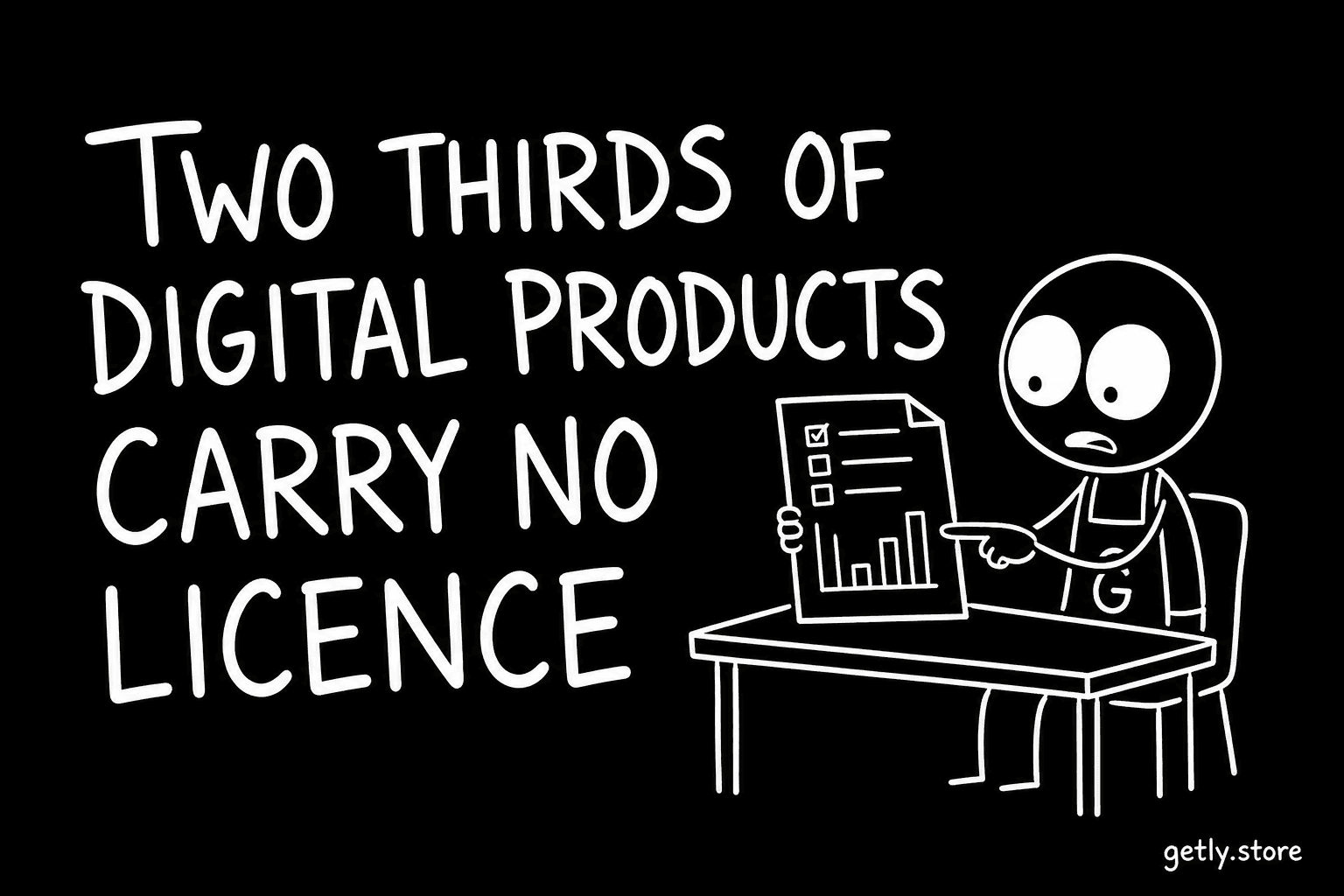
For a digital product, "what am I allowed to do with this" is not a detail. It is most of the purchase. A font you cannot embed, a template you cannot use for a client, an illustration you cannot print on a shirt - each is a different product from the one that permits it, at a different price. And yet, across 4,885 active listings this week, 64.3% carry no licence type at all.
What sellers choose when they choose
Among the 35.7% that do declare a licence, the split is:
- Personal - 17.6% of all listings. Use it yourself; do not resell, do not use for clients.
- Commercial - 10.8%. Use it in work you sell - a client project, a product, a business.
- Extended - 5.5%. Commercial plus the things commercial usually excludes: large print runs, resale as part of a product, redistribution inside a template.
- Custom - 1.1%. The seller's own terms, spelled out in the description.
- CC0 - 0.7%. Public domain. Do anything.
Two things stand out. First, "personal" leads by a wide margin, which is sensible: most sellers would rather sell the narrow licence and be asked than sell the broad one and regret it. Second, "commercial" and "extended" together are one listing in six, even though a large part of the catalogue - templates, icons, fonts, mockups - is bought precisely for commercial use. A buyer with a client deadline who finds no licence on a template does not write to ask. They buy the one that says "commercial" and move on.
Why two thirds are empty
Not neglect, mostly. The licence field became part of the product wizard on 1 August 2026, and it is required for every product created since. The empty two thirds are older listings, published before the field existed, whose sellers have not gone back to set it. When you edit one of those products, a prompt asks for the licence; it does not block the save, because holding a seller who came to fix a typo hostage to a legal question is the wrong trade.
Where a licence is set, it is shown next to the buy button and answered in the product's FAQ block, which is also emitted as structured data for search engines. Where it is not set, the FAQ says nothing about licensing rather than guessing - an unanswered question is better than a wrong answer about someone's rights.
How to choose, in one paragraph each
Personal if your buyer is an individual using the thing for themselves: a planner, a wallpaper, a workbook, a game save. Commercial if your buyer is likely a freelancer or business and the product will end up inside something they charge for: templates, mockups, icon sets, stock imagery. Extended if you want to permit resale-adjacent uses - the buyer's own product that ships your asset inside it - and you have priced for that. CC0 only if you genuinely mean to give the work away; it cannot be taken back. Custom if none of these fits, and then write the terms in the description in plain sentences, because that description is the licence.
One thing the field is not
It is not a contract generator. It is a label, chosen from five, that tells a buyer which of five familiar situations they are in. The value is exactly that familiarity: a buyer who has bought templates before knows what "commercial" means without reading a page of terms. Two thirds of the catalogue currently gives them nothing to recognise. The field takes one click to set and is the first thing a buyer looks for after the price.