 Getly
Getly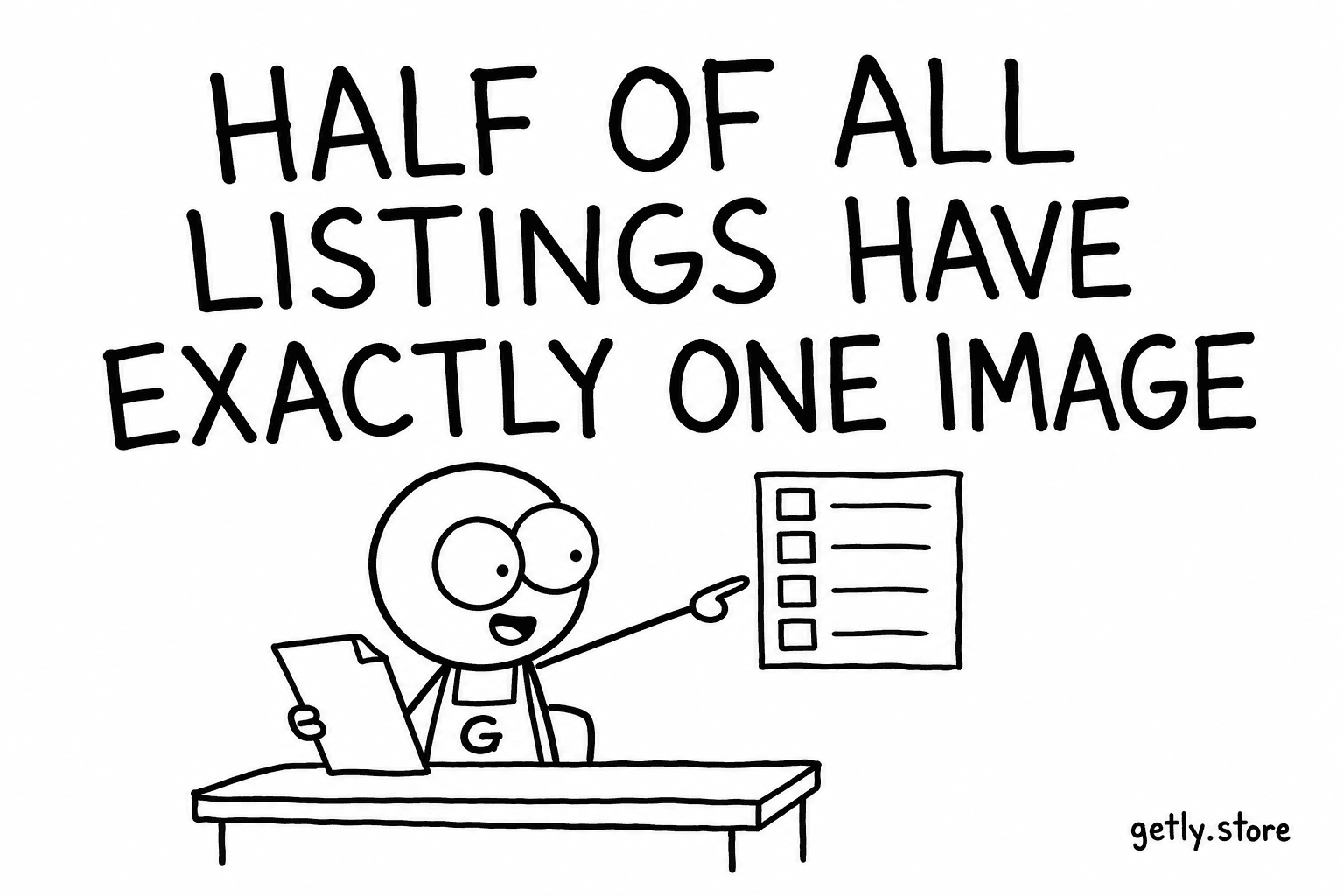
We counted the images on every active listing in the catalogue this week — 4,885 products. Here is the distribution:
- One image — 49.2%. Almost exactly half.
- Two — 16.0%. Three — 14.9%. Four — 6.9%.
- Five or more — 12.8%.
- None at all — 0.2%, and those cannot be published any more; they predate the rule.
So the typical product is sold on a single picture, and in the great majority of cases that picture is the cover: the title set in a nice typeface over a gradient. It tells the buyer what the product is called. It does not tell them what is inside.
What the image count does not do
It would be convenient to say "add more images and you will sell more." We cannot say it, because we measured it and it is not what the data shows. Comparing stores that have made a sale with stores that have not, the average number of images per listing is the same to one decimal place — 2.0 against 2.0. Description length barely moves either. The thing that separates the two groups is how many products the store kept publishing, and even that is partly a consequence of having sold once.
So this is not an article about a lever that lifts a listing. It is about a question a buyer asks that half the catalogue declines to answer.
What the second image is for
The first image says what it is. The second should say what you get. For a template, that is the template with real content in it, not the mockup. For a PDF, an interior spread — a page of the actual book, legible. For an icon pack, the full grid at a size where the icons can be told apart. For a prompt library, one prompt and its output, side by side.
Buyers behave as though this matters even where the sale numbers cannot prove it: on product pages the most common thing a visitor does with an image is try to enlarge it. That is why every image on a listing can now be opened full screen and magnified to four times its size with a scroll wheel or a pinch. A cover magnified four times is a very large title. An interior page magnified four times is a product you can read before you buy.
Where the platform now does the second image for you
For a PDF of ten pages or more, the product page generates a watermarked excerpt of the first pages automatically — never more than 15% of the document, never more than five pages, and always holding at least one back. Just over half of the PDFs in the catalogue qualify. If your product is a document, that excerpt is the second image, and you did not have to make it.
For everything else, the second image is still yours to make. It costs a screenshot. Half the catalogue has not taken it.
A note on the five-image group
The 12.8% with five or more images are not uniformly the best-presented products. A fair share of them are five renderings of the same cover with different backgrounds — a habit inherited from stock-photo sites, where each variant is a separate sale. Here it is one product, and the fourth copy of the cover answers no question the first did not. Five images that each show a different thing is a product page; five that show the same thing is a slideshow.