 Getly
Getly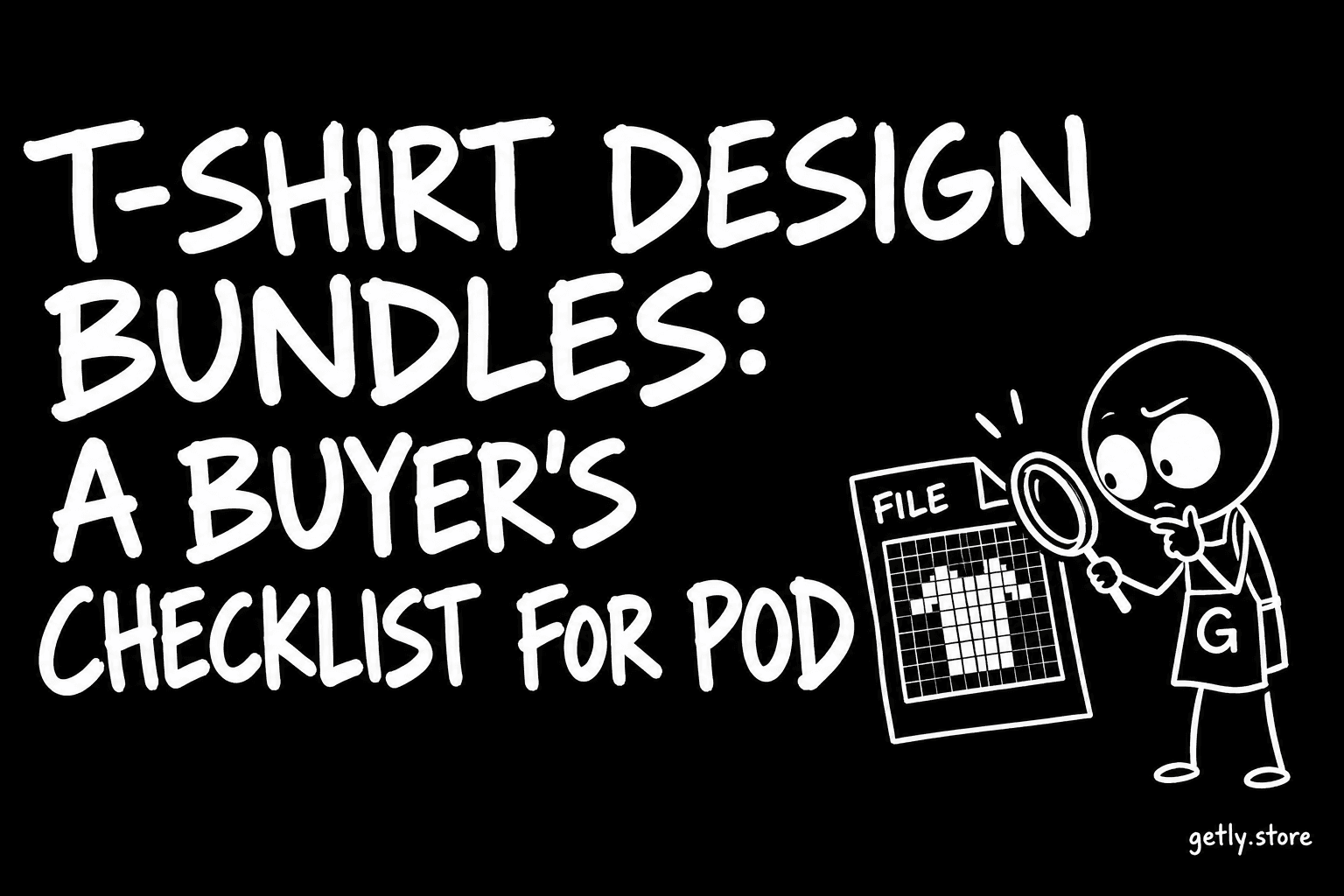
A t-shirt design bundle looks like a shortcut: a folder of ready artwork you upload to a print-on-demand service and start selling. Whether it is a shortcut depends on three things you can check before paying: whether the files are big enough to print, whether the background is transparent, and whether the licence lets you sell shirts with them.
We read the files and descriptions on Getly's T-Shirt Designs shelf, measured 26 September 2026: 92 active listings, a median paid price of about $2.50, with the tenth percentile at $1.48 and the ninetieth at $12.90. These are cheap files, which makes it tempting to skip the checks. Here is why you should not, and how to do them in two minutes.
Check 1: pixels, not DPI
Print services work in pixels at a given density. Printful, for example, asks for at least 150 DPI on most of its products and describes a standard front print area of 12 by 16 inches on its t-shirts (checked 26 September 2026). Multiply it out: a full front print at 150 DPI needs about 1,800 by 2,400 pixels. At 300 DPI it is 3,600 by 4,800.
Now the shelf. We measured the image files we could read: the median file has a long side of 1,424 pixels. 69.32% of files are under 2,000 pixels on the long side, and only 19.32% reach 2,400. Among listings whose images we could read, 24.59% include at least one file that big. So on this shelf, most files will print well only as a small chest design, not a full front.
Descriptions do not help much: 21.74% state a DPI and 20.65% state pixel dimensions. And the DPI figure is the less useful of the two. A DPI number is only a label inside the file; 36.36% of the files carry one, and of those only 9.38% say 300 or more. A 1,000-pixel image labelled 300 DPI is still a 1,000-pixel image: it prints at 3.3 inches wide at that density, whatever the label says.
What to do: look for pixel dimensions in the description. If there are none, ask the seller before buying. Divide the long side by 150 to get the largest print in inches you can make at Printful's minimum.
Check 2: is the background really transparent
A shirt design almost always needs a transparent background. Printful recommends saving print files as PNG with a transparent background and notes that JPG does not support transparency, so a JPG design may print with a white box around it.
On this shelf, 34.78% of descriptions mention transparency. In the files themselves, 37.50% of the images we could read carry an alpha channel, the thing a transparent background needs, and 52.46% of the listings with readable images include at least one such file. By format, 55.43% of listings deliver PNG files, 13.04% deliver JPG files, and 25.00% deliver a ZIP archive whose contents you only see after purchase. Vector formats (SVG, EPS, AI) are almost absent.
An alpha channel is necessary but not sufficient: a PNG can have one and still be filled edge to edge with white. What to do: look at the preview images. A design shown on a checkerboard or on several shirt colours is a good sign; a design shown only on a white square tells you nothing. If the listing says "PNG" but not "transparent", ask.
Check 3: the licence, read for print on demand
This is the check that matters most, because it is the one you cannot fix after buying. Selling shirts with a design is commercial use, and many bundles are sold for personal use only.
On this shelf, the licence set on the listing splits like this:
| Licence on the listing | Share of listings |
|---|---|
| Commercial | 46.74% |
| Personal | 9.78% |
| Extended | 3.26% |
| Not set | 40.22% |
In the text, 25.00% of descriptions use the word "commercial", 26.09% mention print on demand or a named print service, and 22.83% say something about reselling or redistributing the files.
Read three things before you pay:
- Is print on demand named? "Commercial use" can mean you may use the design on your own products, or only in client work. A licence that names print on demand, physical products or merchandise answers the question directly.
- Is there a quantity limit? Some licences cap the number of items you may sell. Look for it before building a store around a design.
- Is reselling the file forbidden? Almost always yes, and that is fine: you are selling shirts, not the artwork. But it also means you cannot put the raw PNG in your own design bundle.
If the licence is not set and the description says nothing, treat the design as personal use until the seller tells you otherwise in writing, through the messages on the platform.
Check 4: things a licence cannot cover
A seller can only license what they own. A design that uses a film character, a sports team logo, a band name or a brand slogan is not made safe by any licence from the person who drew it, and print services remove products for exactly this reason. Fonts inside a design can carry their own licence too; a bundle built on a font with a personal-use licence passes that limit on to you. When a design leans on someone else's name or character, skip it.
A two-minute checklist
- Pixel dimensions stated? Long side at least 2,400 for a full front at 150 DPI.
- Transparent PNG, shown on a checkerboard or on coloured shirts?
- Licence set to commercial or extended, and print on demand named?
- Any quantity limit, and what it is?
- No borrowed characters, logos or slogans?
- If the delivery is a ZIP, does the description list what is inside?
If you are on the other side of this and sell shirt designs, our seller guide to selling t-shirt designs covers how to answer all six before a buyer has to ask.