 Getly
Getly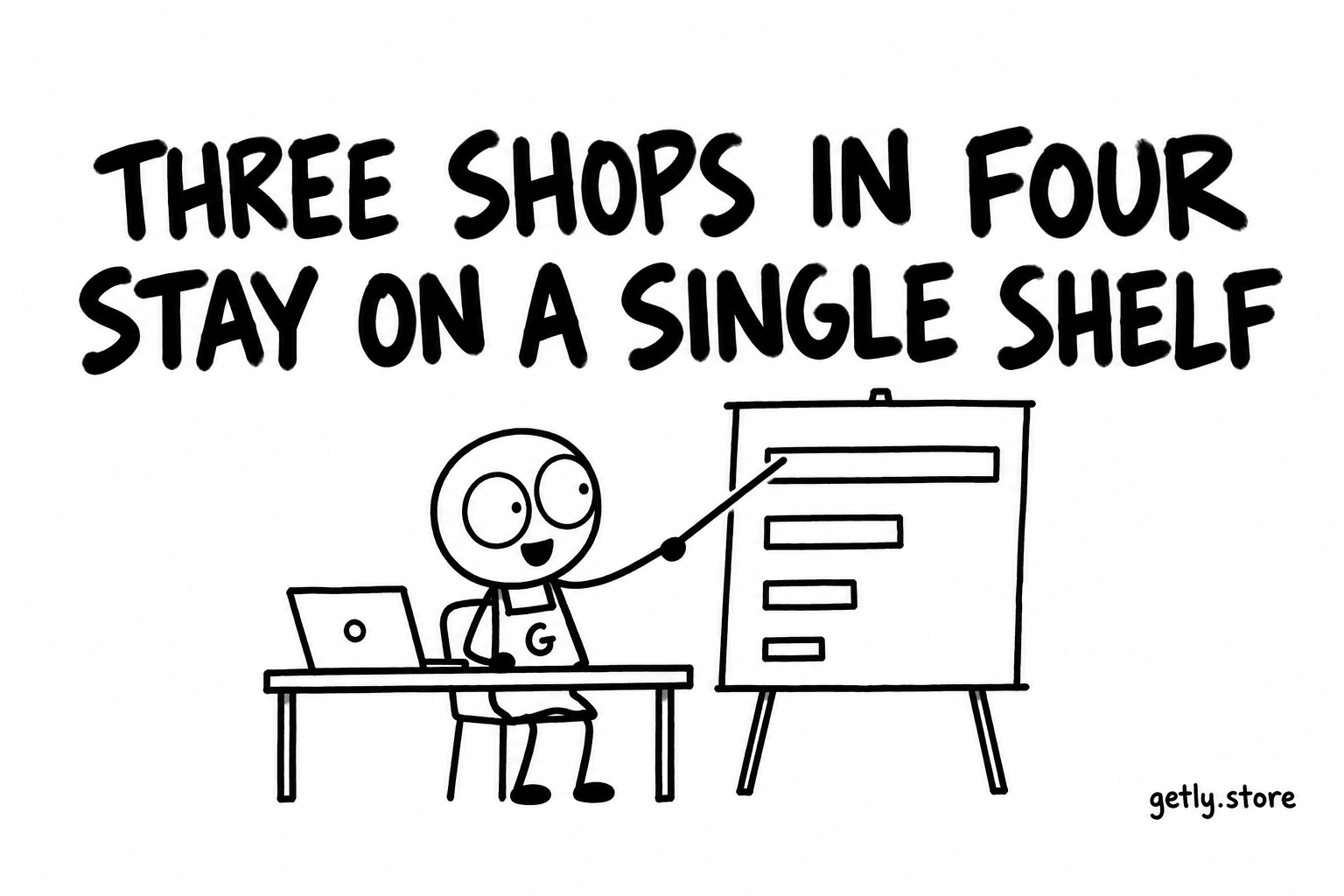
Most digital shops are narrower than their owners think. On 26 September 2026 we looked at every shop on Getly with at least one active listing and counted the leaf categories each one lists in. 74.2% of shops list in a single category. Only 4.8% spread across five or more.
That is three shops in four living on one shelf, and roughly one in twenty living on five. This article is about what that split means for a seller, and how to decide which of the two you should be.
The shape of the catalogue
The same day, the catalogue held 7,143 active listings spread over 437 leaf categories that contain at least one listing. The distribution is steep:
- The ten biggest categories hold 31.6% of all listings.
- The fifty biggest hold 66.5%.
- Every other category shares the last third.
Put that next to the shop numbers and a picture forms. Most sellers arrive with one kind of product, put it on one shelf, and stay. A small group builds something closer to a general store, with an e-book on one shelf, a spreadsheet on another and a set of backgrounds on a third.
Neither shape is wrong. They are different promises to the buyer, and the storefront should keep whichever promise it makes.
What a single shelf tells the buyer
A buyer who lands on a listing and clicks through to the shop is asking one question: is there more of this here? A single-shelf shop answers yes before the buyer has scrolled. Every card on the page is a variation on the thing they came for, and the shop name, banner and description can all say the same thing.
That coherence is cheap to keep and easy to read. It also makes the rest of the storefront easier to write. A shop description for a seller of Excel templates can name the software, the typical use and the level of the user. A shop description for a seller of Excel templates, children's books and PBR materials has to say something so general that it says very little.
We are not claiming that focused shops sell more. We did not measure that here, and a correlation between focus and sales would not tell you which one caused the other anyway. What the data shows is that focus is the normal state of a shop on Getly, and that most sellers reach it without trying.
When five shelves make sense
The 4.8% who list in five or more categories are not necessarily unfocused. Some products genuinely belong on different shelves while serving the same buyer:
- A game artist may list PBR materials, character sprites and UI kits. Three shelves, one customer: the person building a game.
- An author may list e-books, a workbook and a printable planner. Different formats, one reader.
- A teacher may list worksheets, flashcards and a course guide. One classroom.
In each case the spread follows the buyer, not the seller's spare time. The test is simple: can you write one sentence that describes the person every listing in your shop is for? If you can, the shop is focused even across five shelves. If the only honest sentence is "people who like digital things", the shop is a collection of unrelated listings, and the storefront will read that way.
The category is a publishing requirement, so make it the right one
Every listing on Getly needs a category before it can go live, along with a file, an image, a name of at least five characters and a description of at least 150 characters. The category is not decoration. It decides which shelf the listing appears on and which neighbours it is compared with.
Because the fifty biggest shelves hold two thirds of the catalogue, a seller who picks a broad, crowded shelf by habit is choosing the busiest room in the building. Sometimes that is correct, because that is where buyers look. Sometimes a narrower leaf category describes the product better and puts it among fewer, closer neighbours. With 437 populated leaf categories, the narrower shelf usually exists.
A check you can run today
- Open your storefront and write down the category of every active listing.
- If they are all on one shelf, read your shop description. Does it name that shelf's buyer directly? If it is generic, rewrite it for that one buyer.
- If they are spread over several shelves, write the one sentence that describes the person every listing is for. If you cannot, consider whether some listings belong in a second shop or whether the shop description should explain the link between them.
- For each listing, open the category picker and look one level deeper than the category you chose. If a leaf describes the product more exactly, move it there.
None of this changes the product. It changes how quickly a buyer understands what the shop is, and that is the part of the storefront a seller controls completely.