 Getly
Getly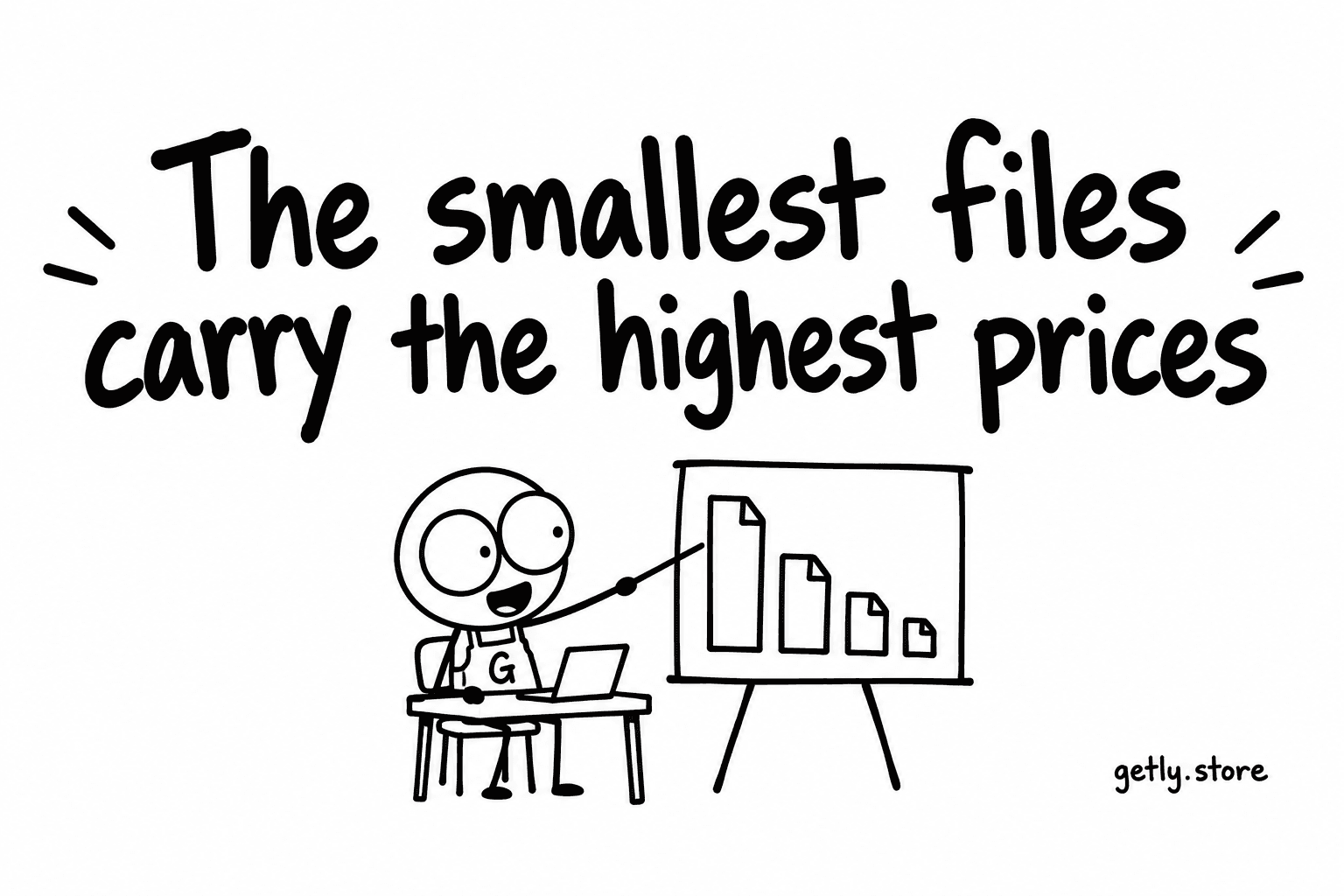
The intuition is that a heavier download is worth more money. The catalogue does not agree. On 19 September 2026 Getly held 6,519 active listings delivering 138.5 GB across 9,508 files, and sorting those listings by weight produces a price curve that dips in the middle.
Not falls away. Dips. The cheapest goods sit in the ordinary middle of the size range, and both ends are worth more than they are.
Median price by payload band
Every live listing, grouped by the total size of the files a buyer receives:
- Under 1 MB — 2,589 listings (41.68%), median price $9.99, median payload 0.1 MB
- 1–10 MB — 2,614 listings (42.08%), median price $4.99, median payload 3.3 MB
- 10–100 MB — 825 listings (13.28%), median price $5.00, median payload 21.9 MB
- 100 MB to 1 GB — 162 listings (2.61%), median price $11.00, median payload 183.5 MB
- Over 1 GB — 22 listings (0.35%), median price $22.48, median payload 1,791.9 MB
A hundred-kilobyte file carries double the median price of a three-megabyte one. Weight only starts earning again past a gigabyte, and by then the band holds about a third of one percent of the catalogue.
What the sub-megabyte band is selling
Nothing under a megabyte is selling volume. It cannot. A 0.1 MB payload is a prompt collection, a spreadsheet model, a colour LUT, a Notion template export, a set of regex rules — things whose value is entirely in how specific they are. Nobody is paying for the bytes. They are paying for the fact that someone already worked out the arrangement and they do not have to.
Which is exactly why the 1–10 MB band is the cheapest on the list at $4.99, and it is also the largest, at 42.08% of live listings. That band is where general-purpose work lives: a small graphics pack, a short PDF, a handful of stock photos. Heavier than a spreadsheet, less specific than one. Specificity is what the price is tracking, and the middle band has the least of it.
Weight only pays at the extreme
The two heavy bands do earn more — $11.00 and $22.48 — but notice how few listings are in them. Together they are under 3% of the catalogue, and they carry most of the 138.5 GB. These are video courses, 3D scenes, sample libraries, source project archives. They are priced higher not because they are big, but because big is the only way to deliver what they are: a thing that could not have been compressed into a spreadsheet without becoming a different product.
The useful reading for a seller is that size is a consequence, never a reason. If a file got large because the work required it, the catalogue prices that. If it got large because you exported at maximum quality and threw the raw sources in as a bonus, the catalogue does not, and you have added a download problem for nothing.
Pricing by effort is pricing by the wrong variable
The most common way a price gets set is to estimate the hours that went into the file and multiply. The measurement says buyers are not reading hours. They are reading how closely the thing matches the job in front of them, and that lines up with weight only at the far end of the range.
Two things follow, and neither requires changing what you make.
If your product is small, stop apologising for it. The sub-megabyte band sits at a $9.99 median, the highest of any band below a gigabyte. A 40-kilobyte file that saves a specific afternoon is not underpriced at ten dollars. It is priced like the rest of its class, and the rest of its class is doing fine.
If your product is in the middle, price is not the lever. At a $4.99 median in the most crowded part of the catalogue, moving to $3.99 buys nothing that the listing above you has not already tried. The lever is the description: what exactly is inside, what it is for, and who it is not for. Vagueness is what pushes a good file down into the commodity band, and it is free to fix — the same edit box you used when you first put the product up.
Weight is easy to measure and specificity is not, which is why sellers reach for the first one when they set a number. The table above is what happens when buyers reach for the second.