 Getly
Getly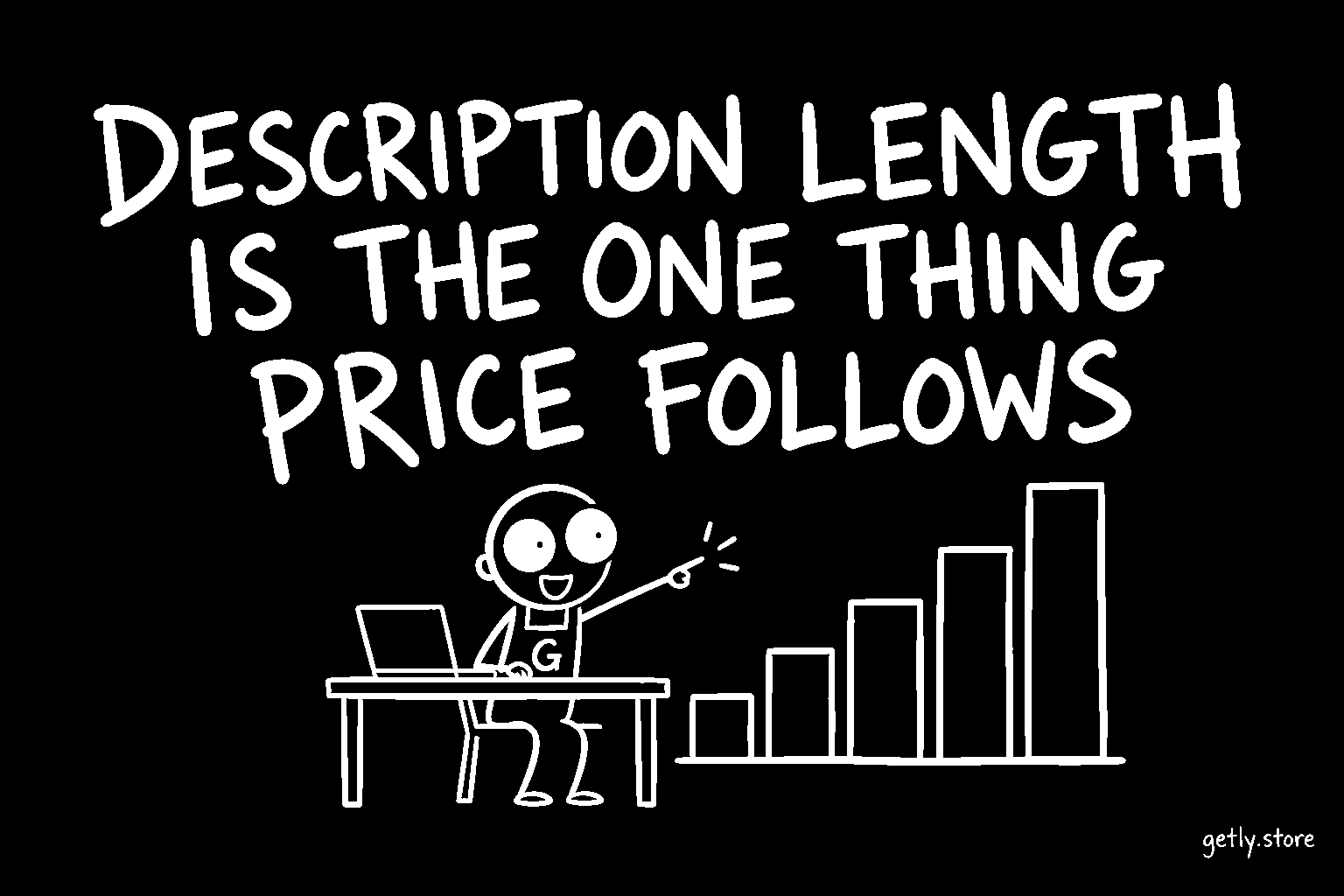
Most listing advice is a list of things to add: more screenshots, a longer title, more files in the bundle. We measured which of those actually move with price across the 6,519 active listings in the Getly catalogue on 19 September 2026. Only one of them does.
The ladder
Live listings grouped by the length of their description in characters, against the median price of each band:
- Under 500 characters — 1,785 listings, median price $5.00
- 500–1,000 — 1,276 listings, median $5.00
- 1,000–2,000 — 2,430 listings, median $6.99
- 2,000–4,000 — 604 listings, median $9.99
- 4,000 and up — 293 listings, median $19.00
That is a straight climb with no reversal anywhere: nearly four times the median price between the shortest band and the longest. For context on where the catalogue sits, the 10th percentile description is 278 characters, the median is 1,082, the 90th percentile is 2,439, and the longest single description runs to 25,707 characters.
The controls, which are what make this honest
A climbing line is only interesting if the neighbouring lines are flat. Both of them are.
Title length does nothing. Cut the same way: 20 characters or fewer gives a $7.99 median, 21–40 gives $6.00, 41–60 gives $5.91, and over 60 gives $7.00. That is noise. The shortest titles and the longest titles land in roughly the same place, with the middle slightly below both.
File count does not climb either — it zigzags. One file: $6.49. Two or three files: $9.99. Four to ten: $3.99. Eleven or more: $6.50. A bundle of eight is the cheapest thing in the catalogue by this cut and a bundle of two is the most expensive. There is no line to draw through those four points.
So the finding is not "more of anything earns more". Three attributes were measured the same way, on the same listings, on the same day. Two are flat or non-monotone. Only the description climbs.
What this is not
This is a correlation measured across listings, not proof that adding characters raises what somebody will pay. The most likely explanation runs the other way round: a long description is more often written by a seller who had more to describe.
A 4,000-character listing usually sits on a product with structure — modules, variants, a licence that needs explaining, a compatibility list, a workflow. The length is a symptom of the product, not a treatment applied to it. Padding a 300-character listing out to 2,000 with adjectives produces a long description and exactly the same product.
The narrower version of the finding is the one worth acting on. At 278 characters — the 10th percentile — there is no room to answer the questions a buyer has before paying. Not "not enough marketing". Not enough facts.
What goes in the space
The gap between the 10th percentile and the median is about 800 characters, which is four or five short paragraphs. The listings that use it well spend it on the same five things:
- What is literally inside — formats, counts, the names of the top-level folders
- What it was made for — the specific job, not the category it is filed under
- What it requires — software and version, or that it requires nothing
- What it is not — the most commonly skipped line, and the one that prevents a refund
- What the licence allows — commercial use, client work, resale
None of those are persuasion. They are the questions somebody asks themselves in the thirty seconds before spending money, and a 278-character description answers about one of them.
If you want a rule of thumb out of the table rather than a theory: the band where the median price first moves off $5.00 begins at 1,000 characters. That is not a target to pad towards. It is roughly how much text it takes to state five facts plainly and stop.