 Getly
Getly
Gumroad vs Lemon Squeezy in 2026: Honest Fee + Feature Comparison
Real fee math, real tradeoffs, no “winner” that conveniently happens to be our affiliate.
TL;DR
Lemon Squeezy is better for SaaS and EU-VAT-heavy businesses; Gumroad is better for first-time creators with the smallest catalog. Lemon Squeezy charges 5% + 50¢ as a Merchant of Record (handles VAT, files your taxes); Gumroad charges 10% plus Stripe processing (2.9% + 30¢) and leaves VAT to you. On a $50 sale, Lemon Squeezy keeps $3.00 versus Gumroad’s $5.95 - a 50% lower platform cost. Below $5 per sale Gumroad becomes competitive again because Lemon Squeezy’s 50¢ floor is proportionally large. Neither pays creators in crypto and neither offers marketplace discovery; if those matter, look further down the page.
Section 1
Quick verdict by use case
The honest answer to “which is better” is “it depends, and not on the dimensions Twitter threads usually cover.” Here are seven specific scenarios with a clear pick. The rest of this page is the reasoning behind these calls.
| Use case | Better choice | Why |
|---|---|---|
| Selling SaaS / subscription product | Lemon Squeezy | MOR handles VAT; metered/recurring billing built-in |
| Selling 1–2 ebooks or templates | Gumroad | Faster setup, no MOR overhead for tiny catalog |
| Selling to EU buyers | Lemon Squeezy | Auto-VAT; 5% + 50¢ saves you 4–8 hrs/month on tax filings |
| Selling under $100/mo total | Gumroad | LS’s 50¢ floor hits small ticket items disproportionately hard |
| Selling over $5k/mo total | Lemon Squeezy | 5% + 50¢ < 10% + Stripe processing once volume scales |
| Need crypto payouts | Neither - Getly | Both Stripe-only; Getly pays USDT/USDC on BNB Smart Chain or Tron |
| Building creator brand on a marketplace | Neither - Getly | Both are storefront tools with no built-in discovery |
Notice that of seven cases, two go to Lemon Squeezy, two to Gumroad, and two to a third option. There is no single platform that wins every scenario - that would be suspicious if there were.

Section 2
The fee structures, decoded
Both platforms publish their fees prominently, but the marketing pages skip the part where the two structures aren’t directly comparable. Here’s what you’re actually paying.
Gumroad
10% commission + Stripe processing (2.9% + 30¢) on every sale. Currency conversion adds another 1–2% if your buyer pays in a non-USD currency. So a $10 sale results in $1 commission + $0.59 Stripe fees = $1.59 total fees. The creator nets $8.41 (84.1%).
Gumroad operates as a payment service provider (PSP), not a Merchant of Record. That means you, the seller, are the legal seller of the product. You are responsible for VAT registration in the EU, sales tax in the US, and any other consumption tax compliance.
Lemon Squeezy
5% + 50¢ flat, with the Stripe processing rolled into that 5% rather than charged separately. So a $10 sale results in $1.00 total fees - creator nets $9.00 (90%). The math is intentionally simple to read.
Lemon Squeezy operates as a Merchant of Record (MOR). Lemon Squeezy is the legal seller; you are the supplier. They collect EU VAT, US sales tax (where required), and remit it on your behalf. You see net earnings after taxes are handled.
Why MOR matters more than the headline percentage
On the surface 10% looks like “double” 5%. The real comparison is messier. To sell into the EU as a non-EU creator on Gumroad, you legally need to register for VAT MOSS or use an intermediary. If you DIY, that’s typically 4–8 hours per month per country plus quarterly returns. Most creators either skip this (illegal but common) or pay an accountant $100–300/month. Lemon Squeezy folds all of that into the 5%.
So the real comparison for an EU-facing seller is “Gumroad 10% + your time and accountant fees” vs “Lemon Squeezy 5% + 50¢ + zero VAT homework.” For most sellers above $1k/month with EU buyers, Lemon Squeezy is materially cheaper.
Section 3
Real fee math at $10, $50, $200 sales
Here is what each platform actually keeps at three common price points. Numbers assume USD checkouts, no currency conversion, no upsells, and the standard fee structure (no enterprise discounts).
| Sale price | Gumroad fees | Gumroad creator nets | Lemon Squeezy fees | LS creator nets | Difference |
|---|---|---|---|---|---|
| $10 sale | $1.59 | $8.41 | $1.00 | $9.00 | LS +$0.59 better |
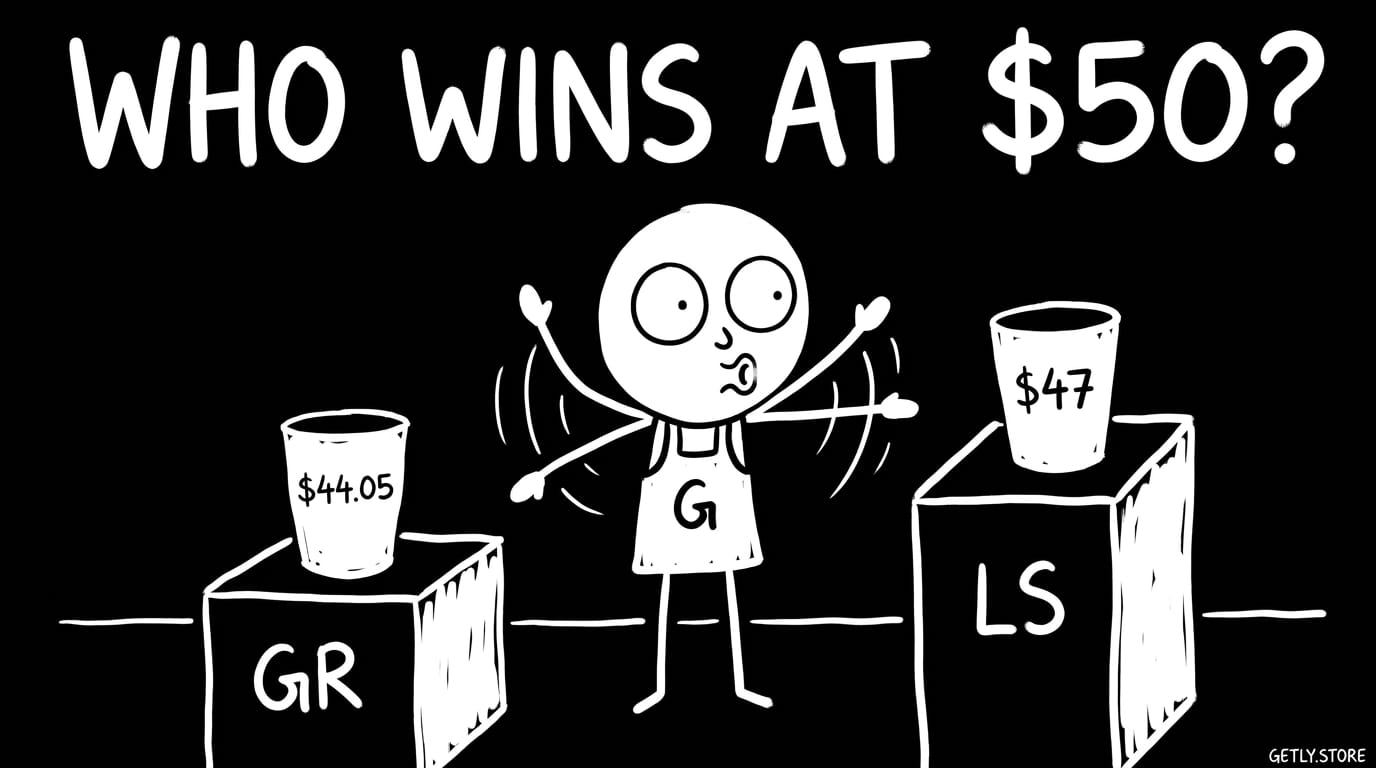
| $50 sale | $5.95 | $44.05 | $3.00 | $47.00 | LS +$2.95 better |
| $200 sale | $20.90 | $179.10 | $10.50 | $189.50 | LS +$10.40 better |
Three takeaways from this table. First, Lemon Squeezy is cheaper at every price point shown - the gap widens as sale price grows because Gumroad’s percentage fee compounds while Lemon Squeezy’s is bounded. Second, the gap on a $10 sale ($0.59) is small enough that other factors (UX, support, account stability) might matter more than fees. Third, this picture flips below $5: at a $3 sale, Gumroad keeps $0.39 and Lemon Squeezy keeps $0.65, so Gumroad nets you more. If your average ticket is <$5 (cheap PDFs, micro-templates, tip jars), Gumroad is genuinely cheaper.
All math here is the platform-side fees only. Add 1–2% on top of either if your buyer pays in a non-USD currency, and add VAT handling cost on Gumroad if you sell to EU buyers (effectively zero on Lemon Squeezy because MOR covers it).
Section 4
Features that aren’t fees
Once you’ve sorted the percentage question, the day-to-day differences come down to feature parity. Here’s where they diverge:
- Subscription billing. Lemon Squeezy ships native subscription/SaaS billing including metered usage, trial periods, proration, and dunning. Gumroad has “memberships” but they are limited - fixed tiers, no metering, no proration. If you sell a SaaS or paid newsletter, Lemon Squeezy is built for it; Gumroad is not.
- Affiliate program. Gumroad has a built-in affiliate system since 2014 - your buyers can sign up to promote your products with one click and Gumroad handles the payouts. Lemon Squeezy supports affiliates via integrations (Rewardful, FirstPromoter) but it’s not native. Edge: Gumroad if affiliates are your primary growth channel.
- Course / membership tools. Gumroad has a basic course UX (lesson list, drip content). Lemon Squeezy doesn’t really do courses - if courses are your product, use Podia, Teachable, or Thinkific instead of either of these.
- Discount codes & coupons. Both have them. Both work fine. Roughly equivalent.
- Customer support. Lemon Squeezy has a stronger reputation in 2024–2025 - most reviews mention 24-hour response times and a help team that actually reads tickets. Gumroad has been criticized publicly for ban-without-notice incidents and slower support since the 2022–2023 layoffs. Edge: Lemon Squeezy.
- Payouts. Both use Stripe Connect under the hood. Same supported countries (~50), same payout cadence options, same fee structure on the creator’s side. Functionally identical.
- Open API & webhooks. Lemon Squeezy ships a clean modern REST API with full webhook coverage and good documentation - designed for SaaS integrations. Gumroad’s API is older, works fine for read operations, but is less expressive for automation. Edge: Lemon Squeezy.
Section 5
Account stability and suspension risk
This section is honest in a way most comparison posts skip. Both platforms have banned creators in 2024–2025 with limited notice. The pattern matters more than the raw count: most reported bans cluster around niches that Stripe (the underlying processor) flags as high-risk.
Gumroad has been the more visible offender, with public Reddit threads through 2023–2025 about creators losing accounts overnight in adult-adjacent, AI-art, crypto-tutorial, and gambling-tutorial niches. Lemon Squeezy has had fewer public incidents but is not bulletproof - they explicitly prohibit several categories in their AUP and they will ban for violations.
The honest framing: if your niche is borderline, neither platform is risk-free. Both rely on Stripe, both inherit Stripe’s risk policy, and Stripe’s risk team has been visibly more aggressive since 2023. If you sell in a sensitive niche, the right move is a backup option you control: a personal Lemon Squeezy + a Payhip account + a Getly listing, so a single suspension doesn’t end your business. This is risk management, not panic - every creator over $5k/month should have a backup payment rail set up before they need it.

Section 6
When neither is the right answer
For about a third of creators, the honest recommendation is to skip both Gumroad and Lemon Squeezy entirely. Here are the six scenarios where a third platform is the correct call:
- Cheapest commission, simple ebooks → Payhip. Payhip charges 5% flat with no per-transaction floor (no 50¢ minimum). On a $3 sale you pay 15¢ on Payhip vs 65¢ on Lemon Squeezy. If your catalog is small, simple, and low-priced, Payhip is mathematically the cheapest.
- High volume, want flat monthly cost → Sellfy. Sellfy charges $29/month and lets you keep 100% of revenue. Above ~$3k/month gross sales, Sellfy is cheaper than either Gumroad or Lemon Squeezy. The math: at $5k/month Sellfy keeps $29 vs Lemon Squeezy keeping $250.
- Marketplace discovery (you don’t want to drive 100% of traffic) → Getly, Creative Market, Etsy. Both Gumroad and Lemon Squeezy are storefronts: you bring all the traffic. Marketplaces have browse pages, search, recommendations, and existing buyers looking for digital goods. If you want sales without running ads, you need a marketplace.
- Crypto-native payouts → Getly. If you’re in a country Stripe doesn’t support (Vietnam, Nigeria, Argentina, Pakistan, Egypt, most of Central Asia), neither Gumroad nor Lemon Squeezy will pay you. Getly pays sellers in USDT/USDC on BNB Smart Chain (from $5) or Tron (from $15) - no Stripe account needed.
- Courses-first → Podia or Teachable. If your primary product is a course with lessons, video hosting, drip content, quizzes, certificates - use a course platform built for it. Gumroad’s course feature is basic; Lemon Squeezy doesn’t have one at all.
- Already have Etsy traffic → Etsy digital products. Etsy supports digital downloads natively. If your existing buyers are on Etsy, listing there gets you instant sales without rebuilding an audience. Fees are higher overall but the discovery is free.
Two of those six recommendations point to Getly - for crypto payouts and for marketplace discovery. The other four don’t. That’s the honest math, not a sales pitch.
Section 7
How to migrate either platform to Getly
If after all of the above Getly is the right fit (crypto payouts, marketplace discovery, or just exhaustion with Stripe’s risk team), the migration is shorter than you might expect.
From Gumroad: Gumroad has a CSV export under Settings → Advanced → Export. Drop that CSV into /dashboard/import on Getly and it imports up to 50 products per batch with descriptions, prices, and cover images intact. File uploads happen separately because Gumroad CSV exports don’t include the actual digital files - you re-upload those once.
From Lemon Squeezy: LS exports as JSON rather than CSV. There’s no automated importer for LS yet on Getly, so the workflow is manual: open each product in LS, copy the description and price, paste into a new Getly product, re-upload the file. Plan on 5–8 minutes per product. Catalogs under 50 products take an evening.
Customer lists do not transfer automatically on either path. Email your existing buyers from your old platform and invite them to follow you on Getly - typical re-opt-in rates are 30–50% within the first week.
Section 8 - FAQ
Frequently asked questions
Which has lower fees, Gumroad or Lemon Squeezy?
It depends on your average sale price. Lemon Squeezy is cheaper for sales above roughly $5–6 because its fee is 5% + 50¢ versus Gumroad’s 10% + Stripe processing (2.9% + 30¢). On a $50 sale Lemon Squeezy keeps about $3 in fees while Gumroad keeps about $5.95. Gumroad becomes competitive at very small ticket sizes ($5 and under) because Lemon Squeezy’s 50¢ floor is proportionally large.
Does Lemon Squeezy handle EU VAT?
Yes. Lemon Squeezy is a Merchant of Record (MOR), which means it acts as the legal seller of your products. It collects VAT from EU buyers automatically and remits it to each tax authority on your behalf. You receive net earnings with the VAT already handled - no MOSS/OSS registration, no quarterly returns to file yourself.
Does Gumroad handle EU VAT?
Gumroad’s stance shifted over the years. As of 2026 Gumroad does not handle EU VAT for most creators - it is the seller’s responsibility to register, charge, and remit VAT according to local rules (typically via the EU OSS scheme). If you sell to a meaningful number of EU buyers, this is real bookkeeping work, usually 4–8 hours per month or an accountant fee.
Can I use Gumroad and Lemon Squeezy at the same time?
Technically yes - you can list the same product on both platforms. In practice it gets messy fast: separate analytics, separate customer lists, separate refund flows, and inconsistent VAT treatment between buyers (one platform handles VAT, the other does not). Most creators pick one and stick with it.
Which is better for digital art?
Neither dominantly. Both are storefront tools with no built-in discovery - you bring 100% of the traffic. For digital art specifically, Creative Market gives you marketplace exposure, Etsy reaches existing craft buyers, and Getly is the option if you want a marketplace with crypto/USDT payouts. Gumroad is fine if you already have an audience; Lemon Squeezy is overkill unless you also sell SaaS.
Which has the easier checkout?
Lemon Squeezy ships a slightly cleaner checkout in 2026 - better default styling, fewer clicks for repeat buyers, and a more modern card form. Gumroad’s checkout is functional but visibly older. The conversion-rate gap is small (low single-digit percentage in informal tests) and far smaller than the gap between either of them and a properly tuned Shopify checkout.
Does either pay creators in cryptocurrency?
No. Both Gumroad and Lemon Squeezy pay out in fiat via Stripe Connect only. If you live in a country Stripe does not support (Vietnam, Nigeria, Argentina, Pakistan, Egypt, most of Central Asia, etc.), neither platform works for you. Getly is the main creator marketplace with native USDT/USDC payouts on BNB Smart Chain and Tron.
Can I switch from Gumroad to Lemon Squeezy easily?
Yes. Both use Stripe under the hood, both store your products as files plus metadata, and both let you export your customer list. Gumroad has a CSV export; Lemon Squeezy has JSON export and a documented import flow. Plan on 30 minutes per 50 products if you want to preserve descriptions and pricing manually. Customers do not transfer automatically - you will need to email your old list to invite them to the new store.
By Mykola Piatkov - solo founder of Getly. Updated April 2026.
Want a third option built for the cases neither covers?
Getly is a marketplace (not a storefront), pays in USDT/USDC, and works in countries Stripe doesn’t. Listing is free, no card on file required.