 Getly
Getly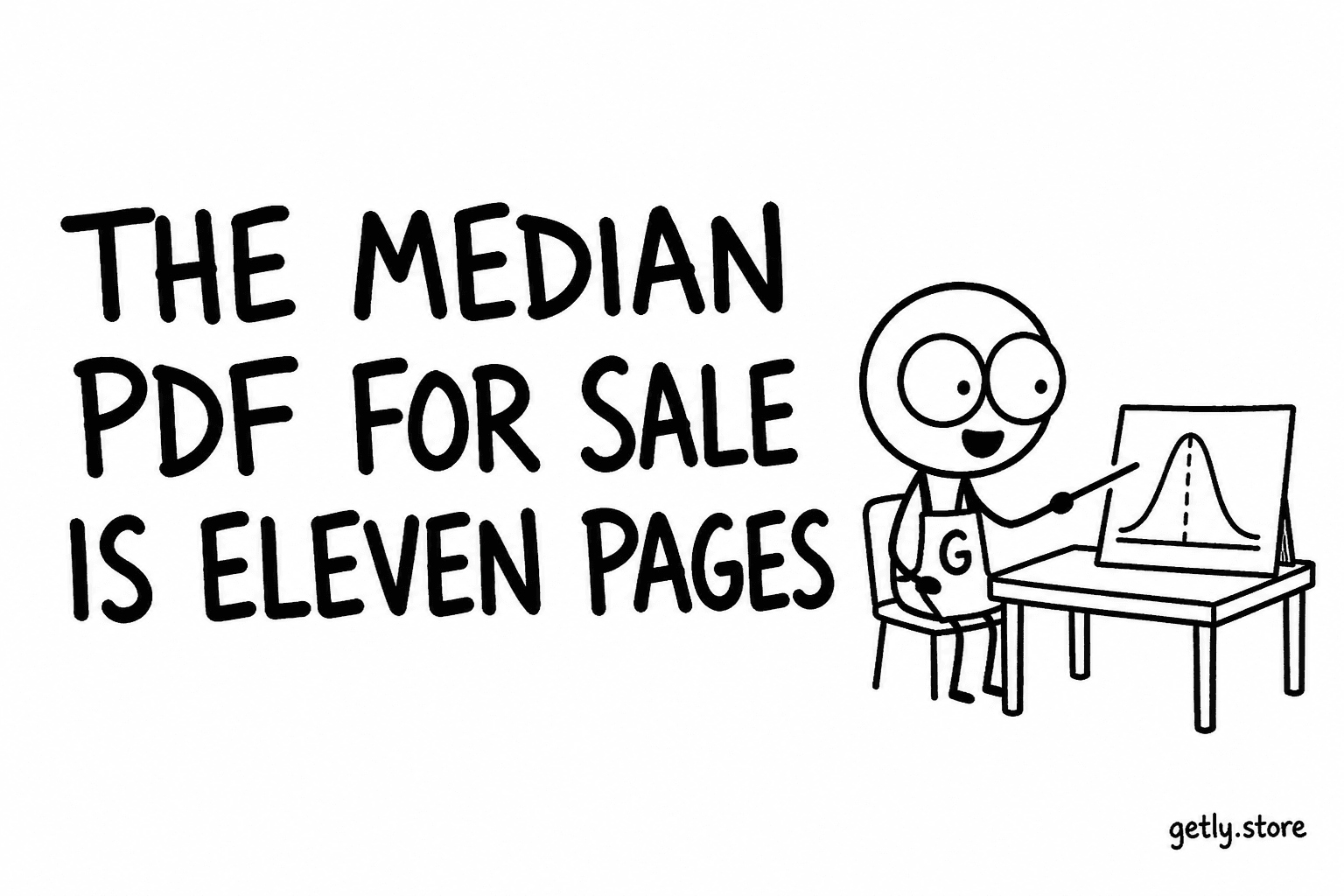
"PDF" is the most common format in the catalogue by a wide margin, and it is also the least informative word on a listing. It covers a one-page checklist and a six-hundred-page manual equally. So we counted. Every PDF that is the current file of an active product and whose page count we have read — 2,252 files, measured this week.
The distribution
- 25th percentile 3 pages · median 11 · 75th percentile 29.
- 27.6% are three pages or fewer.
- 7.1% are a hundred pages or more. The longest is 2,612.
- The mean is 32 — pulled up by the books. Do not confuse it with the typical file.
So the typical document for sale is short: a planner, a worksheet, a cheat sheet, a set of templates. One in four is essentially a single sheet. One in fourteen is a book. And the single word "PDF" on the listing card treats all three identically.
What the page count tells a buyer
More than the seller usually thinks. A buyer who sees "PDF, 3 pages, 0.4 MB" knows they are buying a printable and prices it in their head accordingly. A buyer who sees "PDF, 240 pages" knows they are buying a book and will read the description differently — looking for a table of contents, not a preview image. The number does not need to be large to be useful; it needs to be there. Since August the product page shows it automatically for a single PDF, read from the file itself rather than typed by the seller, because the typed number was wrong often enough to be worse than none.
How Look Inside treats each size
Since this month a PDF product can show buyers a watermarked excerpt of its first pages, generated on demand. The rule that decides how much is strict, and the page count is what drives it:
- Under ten pages: no excerpt. A three-page checklist shown three pages deep has been given away. Roughly 46% of PDFs fall here, and for them the second product image is still the seller's job.
- Ten to nineteen pages: two pages. The cover and one interior page — enough to judge the design and the density, not enough to use.
- Twenty to thirty-three pages: three or four pages, never more than 15% of the document.
- Thirty-four pages and up: five pages, the cap.
- In every case at least one page is held back, and the last page is never shown.
Just over half the PDFs in the catalogue — 54.1% — qualify. The seller does nothing to enable it; it appears when the file meets the rule and does not when it does not.
What this suggests about how to package a document
If your product is genuinely short, say so and price for it; a three-page template at $3.99 is an honest product, and 27% of the catalogue agrees with you. Do not pad it to reach a page count. But if you are choosing between shipping a set of six two-page templates as six products or as one twelve-page file, the twelve-page file gets an excerpt and the six two-page files do not — and the excerpt is the first time a buyer sees your actual work rather than a picture of it.
For the books, the 7% at a hundred pages and beyond: your five-page excerpt will almost certainly be the cover, the copyright page, the contents and the first page of the introduction. Put something worth reading on page five. The buyer will see it.