 Getly
Getly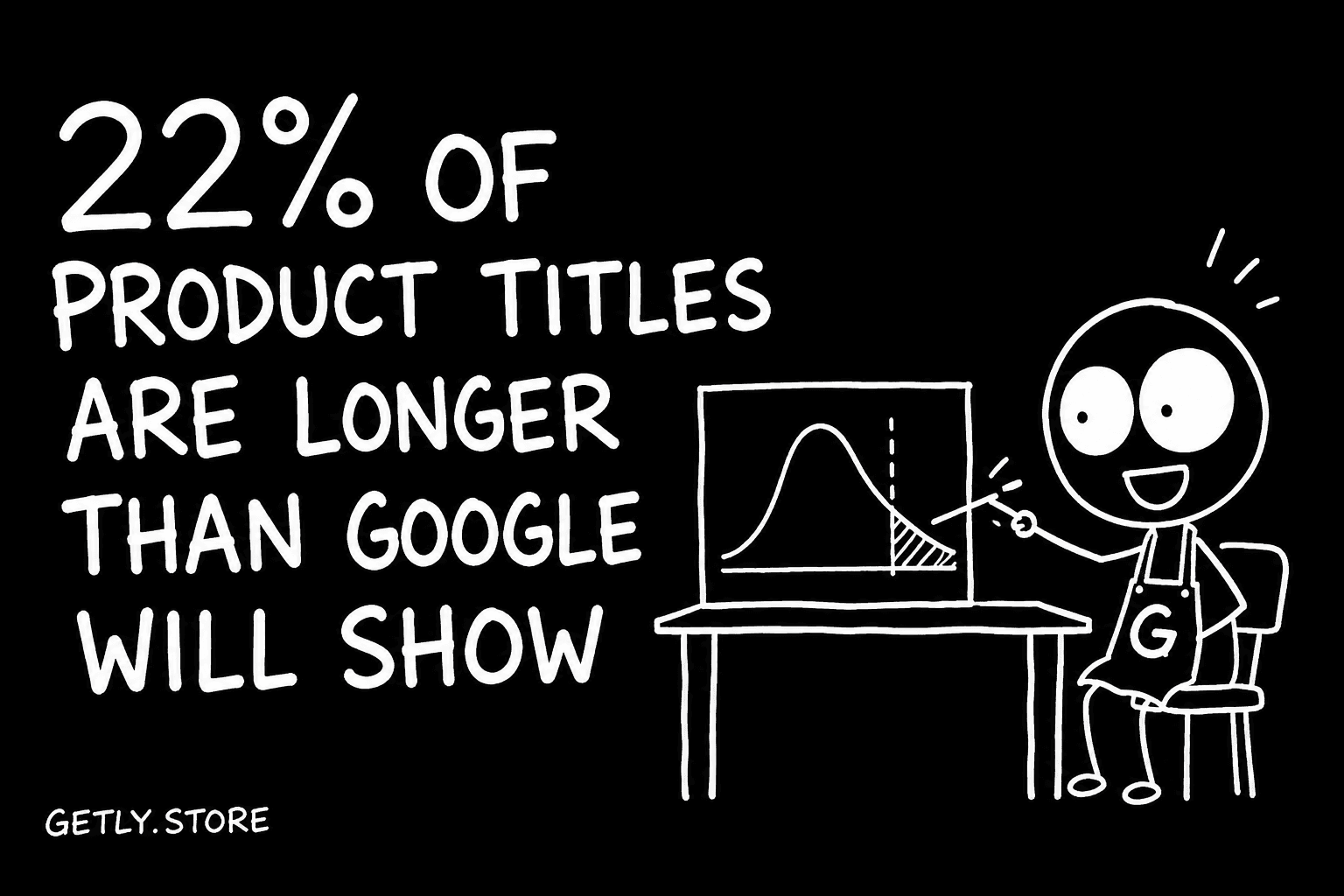
A product title does three jobs at once. It is the headline on the product page, the link text in search results, and the first four or five words a buyer sees on a card between twenty other cards. Three jobs, one string. Here is how the catalogue's 4,885 active titles are doing at it, measured this week.
The distribution
- 10th percentile 13 characters · median 36 · 90th percentile 83.
- 22.4% of titles are 60 characters or longer.
- The longest active title is 499 characters. That is a paragraph.
- 4.1% are written entirely in capitals.
- 84 end in "2025" or "2026".
What happens past sixty
Google does not count characters; it measures pixels, roughly 600 of them, and cuts the title where it runs out. In practice that lands somewhere between 55 and 65 characters depending on the letters. Past that point, the buyer sees an ellipsis. So for one title in five, the search result shows the first two-thirds and hides the rest — and the rest is usually where sellers put the qualifiers that would have made the buyer click: "commercial licence", "300 DPI", "Canva editable".
Until recently, the platform made this worse: the page title was assembled as "product name — Getly" and then clamped at a fixed length, which cut 534 titles mid-word — "Wedding Invitation Templ…". That clamp now cuts at a word boundary, so the visible fragment at least ends on a whole word. It cannot fix the choice of what to say first. Only you can.
Why five characters is now the floor
At the other end, there is a hard rule: a title must be at least five characters long to publish. This is not a taste judgement; we measured it. The shortest title that has ever sold anything here is five characters long. Below that line — "Wow", "Www", "File", "200" — twenty-six active products currently sit, and as a group they have earned nothing and told the buyer nothing. Five is deliberately a length rule and not a quality rule: "Gojo", "Vans", "Bear" are real names of real things, and a rule that rejected them would be refusing honest work. The floor is enforced in the wizard on the first step, so a four-character name is refused before you spend six steps on the rest of the listing.
How to write the string
Front-load the noun. The first three words survive everywhere: the card, the search result, the browser tab. "Minimal Poster Templates — 24 Canva layouts, A3 & A4" works cropped to "Minimal Poster Templates". "The Ultimate Complete Professional Bundle of Modern…" works cropped to nothing.
Put the qualifier that changes the decision second, not last. If the licence, the format or the count is what separates your product, it belongs inside the first sixty characters, not after them.
Drop the year. Eighty-four titles carry one. It buys nothing in search that the "updated" date on the page does not already provide, and next January it makes the product look old.
Do not shout. All-capitals titles read as a different, cheaper category of product, and on a card next to mixed-case neighbours they look like an advertisement rather than a name.
Keep the paragraph for the description. A 499-character title is a description that got into the wrong field. The description has room, gets indexed, and is where the buyer expects to read.
The test
Read your title cropped to its first sixty characters. If you would not click it, neither will anyone else — and for one title in five, that cropped version is the only one Google shows.