 Getly
Getly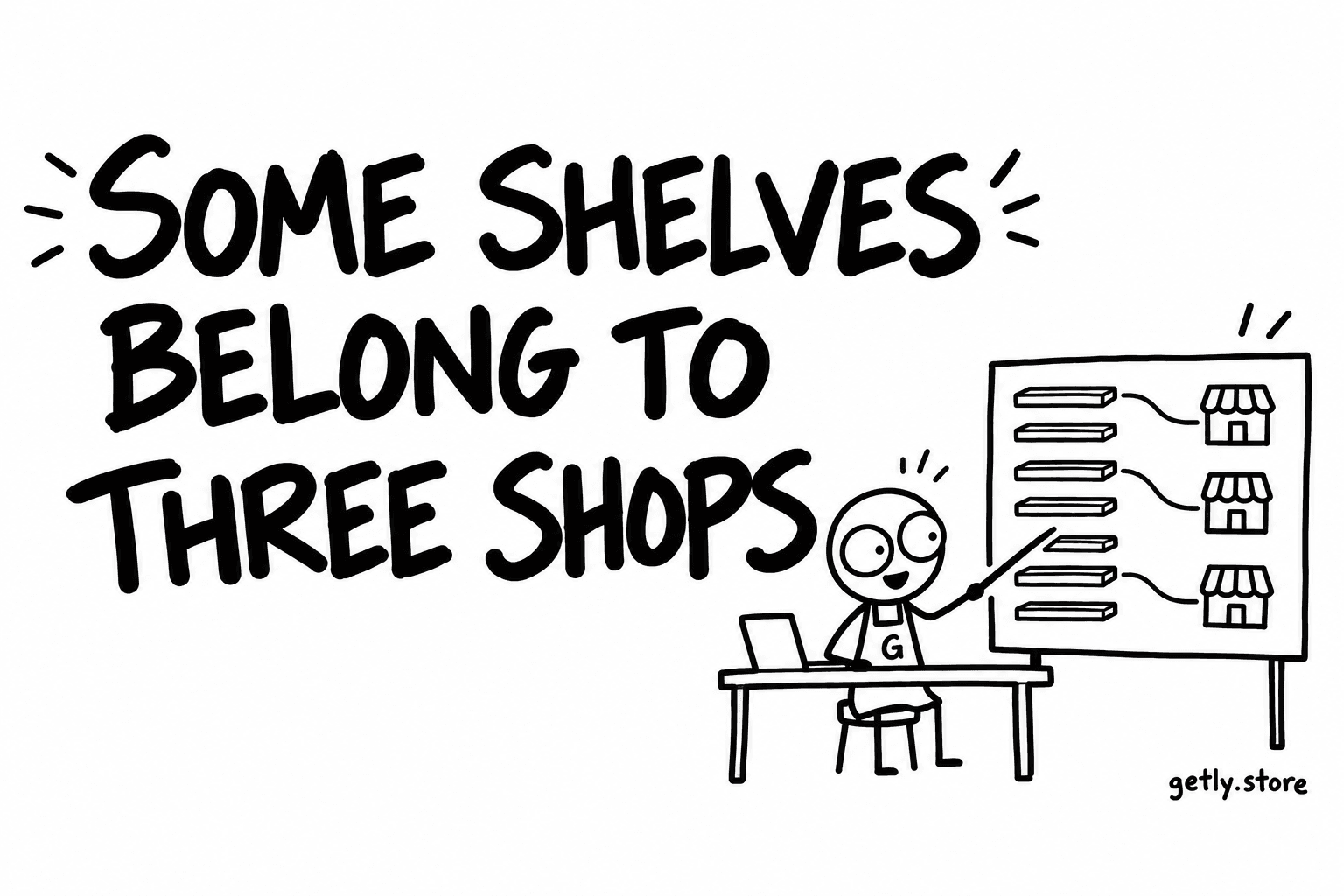
A category page looks like a market: a grid of listings, a price on each, a choice for the buyer. Whether it actually is one depends on a number the grid does not show you, which is how many different shops the listings come from. On 26 September 2026 we counted that for the biggest shelves in the Getly catalogue, and the answer ranges from "almost every listing is a different seller" to "three shops hold the whole shelf".
The catalogue that day held 7,143 active listings in 437 leaf categories with at least one listing. The fourth largest of those shelves, Animals & Wildlife with 188 listings, belongs entirely to three shops.
Eight shelves, eight different markets
Here are eight of the largest shelves, with the numbers that describe who is selling on them and how:
| Shelf | Listings | Median paid price | Middle half of prices | Who holds it | Avg images | With video |
|---|---|---|---|---|---|---|
| Backgrounds & Wallpapers | 280 | $1.99 | $1.99 to $3.00 | about a quarter as many shops as listings | 2.1 | 0.7% |
| Animals & Wildlife | 188 | $4.00 | $4.00 to $4.00 | three shops | 1.1 | 0% |
| Guides & Tutorials | 154 | $12.99 | $5.00 to $34.99 | a little under one shop per two listings | 2.0 | 0.6% |
| Business & Money | 150 | $11.00 | $5.00 to $19.00 | about one shop per two listings | 2.2 | 2.7% |
| Children's Books | 143 | $4.99 | $3.00 to $8.00 | about two shops per three listings | 2.4 | 0.7% |
| Excel Templates | 125 | $12.99 | $9.90 to $12.99 | about one shop per six listings | 1.8 | 7.2% |
| Illustrations | 124 | $15.00 | $5.00 to $50.55 | about one shop per two listings | 2.0 | 0% |
| Self-Help & Personal Development | 111 | $10.00 | $5.00 to $19.99 | about seven shops per ten listings | 1.6 | 0.9% |
Read the "who holds it" column against the "middle half of prices" column and a pattern shows. Where many shops share a shelf, prices spread out: Illustrations runs from $5.00 to $50.55 across its middle half, Guides from $5.00 to $34.99. Where a few shops hold most of a shelf, prices bunch: Excel Templates sits between $9.90 and $12.99, and Animals & Wildlife does not move at all. The 25th percentile and the 75th percentile are both $4.00.
That is a correlation across eight shelves, not a law. It has an obvious explanation, though. A shop that lists sixty items usually prices them by one habit, so a shelf dominated by a few shops shows a few habits. A shelf with many independent sellers shows many.
What a buyer sees on a shelf like that
A buyer who opens Animals & Wildlife sees the same three storefront names again and again, the same price on almost every card, and roughly one image per listing (the shelf averages 1.1). No listing on it carries a video. Nothing about that is against any rule. It does mean the shelf offers a buyer very little to choose between, and a newcomer who arrives with something visibly different has an unusually clear space to stand in.
The same is true, in a milder form, of Excel Templates. Few shops hold it and prices sit in a narrow band. But it is also the shelf in this table where video is most common, at 7.2% of listings, and its sellers have clearly thought about presentation. A concentrated shelf is not automatically a sleepy one.
What these numbers do not tell you
They say nothing about demand. A shelf held by three shops could be a shelf nobody else has noticed, or a shelf where three shops arrived early and nobody else bothered because buyers are few. We are not publishing how often any of these shelves sells, and you should not read the listing count as a proxy for it. Plenty of listings on a shelf only proves that plenty of listings were made.
They also say nothing about quality. Three shops producing 188 listings may be doing excellent work. The point is narrower: when you plan a listing, the number of competing shops tells you more about how crowded your position will feel than the number of competing listings, and the category page does not show you that number directly.
How to read your own shelf in ten minutes
You can run this check on any category before you publish into it:
- Count the storefronts, not the cards. Open the category page, sort by newest, and note the shop name under each of the first twenty or thirty listings. If the same few names repeat, you are looking at a shelf held by a few sellers.
- Write down the prices. A tight band means the shelf's price was set by a few shops' habits. You do not have to match it. A higher price with a better presentation is a real position on a shelf where everyone else looks the same.
- Count images and look for video. On a shelf averaging one image, a listing with four clear images and a short video is different at a glance. On a shelf where video is already common, it is simply expected.
- Read two or three descriptions. If they are all short and similar, a description that spells out exactly what is included, which formats, and the licence answers questions the rest of the shelf leaves open.
What to do today
Pick the category you sell in, or the one you are about to enter, and do the storefront count above. If a handful of shops hold it, decide deliberately whether you are joining their price band or standing apart from it, and give your listing the images, the video or the plain description that makes the difference visible in the grid. If many shops share it, look at where the middle half of prices sits and place yourself inside it on purpose, not by accident. Either way, the decision should come from the shelf you actually looked at, not from the size of the number next to the category name.