 Getly
Getly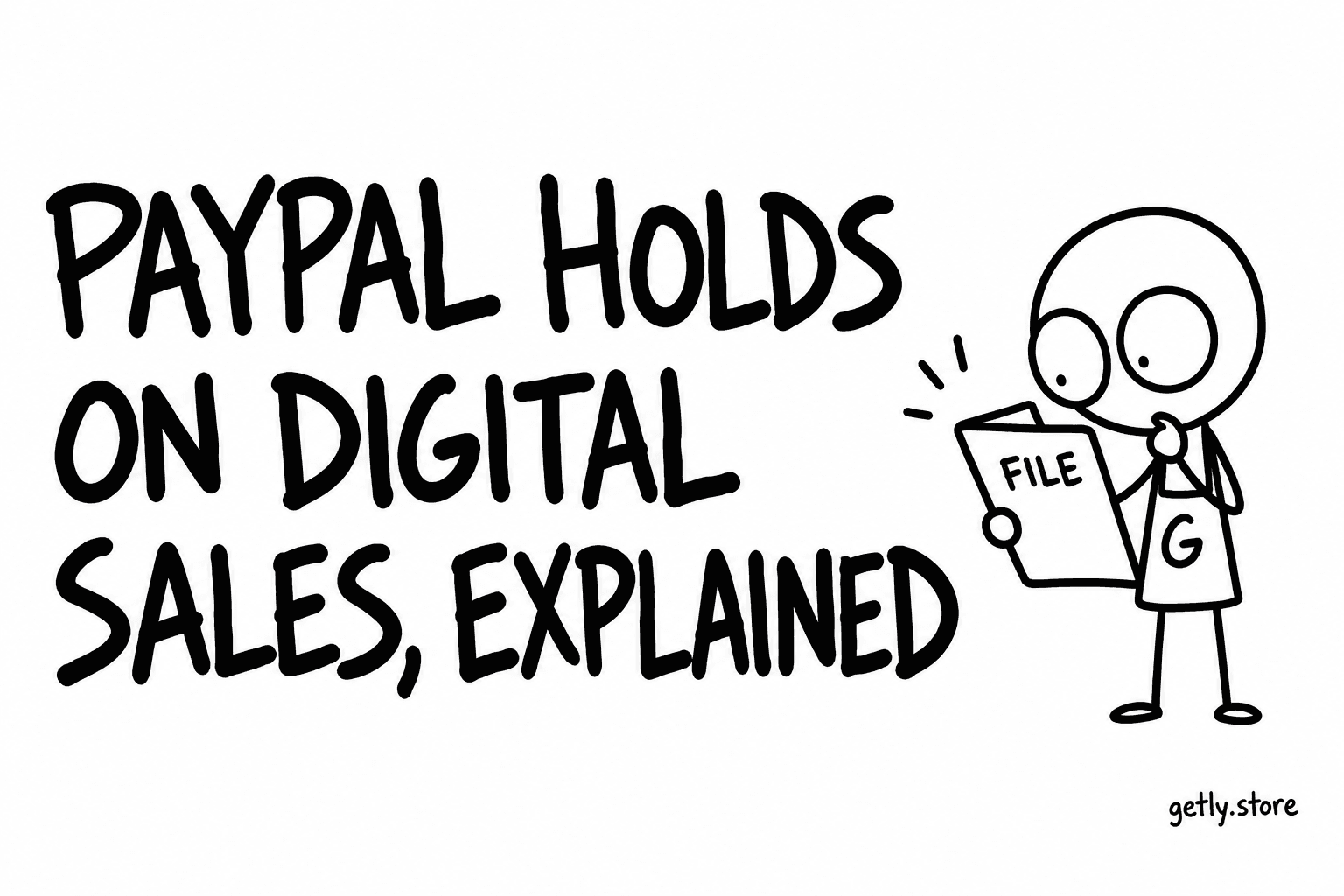
You sold a template, the buyer downloaded it within a minute, and PayPal shows the money as "on hold". For sellers of digital products this is one of the most confusing moments with PayPal, because the usual advice is written for parcels: add a tracking number and wait for the courier. A download has no courier. It does have its own release path, and most sellers never use it.
Everything below about PayPal's rules comes from PayPal's own help pages, checked 26 September 2026. PayPal changes its policies and applies them differently by country and account, so treat this as a map of how the system works, and read the notice in your own account for the reason that applies to you.
Why PayPal holds a payment at all
A hold means the payment has arrived in your account but is not yet available to withdraw or spend. PayPal describes it as a way to cover the possibility of a buyer complaint while the transaction is fresh. Its help pages list the usual reasons:
- You are a new seller. PayPal says it holds the first payments of new sellers for up to 21 days while the account builds a selling history.
- You have not sold in a while. A dormant account is treated a little like a new one.
- Your selling pattern changed. PayPal names an unexpected surge in sales, a change in business type, a change in average selling price, and a change in the type of item sold.
- Complaints or refunds. Several buyer reports or refunds can trigger holds on later payments.
- Higher-risk items. PayPal lists event tickets, consumer electronics, travel packages and gift cards among them.
- Unfinished verification. Payments can stay held until you complete the identity checks PayPal asks for.
Two of those reasons are worth pausing on for digital sellers. A launch that works is, from PayPal's side, an unexpected surge. And moving from $5 printables to a $60 course bundle is a change in average selling price. Neither is a problem, but both are the kind of change that can put new payments on hold even on an account that has sold for years.
How the hold is released for a download
PayPal's help page on releasing held payments describes three routes. Two of them are for physical goods: adding tracking from an approved carrier, or buying the label through PayPal, after which the hold is released about 24 hours after the courier confirms delivery.
The third route is the one for downloads, services and anything else without a parcel. PayPal's own examples are piano lessons and e-books. You update the order status yourself:
- Open Activity in your PayPal account and find the payment.
- Click Get your money.
- Choose Service or virtual product.
- Set the status to Completed and submit.
PayPal says it releases the hold 7 days after you confirm the order as Completed. That is the whole trick, and it is the reason a digital seller who never touches this screen can wait far longer than one who does: without the update, the payment simply sits until the hold period ends.
PayPal also notes that in rare cases, after these steps, it may still keep a payment for up to 21 days, for example when it sees an unusual change in your selling pattern. Marking an order Completed shortens the usual case; it does not override a review.
| What you sold | What PayPal wants | When the hold lifts, per PayPal |
|---|---|---|
| A parcel, shipped with an approved carrier | Tracking number | About 24 hours after confirmed delivery |
| A download, ebook, lesson or other service | Order marked Completed as "Service or virtual product" | 7 days after you mark it Completed |
| Anything, during an unusual pattern or review | The steps above, plus patience | Up to 21 days |
Mark it Completed only when it is true
It is tempting to mark every order Completed the moment it arrives. Do not. The status is a statement to PayPal that the buyer has received what they paid for, and PayPal uses it when a buyer later says they did not. For a download, "Completed" should mean the buyer actually has access: the file was delivered, the download link was opened, the licence key was issued.
Keep the evidence that makes that statement true. Most storefront tools log when a download link was used; keep those logs, the email that delivered the file, and the listing text as it was on the day of the sale. If a buyer opens a dispute saying the item was not received, a download record is the digital equivalent of a delivery confirmation.
Getting out of new-seller holds
PayPal says it reviews accounts regularly to decide when a seller can access money faster. The conditions it lists are: an active, confirmed bank account or card; a confirmed mobile phone as the primary contact; a certain number of sales and a certain total amount of sales; a period without buyer disputes; and no active account limitations. PayPal does not publish the exact thresholds, so there is no number to aim for, only a direction.
What you can control, in order of effect:
- Finish verification and confirm your bank account and phone. An unfinished step can hold everything else.
- Mark digital orders Completed as soon as delivery is real, every time, so each payment starts its 7-day clock.
- Describe the item exactly. Most "not as described" complaints on downloads come from a listing that did not say which software opens the file, what size it is, or what is not included.
- Answer buyers before they go to PayPal. A refund you agree to on your own terms is cheaper than a dispute, which counts against the history PayPal reviews.
- Change prices and product types gradually when you can, and expect a hold after a launch rather than being surprised by one.
- Take payment as goods and services. PayPal's help pages note that a payment for a sale received the wrong way is itself a reason for a hold.
When a marketplace is the merchant
Everything above applies when the buyer pays you through PayPal: your own site, a checkout link, a storefront connected to your PayPal account. On a marketplace that is the merchant of record, the buyer pays the marketplace, and the PayPal hold sits on the marketplace's account, not yours.
That is how it works on Getly. The buyer pays Getly (by PayPal or cryptocurrency), and when our records show the buyer actually received the product, a completed download or an issued licence key, Getly marks the order Completed in PayPal as a virtual product automatically. That shortens the hold on our side without anyone pressing a button, and it only happens after real delivery, for the same reason you should not mark an order early yourself.
Sellers are not paid through PayPal at all. Getly pays sellers on the 1st and the 15th in USDT or USDC on BNB Smart Chain (from $5) or USDT on Tron (from $15), on its normal schedule, regardless of any PayPal hold on the buyer's payment. There is no listing fee, and the seller keeps 80% by default; current rates are on the pricing page. If you have not set up a wallet before, our guide to crypto payouts on BNB Smart Chain walks through it, and the seller page covers the rest.
A five-minute check for your own PayPal account
- Open Activity and filter for payments on hold. Note how many are for downloads.
- For each one the buyer has genuinely received, choose Get your money, then Service or virtual product, then Completed.
- Open the notice under your balance and read the reason PayPal gives for your account. If it names verification, finish that first.
- Check that your bank account and phone are confirmed.
- Reread your best-selling listing and add anything a buyer could claim was missing: file format, the software that opens it, the size, what is not included.