 Getly
Getly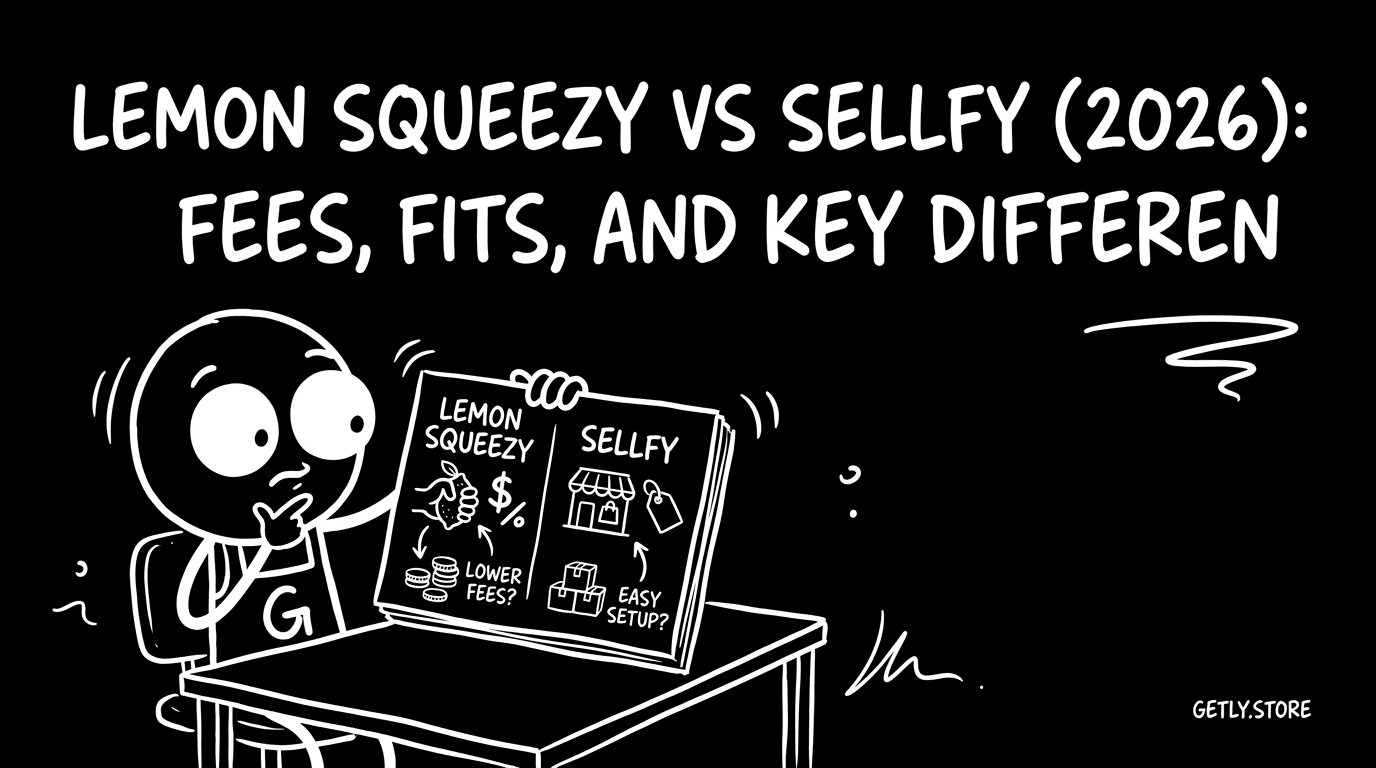
If you’re choosing between lemon squeezy vs sellfy in 2026, the biggest practical difference is not “ease of use”-it’s the pricing model and what each platform does with taxes and VAT. Lemon Squeezy charges a percentage per transaction with Merchant of Record handling, while Sellfy charges a monthly subscription with 0% commission per sale.
This lemon squeezy sellfy comparison will help you decide which one matches your business type (SaaS, downloads, templates, ebooks) and your expected volume-so you don’t pay for the wrong mechanics.
TL;DR - Which Should You Pick?
- Pick Lemon Squeezy if you want percentage-based fees plus Merchant of Record VAT/sales tax handling, especially for EU/global digital sales.
- Pick Sellfy if you can sustain high volume, because it’s subscription-based with 0% commission per sale.
- Neither is a built-in marketplace: lemon squeezy sellfy both have no buyer-side marketplace discovery, so you’ll rely on your own traffic.
- If you need crypto payouts, neither fits (both are cryptoPayouts = NO).
- Most solo creators should sanity-check fee math using your actual average order price-Sellfy can be expensive in slow months.
Fee Math at $10, $50, and $200
Both platforms charge fees, but in fundamentally different ways. Lemon Squeezy uses 5% + 50¢ per transaction, which (per their Merchant of Record model) includes payment processing and VAT as Merchant of Record. Sellfy is 0% commission per sale, meaning the “per sale” math is much lighter-but you pay a separate $29–159/month subscription depending on tier.
Below is the per-transaction fee math using the “effective fee” examples provided. Note that Sellfy’s subscription cost is not included in the per-sale rows (because the ground-truth figures only specify effective fee at price points from commission + per-transaction elements).
| Sale Price | Lemon Squeezy fees | Lemon Squeezy net | Sellfy fees | Sellfy net | Winner |
|---|---|---|---|---|---|
| $10 | $1.00 (~10% on $10 sale) | $9.00 | $0.60 + 30¢ (= $0.90; ~3% + 30¢) | $9.40 | Sellfy |
| $50 | $3.50 (~6% on $50 sale) | $46.50 | ~$1.70 + 30¢ (effective fee ~3% + 30¢; shown net as $48.30) | $48.30 | Sellfy |
| $200 | $10.00 (~5% on $200 sale) | $189.50 | ~$6.60 + 30¢ (effective fee example shown via net as $193.40) | $193.40 | Sellfy |
Reading this table correctly: “Sellfy fees” and “Sellfy net” here reflect the provided effective-fee examples at those specific price points. Sellfy also has a separate monthly subscription cost ($29–159/mo) that can dominate your real monthly profitability if sales are inconsistent.
Lemon Squeezy vs Sellfy: Verdict by Use Case
| Use Case | Pick | Why |
|---|---|---|
| SaaS / subscription product | Lemon Squeezy | Lemon Squeezy’s best-fit positioning is SaaS and developer tools, and it runs as Merchant of Record (VAT/sales tax handling). That’s usually the cleanest path when you’re selling recurring digital access to global customers. |
| Selling 1–2 ebooks or templates | Lemon Squeezy (usually) or Sellfy (only if volume is steady) | Lemon Squeezy is free to start with monthly subscription = Free, so you don’t pay a baseline while you test demand. Sellfy’s 0% commission can win later, but its monthly subscription is a fixed burn if volume is low. |
| Selling to EU buyers | Lemon Squeezy | Lemon Squeezy acts as Merchant of Record and is explicitly positioned for global/EU compliance (handling VAT/MOSS and similar obligations). Sellfy does not act as Merchant of Record (VAT/sales tax handling: NO). |
| Small ticket items (under $20) | Lemon Squeezy or Sellfy (depends on volume) | Per-transaction math at $10 is shown as netting higher on Sellfy in the examples, but Lemon Squeezy has no monthly subscription cost. For small, sporadic sales, the subscription can outweigh commission advantages. |
| Higher volume ($5k+/mo) | Sellfy | Sellfy is best fit for high-volume creators (explicitly $1.5k+/mo) because a flat monthly subscription plus 0% commission can beat percentage-based competitors on the math when sales are consistent. |
| Need crypto payouts | Neither - pick a marketplace with native crypto payouts like Getly | Both platforms are listed as cryptoPayouts = NO. If crypto payout support is a hard requirement, neither lemon squeezy or sellfy comparison helps-you’ll need a third option that supports crypto payouts. |
Feature Differences That Actually Matter
Subscription/recurring billing: Lemon Squeezy is positioned as best fit for SaaS, developer tools, and digital downloads sold to global (especially EU) customers. That naturally aligns with recurring revenue models where you want a payment flow that stays consistent across jurisdictions. Sellfy is a subscription-based platform itself (monthly plans), but the ground-truth data we have here doesn’t label it specifically as a recurring-billing SaaS system-so if your core business is subscriptions, Lemon Squeezy is the safer assumption from the provided fit.
Affiliate program & built-in growth mechanics: The ground-truth blocks provided do not state any affiliate-program details for either platform. So in this lemon squeezy sellfy comparison, I’m not going to over-claim affiliate capabilities. The one growth-related difference we can be definitive about is marketplace discovery: both platforms have buyer-side marketplace discovery = NO. Practically, that means you should plan to bring your own traffic and distribution (email, SEO, communities, ads, partnerships) rather than relying on a built-in discovery engine.
Course delivery features / asset marketplaces / curated catalogs: The ground-truth describes Lemon Squeezy as not designed for asset marketplaces or curated catalogs (every sale must come from your traffic). It also does not describe Sellfy as a buyer-side discovery marketplace. If you’re building a “catalog” business (many buyers browse to find things), the no-discovery flag on both platforms is the key constraint.
Merchant of Record and taxes: This is the most consequential “it just works” difference. Lemon Squeezy acts as Merchant of Record (handles VAT/sales tax: YES). That’s explicitly helpful for global selling-especially EU buyers-where VAT handling is often a major operational headache. Sellfy is Merchant of Record: NO, so you should assume you’re responsible for more of the tax/VAT compliance work (even if the platform still processes payments).
Suspension Risk and Account Stability
On account stability: both platforms are commonly used by digital creators, and neither is described in the provided ground-truth data as having a notable suspension pattern. The higher-level risk signal here is “business-model mismatch” rather than “sudden platform instability”-for example, Sellfy’s monthly subscription can hurt cash flow if sales dip, and Lemon Squeezy’s percentage + per-transaction structure can be more expensive if you scale in a way that makes fixed-fee economics more favorable elsewhere.
If you want the least operational friction, align the platform’s intended use case with your business (Merchant of Record needs for EU selling with Lemon Squeezy; steady high volume with Sellfy). That reduces the chance you’ll end up fighting the economics later.
Migration Path: Switching Between Lemon Squeezy and Sellfy
Migration is rarely “one click.” A realistic approach is: export your product list, rebuild the catalog in the new platform, and then redirect customers via updated links (landing pages, purchase buttons, and any existing checkout URLs you can control). Expect to recreate product pages and pricing in the destination store, and then re-verify payment/tax settings according to the new Merchant of Record behavior (Lemon Squeezy handles VAT/sales tax as Merchant of Record; Sellfy does not).
Effort-wise, plan on several hours for setup per ~50 products if your product details are non-trivial (titles, descriptions, downloads, media, and purchase flows). What typically does not transfer automatically: customers, order history, and prior transaction records (the new platform is a separate system). Also assume you’ll need to update analytics tracking so you can measure whether your traffic is converting in the same way after the switch.
When to Pick a Third Option
Consider a third option if you hit a hard requirement that lemon squeezy vs sellfy can’t satisfy. The clearest gap from the provided data is crypto payouts: both platforms explicitly have cryptoPayouts = NO, so if you need native crypto payout support, pick a platform that supports it rather than trying to force a workaround.
If your requirement is not crypto payouts, then third-party marketplaces may still be relevant-but the key is whether you truly need buyer-side marketplace discovery. Since both platforms have buyer-side marketplace discovery = NO, a marketplace with real discovery can matter if distribution is your bottleneck.
Bottom Line
In 2026, choose Lemon Squeezy for Merchant of Record VAT/sales tax handling and a SaaS/developer-tools-friendly fit when you’re selling globally (especially EU), while choosing Sellfy when you can sustain steady high volume and want 0% commission per sale with a flat monthly plan. Next step: visit Lemon Squeezy and Sellfy, then run the fee math using your real average price and monthly units before you commit.
Frequently asked questions
Which is cheaper for a $10 digital product in 2026?
Based on the provided effective-fee examples, Sellfy nets $9.40 on a $10 sale, while Lemon Squeezy nets $9.00. That means Sellfy has the edge on per-sale math at this specific price point.
Does Lemon Squeezy handle VAT and sales tax as Merchant of Record?
Yes. Lemon Squeezy acts as Merchant of Record and handles VAT/sales tax (Merchant of Record: YES). Sellfy does not (Merchant of Record: NO).
Do Lemon Squeezy or Sellfy provide buyer-side marketplace discovery?
No, both are listed as having buyer-side marketplace discovery = NO. In practice, you should expect to drive sales with your own marketing and traffic rather than relying on built-in discovery.
Can either platform pay creators out in crypto?
No. Both platforms are listed with cryptoPayouts = NO, so you should not expect native crypto payouts from either Lemon Squeezy or Sellfy.
When does Sellfy tend to make more sense than Lemon Squeezy?
Sellfy is positioned for high-volume creators (explicitly $1.5k+/mo) because it charges 0% commission per sale with a flat monthly subscription. If your sales are inconsistent, the monthly fee can outweigh commission-based advantages.