 Getly
Getly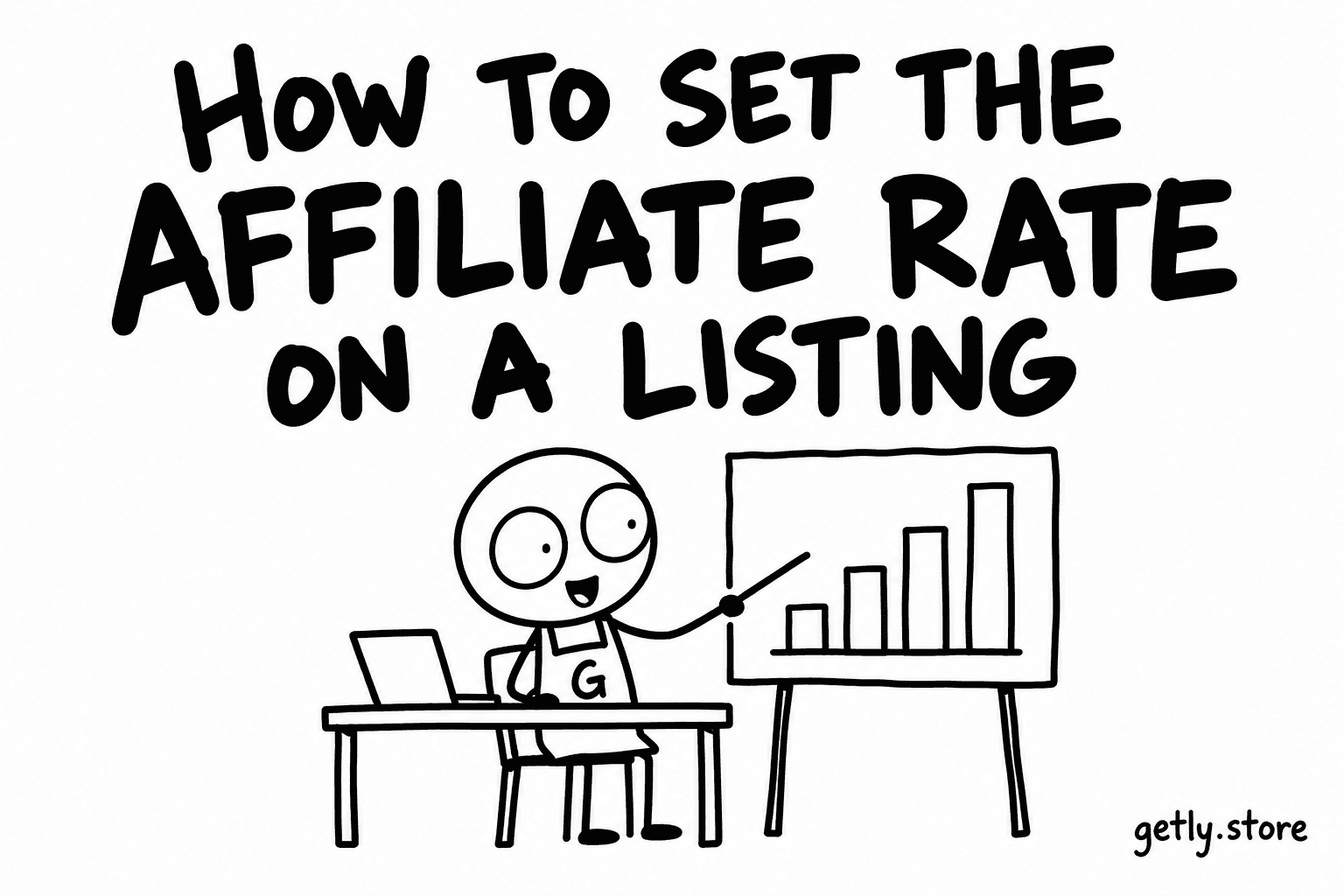
Most listings here already have an affiliate program attached — 75.07% of active listings carry one, and 96.32% of those are switched on. Almost nobody has chosen the number. Measured on 19 September 2026, 75.26% sit on exactly 15%, which is the value the field arrives with.
What is interesting is the shape of what is left. The second-largest cluster is not 14% or 16% — nobody nudges. It is 50%, on 3.62% of programs. Then 10% (9.73%), 20% (2.13%), 30% (1.61%), 5% (1.33%), 40% (1.23%) and 1% (0.96%). Median 15, mean 16.21, highest value stored 60. People either leave the default alone or jump to a round number they picked for a reason.
What the rate actually is
It is the share paid to whoever brought the buyer. Someone joins the affiliate program, gets a link to your listing, posts it somewhere, and a purchase through that link records a commission against the sale.
The share comes out of what the sale leaves you after the platform commission, not out of the platform's side. So the rate is a slice of your own proceeds, which is why the field shows a worked example underneath it — for a $10 sale it tells you what the affiliate earns and what you keep, at whatever rate is currently typed in. Your own commission rate is the one on your payouts page; read it there rather than assuming, because it depends on your tier and on how the buyer arrived.
Two things never pay a commission, and both are deliberate. A sale to somebody who is themselves the seller of that item is not a referral. Nor is a purchase the affiliate makes for themselves.
Setting it
- Open Dashboard → Products and edit the listing, or create a new one.
- Go to the last step of the form, where publishing options live.
- Switch on the affiliate program.
- Enter the rate. The field takes a whole number from 1 to 50.
- Read the example underneath before saving — it is the fastest way to see whether the number is what you meant.
- Save.
Fifty is a ceiling, not a suggestion: the payout is capped at 50% however the value was stored, which is why a saved 60 pays the same as a saved 50. Turning the program on also lists the product where affiliates look for things to promote, and they can filter that list by minimum rate and sort by it — so the number is not only what you pay, it is also how visible you are to the people who might carry you.
Why a digital product can afford a high share
On a physical product the unit cost is real: materials, printing, packing, postage. Half the price may be less than the product cost you, and a 50% affiliate rate is simply impossible.
A file has no unit cost. The tenth copy costs you the same as the thousandth, which is nothing. That is why rates here can sit at levels that would be ruinous anywhere else — the question is not "can I afford this" but "is this sale worth more to me than the share I am giving up".
What 50% is actually for
It is a campaign rate, and it is strange as a permanent one.
It makes sense for a launch week, when the point is to reach people faster than you can on your own. It makes sense for one specific partner with an audience you cannot reach, where half of a sale that would not have happened is the whole argument. It makes sense for a bundle push where volume is the goal.
Left on permanently, it means every ordinary sale that happens to arrive through a link costs you half your proceeds — including sales from people who would have bought anyway, having found the link in a roundup rather than been persuaded by it. Set it high on purpose, put the end date in your calendar, and move it back down.
How to choose the number
One question decides it: what is the cheapest other way you have of reaching one new buyer?
If you have an audience already — a list, a following, a channel — reaching one more person is nearly free, and a high rate buys you little you could not get yourself. Fifteen is a reasonable place to leave it.
If you have no distribution and no budget, an affiliate is the only channel you can pay for out of revenue instead of up front, and you pay nothing when it does not work. That is worth more than a percentage point, and 25 to 40 is defensible.
If you are paying for ads, you already know your number: whatever a buyer costs you there is the ceiling for what one should cost you here, and it is usually higher than you would guess.
The part that matters more than the rate
An affiliate program only does anything once somebody is actually promoting the listing. The rate is a term of an agreement, not a growth setting — raising it on a listing nobody is linking to changes nothing, because zero of a bigger share is still zero.
So treat this as a lever for a seller who already has somebody in mind: a reviewer, a newsletter, a course, a partner whose work sits next to yours. Set the rate, then go and tell them it exists. The number is the easy half.