 Getly
Getly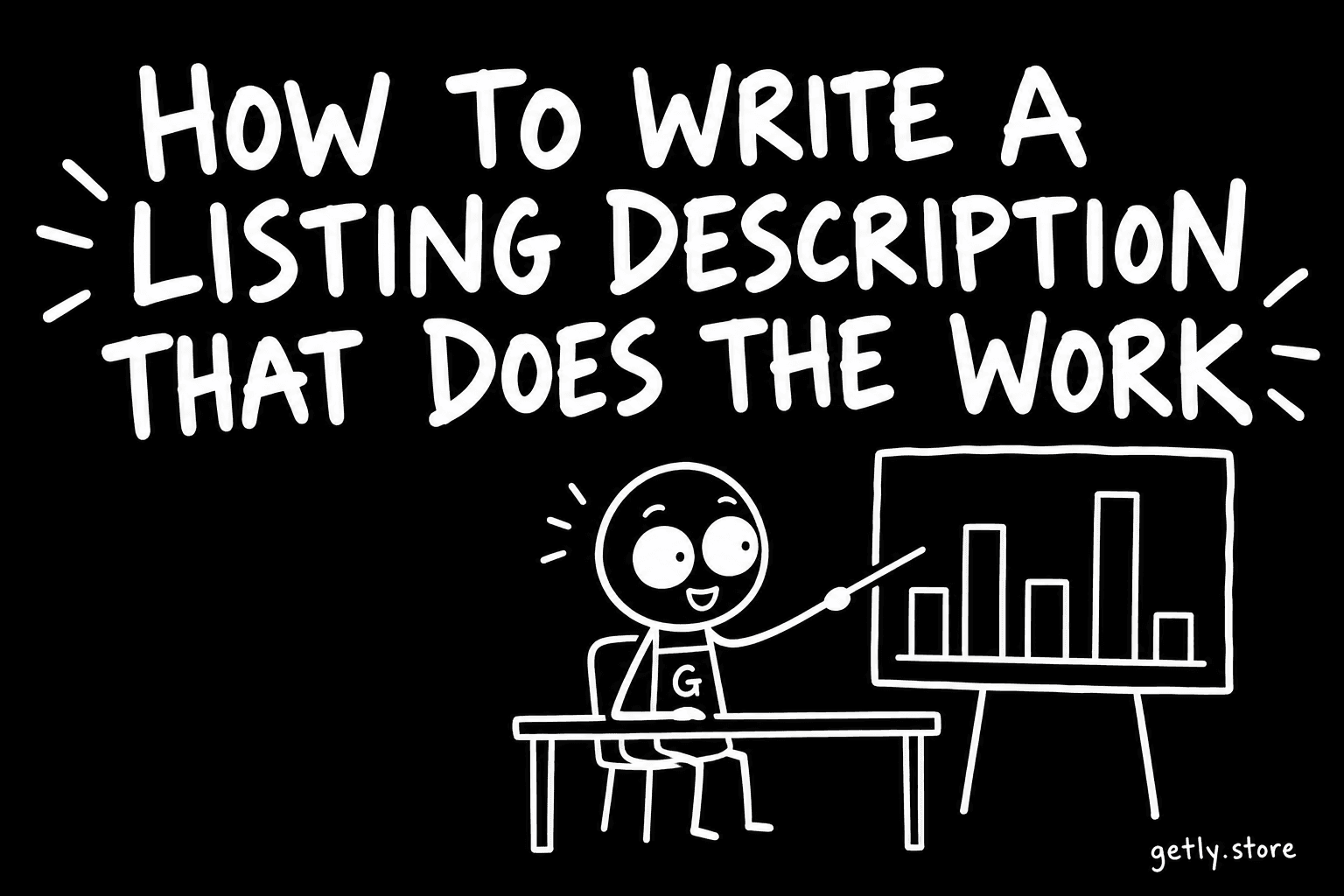
Of the things you control on a listing, description length is the one that moves in a straight line with price. Measured on 19 September 2026 across live listings, median price by description length:
- Under 500 characters — $5.00.
- 500 to 1,000 — $5.00.
- 1,000 to 2,000 — $6.99.
- 2,000 to 4,000 — $9.99.
- Over 4,000 — $19.00.
Nothing else behaves like that. Title length is flat across its bands — $7.99, $6.00, $5.91, $7.00, wandering rather than climbing — and file count is not monotone at all.
What the bands say, and what they do not
Read this as a correlation, because that is what it is. A long description is more often written by somebody who had more to sell — a bigger pack, a deeper tool, a licence question worth answering. The length did not make the price; both came from the same thing.
So do not pad. Writing 4,000 characters about a $5 icon set does not turn it into a $19 icon set. What the curve genuinely tells you is narrower and more useful: listings that ask for real money have an explanation attached, and a listing with no explanation tends to settle at the floor.
For orientation: the 10th percentile of description length is 278 characters, the median 1,082, the 90th percentile 2,439. The middle of the catalogue is roughly a thousand characters — five or six short paragraphs, about what it takes to answer a buyer's questions once each.
The sequence to write in
The order matters more than the prose, because a reader stops early and the answers they need have to arrive before they do. In the product wizard this is the first step, under the name.
- What it is. One sentence, plain nouns. "A 42-page Notion template for freelance invoicing." Not a promise, a description.
- Who it is for. Name the person. Naming them also tells everyone else they are not the buyer, which saves you a refund.
- What is in the download. Formats, counts, sizes, dimensions. This is the paragraph people scroll to look for.
- How to use it. What software they need, what to do first, how long setup takes.
- The licence. Personal or commercial, and what commercial covers here.
- What it is not. The shortest section and the one that pays for itself — "no source files", "not print-ready at A0", "requires a paid Notion plan".
Under the description field a counter shows how many characters you still need to clear the 150-character floor; it counts the same way the publish check does, so the number on screen is the number being judged. If the blank page is the problem, the draft button beside it writes a first pass from your name, category and tags — it needs the name filled in first, and it is a draft, not a description.
Formatting: one list, two headings, no wall of emoji
Most sellers format something: 80.06% of descriptions use some HTML. Fewer use the parts that help a scanner — a list in 33.29%, a heading in 27.81%, bold in 37.29%, a link in only 3.67%. And 6.44% are one unbroken paragraph, the single shape guaranteed not to be read.
A workable default: two headings, one list for the contents, bold on three or four things somebody would search for. That is enough structure for a fifteen-second decision.
Emoji appear in 18.71% of descriptions. The common ones are ✨, ✔, ✅, 🎯, 💡 and 🚀 — three different check marks in the top ten, all doing the same job. As bullets they are fine if you pick one mark and keep to it; mixing three reads as text assembled from other people's listings. Inside sentences they cost readability, and a screen reader says the name of each one out loud.
The questions nobody answers
Four things buyers look for before paying, and how often a live description mentions them: the licence — 12.36%. Commercial use — 5.28%. Instant delivery — 5.11%. Refunds — 2.21%.
Two of those are already answered for you — delivery is immediate and the refund window shows on the listing — but say them anyway, one line each. The licence is the real gap: it is the most common pre-purchase question and seven listings in eight do not address it.
The short description is a separate job
It sits above the main field, a single line, capped at 500 characters. 91.35% of listings fill it, with a median of 111 characters — so the cap is not the constraint, the job is. Only 0.93% repeat the title word for word, which is the one mistake worth avoiding: it appears where the title already appears, so a copy wastes the slot.
Write the sentence that follows the title: the title names the thing, this says who it is for or what it saves them.
Check it by reading two lines
Save, open the public page, and read only the first two lines as a stranger. If they do not say what it is and who it is for, find the sentence that does and move it up. Everything below is for the reader who is already interested; those two lines decide whether anyone is.