 Getly
Getly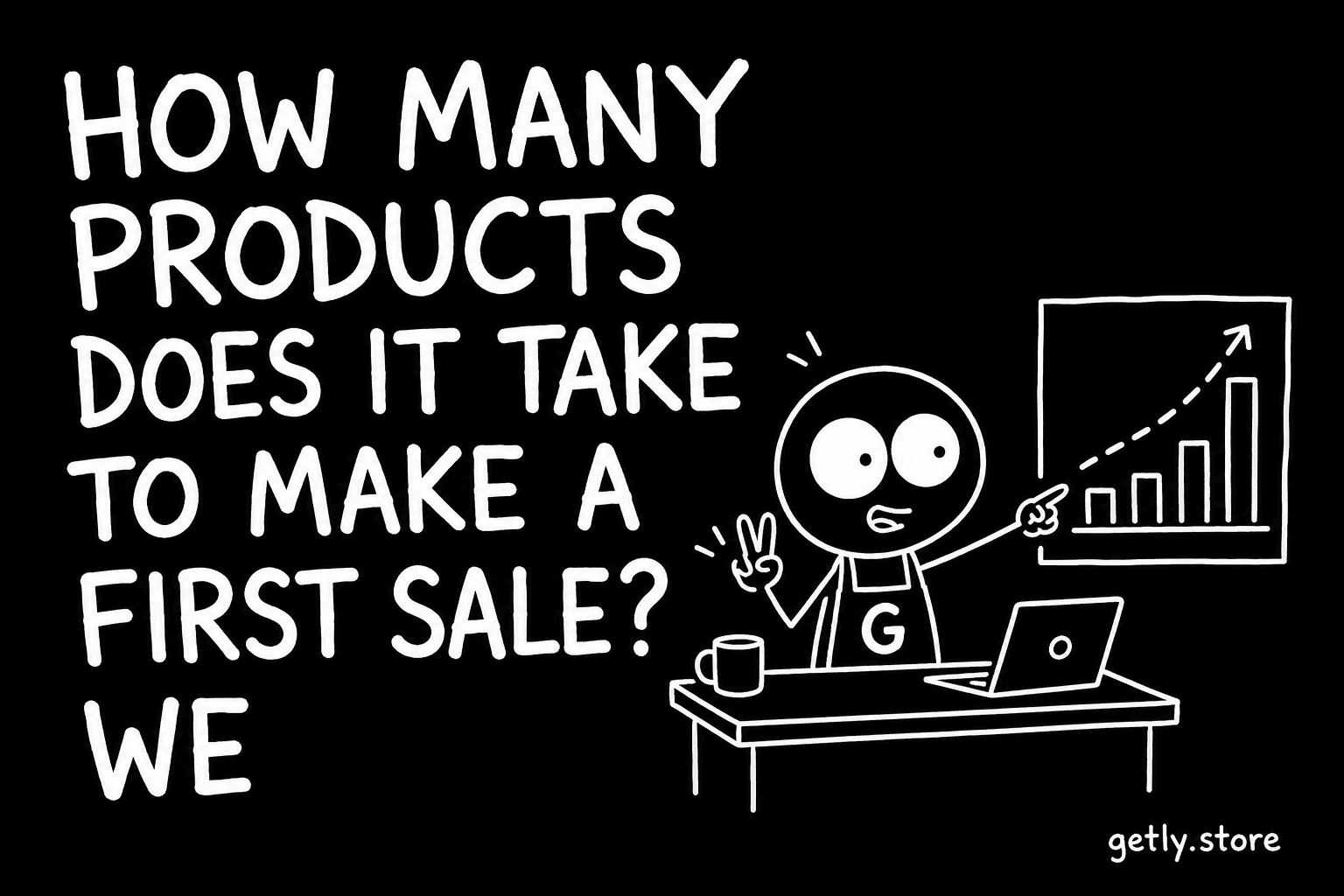
Advice about how many products a new digital seller "needs" is usually a number someone made up. We can do better than that, because we can count. What follows comes from the Getly catalogue on 29 August 2026 - 4,316 live products, and every store behind them that has published at least one.
The headline number, and why it misleads
Split those stores into two groups - the ones that have made at least one paid sale, and the ones that have not - and the difference is stark:
- Stores with a paid sale: 5.7 live products on average
- Stores with no sale yet: 2.6 live products on average
The selling group is roughly one store in thirty, so treat the first line as the smaller sample of the two.
Twice as many listings. It is tempting to read that as a target: publish six things and you will sell. That reading is wrong, and the same dataset says why.
When we look at how many products each of those sellers had at the moment their first sale landed, the average is 4.6 - but the median is 1. More than half of the sellers who have sold anything made their first sale while holding a single product.
Both numbers are true at once. A handful of sellers with large catalogues pull the average up; the typical first sale happens early, on a small catalogue, and the bigger catalogues came afterwards.
What that means if you are starting
The honest reading is that catalogue size is a consequence of selling, not a prerequisite for it. Sellers who make a sale keep going, and their catalogues grow. Sellers who publish two things and stop stay at two things.
So the useful question is not "how many do I need" but "how long am I prepared to keep going". A first product can sell. It usually will not sell in its first week, and the sellers who are still publishing in month three are the ones represented in that 5.7.
There is a second, quieter number worth sitting with. Nearly two thirds of the people who set up a store never list a single product. Whatever is hard about selling digital goods, the hardest step is measurably the first one.
What does not separate the two groups
This is where the data refused to say what we expected. We compared the two groups on the things every guide tells you to fix:
- Average description length: 1,323 characters for sellers who have sold, 1,244 for those who have not
- Average images per product: 2.0 for both groups
Essentially identical. The stores that sell are not writing meaningfully longer descriptions, and they are not uploading more pictures. Whatever separates them, it is not listing polish - at least not at the level a character count can see.
We are not going to pretend to know the full answer from this. What we can say is that if you have written a real description and added a couple of images, you have already matched the sellers who sell on those two axes, and hunting for a third image is unlikely to be what is standing between you and a first order.
A more useful thing to check
One number in the same dataset does separate the groups, and it is about price rather than presentation. The median listed product on Getly costs $6.51. The median product that actually sold cost $9.99.
Buyers are not gravitating to the cheapest thing on the shelf. If your instinct on a first listing is to price it low to reduce the risk of nobody buying, the catalogue suggests that instinct is backwards - the things people pay for sit above the middle of the price range, not below it.
That deserves its own article, and it will get one. For now: publish the thing, price it like it is worth something, and plan to still be publishing in two months. The catalogue says that is what the sellers who sell did.