 Getly
Getly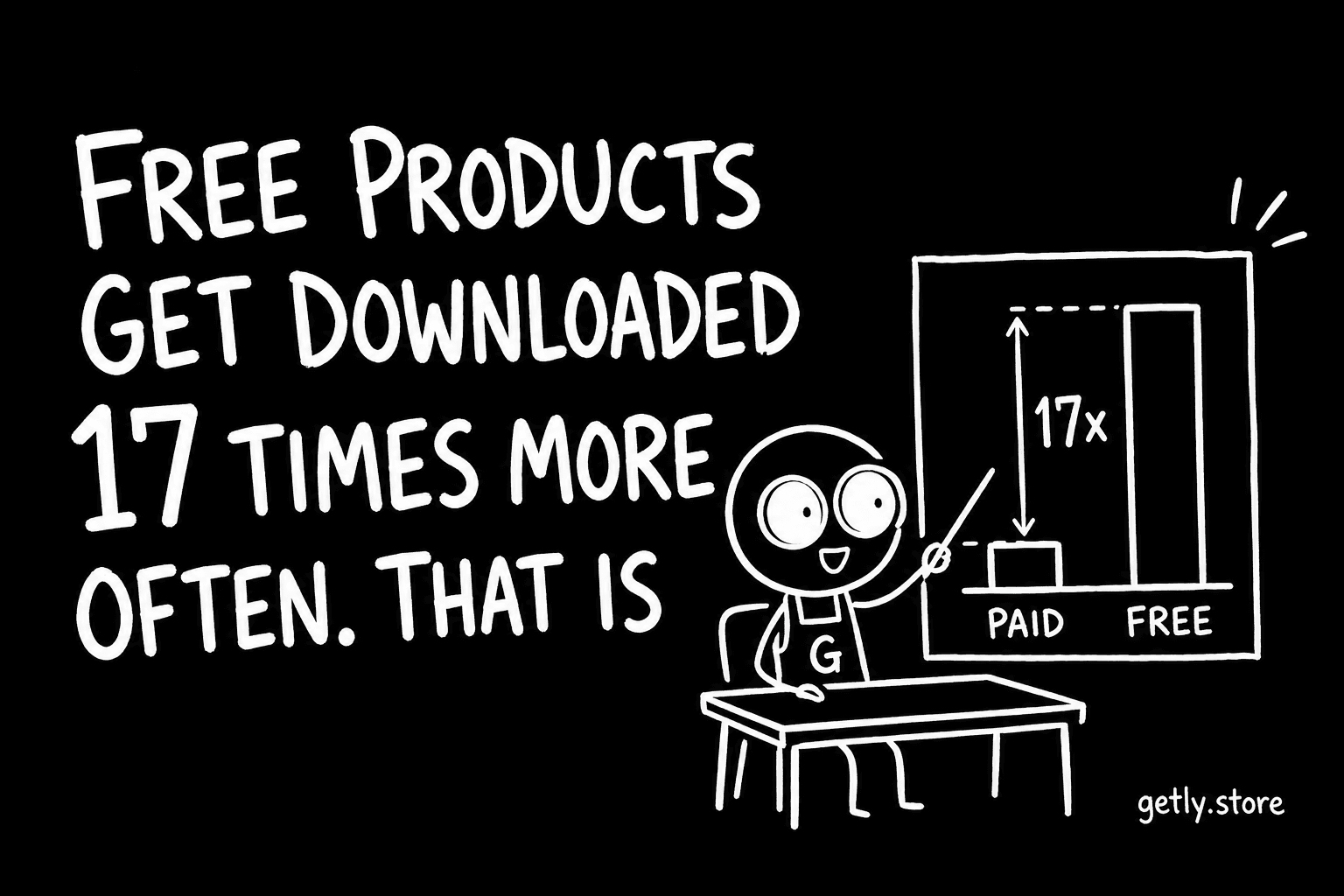
Measured across the Getly catalogue on 30 August 2026:
- 89 free listings, averaging 1.7 downloads each
- 4,308 paid listings, averaging 0.1 downloads each
Seventeen times the traffic. It is the most quoted argument for a free tier, and taken alone it is misleading in three separate ways.
What the gap really measures
It measures friction, not desire. A free download costs a buyer nothing but a click; a paid one costs a decision, a card, and a moment of doubt about whether the file is what it claims. Of course more people take the free thing.
The comparison people actually want - do free listings lead to paid sales later - is one this catalogue cannot answer yet. Only 59 stores have made a paid sale at all, and the free listings are spread thinly across many more. There is no honest cohort here, and inventing one would be worse than saying so.
Where a free product genuinely earns its place
Three situations, and they have something in common: the free thing is a sample of a specific paid thing, not a standalone giveaway.
A slice of a larger pack. Five icons from a set of two hundred. The buyer learns your style, your file organisation, and your naming - all of which are the real risk in buying a large pack.
A working demo of something technical. A template with two of its twelve screens. It answers "will this open in my software and look like the screenshots" before money changes hands.
The first chapter. For anything long-form, the standard trade: they read enough to know whether your voice is for them.
In each case the free listing has a job and a destination. What does not work is a free product with nothing behind it - a store whose whole catalogue is free is not underpriced, it is not selling, and no amount of downloads changes that.
The number that argues against pricing low
There is a separate measurement in the same catalogue worth putting next to the download gap. The median listed paid product costs $6.51. The median product that actually sold cost $9.99.
Sales are not concentrated at the cheap end of the shelf. So the instinct that a free tier and a low price are two versions of the same "lower the barrier" strategy does not hold: the free listing lowers a barrier to a download, and a low price lowers what you are paid without buying you the same traffic.
How to set it up so it can be measured
If you do run a free product, do two things that cost nothing and make the result knowable.
Link it explicitly to the paid version - in the description, by name. A buyer who downloaded the sample and liked it should not have to search your store to find what it was a sample of.
And give it a real listing. Free products on Getly get the same page as paid ones: the same file facts read from your upload, the same category placement, the same search presence. A free listing with a two-line description does not read as generous; it reads as unfinished, and it is the first thing a potential buyer sees of your work.
The honest summary
Free gets downloads. Downloads are not sales, and this catalogue cannot yet prove that one leads to the other. Use a free product as a sample with a named destination, price the paid version like the work it is, and treat the 17× as what it is: a measure of how much easier it is to click a free button than to make a decision.