 Getly
Getly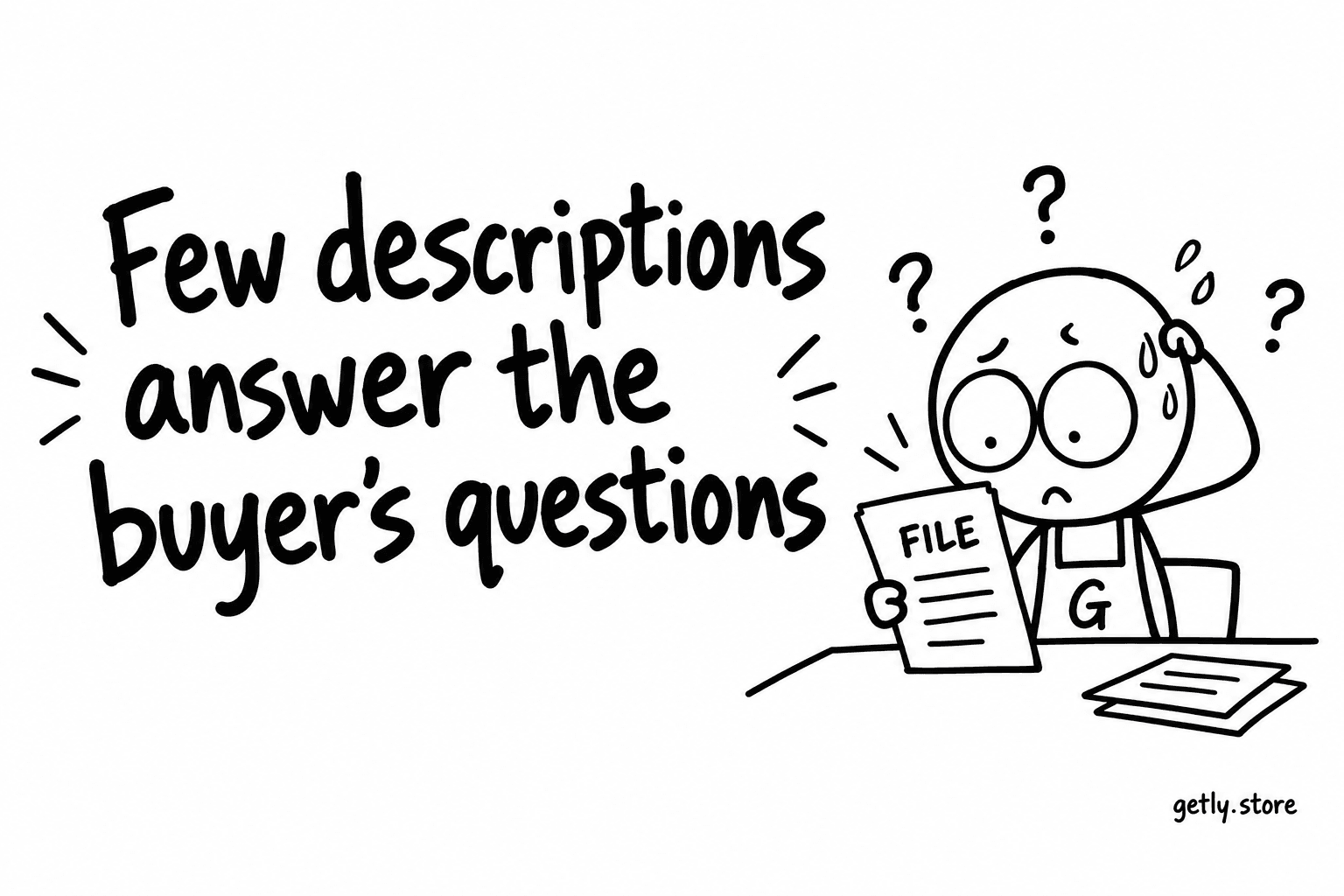
A buyer standing in front of a digital product has questions, and they are almost always the same ones. What exactly do I get? Will it open on my computer? Can I use it for a client? What if it is not what I expected? A physical shop has a person to ask. A listing has only its own text.
On 26 September 2026 we measured how often that text answers the questions directly. Across 7,143 active listings, only 6.99% of descriptions include an FAQ section. The individual answers are not much more common:
- 23.60% of descriptions spell out what is included
- 16.16% mention a licence
- 9.53% mention compatibility, software or requirements
- 2.88% mention refunds
Put another way, a buyer who needs to know whether a file will open in their program has roughly one chance in ten of finding out from the description. The rest have to guess, message the seller and wait, or leave.
Why the questions go unanswered
A seller knows the product too well. The format, the software it was made in, the licence they intend: all of it is obvious to the person who made it, so it never feels worth writing down. Descriptions end up describing how good the product is rather than what it is, because the second part seems too plain to mention.
The buyer has the opposite problem. They know nothing except what the page shows. Every fact left out becomes a question, and an unanswered question at the moment of payment is one of the easiest reasons to close the tab.
The six questions worth answering
You do not need to guess what buyers ask. These come up for nearly every kind of digital product:
- What exactly will I download? Number of files, formats, sizes or page counts. "One PDF, 48 pages, A4 and US Letter."
- What do I need to open or use it? The program and version, or "any image viewer", or "a browser". Say it even when it seems obvious.
- What am I allowed to do with it? Personal use, commercial use, client work, resale of the file itself. One or two plain sentences beat a paragraph of legal-sounding text.
- How do I get it after paying? On Getly the file is in the buyer's library right after payment, and a receipt email carries a download link. If you deliver a licence key, say so.
- Can I see it before buying? Point to the preview images, a "look inside" PDF preview or a separate preview file if the listing has one. Only 13.5% of listings carry a separate preview file, and 0.49% offer a free demo, so saying where the preview is helps.
- What if it does not work for me? Every shop on Getly has a refund window of at least 30 days. The buyer requests a refund from their library and Getly, not the seller, decides it. You can say that plainly; it is true of every listing.
Where to put the answers
There are two reasonable places, and they suit different listings.
Inside the description, as facts. For a simple product, the answers fit into two or three short lines near the top: what is included, what it opens in, the licence. A buyer who reads only the first screen gets everything they need.
At the end, as an FAQ. For a product with more moving parts (a template with setup steps, a code kit, a course with modules), a short FAQ at the bottom of the description works well. Write the questions the way a buyer would type them, and keep each answer to one or two sentences. Five or six questions is plenty; an FAQ of twenty turns into a manual.
Either way, the answers must be true for this specific listing. An FAQ copied from another product, promising a format or a licence the file does not have, is worse than no FAQ.
Your messages are a list of missing answers
If you have been selling for a while, you already have the best source for your FAQ: the questions buyers have sent you. Each message that asks "does this work in Canva?" or "can I use it on a T-shirt I sell?" is a question the description failed to answer. Collect them, and the ones that come up twice belong on the listing.
We have no measurement here that connects an FAQ to more sales, so do not treat it as a trick. Treat it as removing one reason not to buy, and as fewer messages to answer later.
What to do today
Open your most visited listing and read it as a stranger who has never seen your work. For each of the six questions above, check whether the description answers it. Write the missing answers in plain sentences, either near the top or in a short FAQ at the end, and save. Then look through your messages from buyers and add any question that has come up more than once.