 Getly
Getly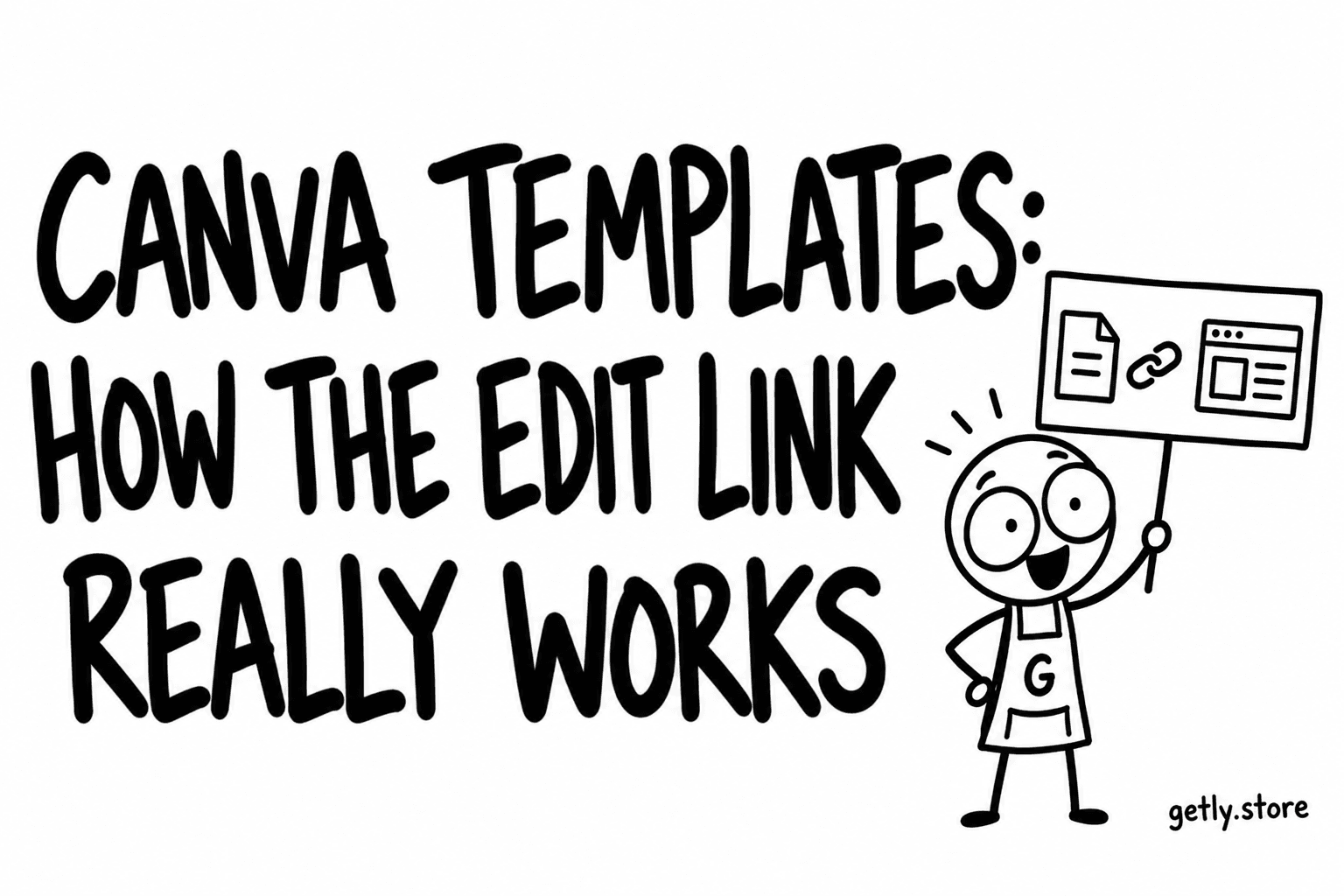
When you buy a Canva template, you usually do not download the template. You download a file, often a one-page PDF, with a link inside it, and the link opens the design in Canva. What that link does decides what you have bought: your own editable copy, a shared file that other buyers also edit, or a picture you can only look at.
We opened the files delivered by the Canva Templates shelf on Getly, measured 26 September 2026: 75 active listings, a median paid price of $5.00, with the tenth percentile at $1.87 and the ninetieth at $14.10. Here is what the three kinds of delivery are, how to tell them apart, and what we found.
Three things a Canva listing can deliver
- A template link. Canva's help page (checked 26 September 2026) describes it: the designer opens the design, selects Share, then Template link, then Create template link. Anyone with the link can view the design and use it as a template, which means you start your own design from it. Canva says creating a template link is available on its paid plans (Pro, Teams, Enterprise) and on Canva for Education and for Nonprofits. The designer can delete a template link at any time, which makes the URL inactive.
- A shared design link. The ordinary Share link, set to "can edit", "can comment" or "can view". Canva's help page notes that when edit access is given to anyone with the link, people can make changes without signing up or logging in, and they appear in the design as guests. In other words, you are working inside the seller's design, not a copy of it.
- A flat file. A PDF, PNG, JPG, PPTX or video exported from Canva. You can print or use it as it is, but it is not a Canva template: there is nothing to open in Canva.
What we found in the files
On this shelf, 54.67% of listings deliver at least one PDF, and 46.67% deliver PDFs only. 34.67% deliver images (PNG or JPG), and 29.33% deliver images with no PDF at all. PowerPoint files and videos appear in 4.00% of listings each.
We then read every delivered PDF for clickable links. 16.00% of the shelf delivers a PDF containing a Canva link. Those links split evenly:
| Kind of link inside the PDF | Share of listings with a Canva link |
|---|---|
A link ending in /edit, generated by Canva's Share button | 50% |
A /view link from Canva's publish flow, the shape template links take | 50% |
Several of them are short canva.link addresses; we followed each one to see where it lands. The rest of the shelf, most of it, delivers no Canva link at all: flat exports, which you can use but cannot edit in Canva.
That matters because descriptions rarely say which one you get. Only 6.67% of descriptions mention a template link or a canva.com address, and 10.67% say anything about which Canva account or plan you need.
Why an edit link is a problem for you
An edit link opens the seller's own design. If the seller shared it with edit access for anyone with the link, every buyer lands in the same file. Someone before you may have replaced the text, deleted a page or changed the colours, and whatever you type is visible to the next buyer too. If the seller shared it with restricted access, you may only be able to request access and wait.
Canva's template link exists precisely to avoid this: each person who opens it starts their own design. Since Canva reserves template links for its paid plans, a seller on a free plan may not be able to create one, which is one plausible reason edit links appear. It is not something a buyer should have to work around.
What to do if you receive an edit link: before you change anything, make your own copy in Canva and work on that. Then message the seller and ask for a proper template link.
Pro elements and what the seller is allowed to sell
Canva's rules for selling designs made in Canva (checked 26 September 2026) draw a clear line. A template that uses Canva's Pro content may only be sold as a Canva template link, never as a PDF or other file, flattened or not. A template made only with free content may be sold as a PDF or as a template link. And a template must be something meant for the end user to edit; a finished design is not a template.
For a buyer this means two things. If a listing sells a flat PDF of a design that looks full of premium stock, ask about it. And if the template relies on Pro elements, you may need your own Canva plan to use them without watermarks; the listing should tell you, and if it does not, ask before you buy.
Before you buy: a checklist
- Does the description say "template link", or only "Canva template"? The first is specific; the second can mean any of the three deliveries.
- Does it say which Canva plan you need, free or Pro?
- Does it say what else is included: page count, sizes, fonts?
- Is a licence set? On this shelf 80.00% of listings have none, and 13.33% are commercial. If you will use the result for a client or a product, you need to know.
- After purchase, open the link right away while you are signed in to your own Canva account, and check you are working on a copy.
If the link does not work
A template link can be deleted by the person who made it, and a shared design can be made private. If your link stops working, message the seller through the platform first and ask for a fresh link. On Getly, a template link is an accepted way to deliver a Canva template, so a seller who delivers one is expected to keep it working. If you are selling Canva templates yourself, the fair version is simple: create a template link, put it in a PDF with a line on which plan it needs, and say so in the description. You can open a shop in a few minutes, and rates are on the pricing page.