 Getly
Getly
By the end of this guide, you can write translation prompts that preserve meaning, handle idioms with judgment, and match the tone of a product page, email, or support reply. You will also know when one polished version serves the job and when two variants give your reader a better choice.
1. Define the translation job before you name the language
A translation prompt needs more than a source sentence and a target language. Tell the translator who will read the text, where the text will appear, and what the text needs to achieve. A product description may need persuasive, natural language. A setup instruction may need short, literal wording. A customer reply may need warmth and restraint.
Start with these details:
- Source language and target language: State both, even if the source seems obvious.
- Audience: Name the buyer, creator, subscriber, student, or support customer.
- Format: Specify a headline, button, product page, email, caption, instruction, or chat reply.
- Purpose: Explain whether the copy should inform, persuade, reassure, invite action, or preserve a brand voice.
- Constraints: Add character limits, required terms, pronouns, spelling conventions, and formatting rules.
Use a prompt such as: “Translate this product description from English into Spanish for independent designers buying digital templates. Keep the copy warm and concise. Preserve the product name, file types, and three bullet points. Use Latin American Spanish and avoid slang.”
This context prevents a common error: a grammatically correct translation that sounds wrong for its setting. A translator can choose “download,” “get access,” or “receive the files,” but the best choice depends on the transaction and the reader.
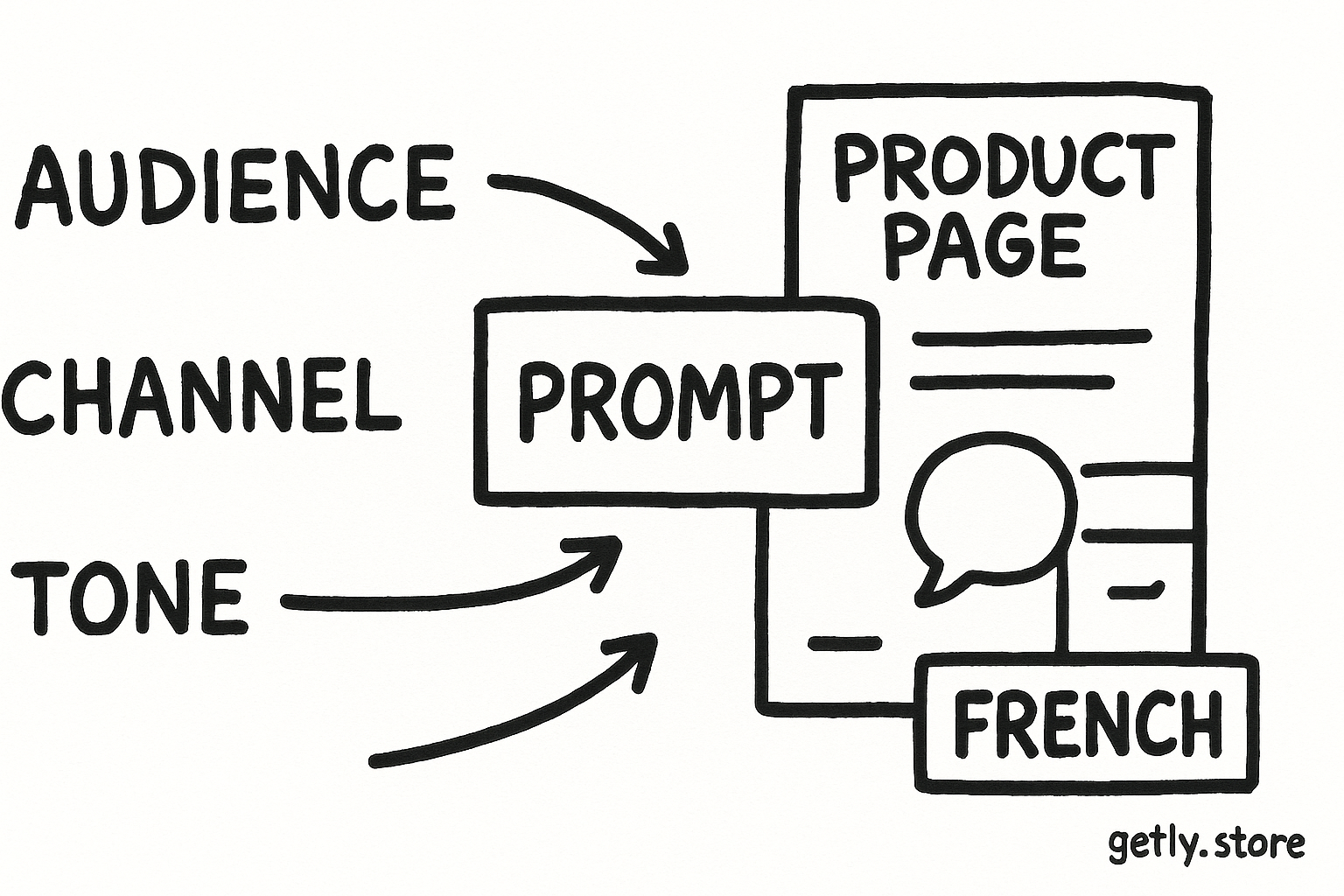
Name the audience
Tell the translator who will read the text and what knowledge they already have.
Name the channel
Identify the page, message, caption, email, or interface element that will hold the translation.
Set the register
Choose a tone such as formal, friendly, direct, playful, technical, or premium.
Add review rules
Ask for preserved names, checked numbers, natural idioms, and a short note about difficult choices.
2. Give idioms a job, not a word-for-word order
Idioms carry an intended effect rather than a literal instruction. “Break the ice” usually means creating a relaxed opening, not breaking frozen water. “On the same page” often means sharing an understanding. A literal translation can preserve the words while losing the joke, warmth, urgency, or cultural reference.
Ask the translator to identify an idiom, explain its intended meaning in a few words, and choose a natural equivalent for the target audience. You can also set a priority:
- Preserve the effect: Use this priority for marketing, social posts, and conversational copy. The target text should create a similar reaction.
- Preserve the image: Use this priority when the metaphor supports a campaign, title, or creative concept that matters to the brand.
- Explain the reference: Use this priority when a cultural phrase carries essential information or appears in educational material.
- Stay literal: Use this priority for safety instructions, legal language, technical steps, and labels where precision outranks personality.
Try this prompt: “Translate the sentence into French for a friendly onboarding email. The phrase ‘get the ball rolling’ means ‘start the project.’ Use a natural French expression with the same encouraging effect. Do not translate the sports image unless French readers use it naturally.”
For a slogan, request a short rationale after the translation. The rationale should name the source idiom, its intended meaning, and the strategy used. Ask for the rationale outside the final copy so you can remove it before publishing.
Do
- Explain the idiom’s intended meaning.
- Ask for a target-language equivalent that fits the audience.
- Request a literal gloss when the wording affects a campaign concept.
Don't
- Tell the translator to preserve every word.
- Assume a familiar English metaphor works in another culture.
- Publish an idiom without checking its social tone.
3. Control register with examples and boundaries
Register describes the social distance and level of formality in language. A formal register can suit a licensing notice. A friendly register can suit a welcome email. A premium brand may want polished language without sounding stiff. “Please purchase the item” and “Grab your copy” can describe the same action, but they create different expectations.
Give the translator a register label, then define that label with behaviors. “Friendly” should mean short sentences, direct address, and a warm greeting. “Professional” might mean clear wording, no slang, and respectful forms of address. “Playful” might allow a light metaphor while excluding sarcasm.
Include one or two approved examples from the same brand. Examples help the translator match sentence length, punctuation, pronouns, and vocabulary. Mark each example as a model for tone, not text to copy. If you have a glossary, list terms that must stay consistent, such as a product name, subscription tier, file format, or button label.
| Register | Useful instruction | Watch for |
|---|---|---|
| Formal | Use respectful wording, complete sentences, and no contractions. | Stiff phrasing that obscures the action. |
| Friendly | Use direct address, natural contractions where appropriate, and a warm tone. | Slang that narrows the audience. |
| Premium | Use precise, composed language with restrained enthusiasm. | Exaggerated claims and ornate wording. |
| Technical | Keep terminology exact and explain specialist terms only when the audience needs it. | Creative synonyms that change the meaning. |
Tell the translator which regional variety to use when the target language has meaningful differences. Name European Spanish or Latin American Spanish, Brazilian Portuguese or European Portuguese, and the spelling convention for English. Add the audience’s location if currency, dates, measurements, or forms of address matter.
4. Ask for two variants when the choice affects the outcome
Two variants help when translators face a legitimate trade-off. A natural idiom may sound less literal. A short button label may lose a nuance. A slogan may need one version for clarity and another for personality. Two options can expose that choice without forcing you to compare a long list of minor rewrites.
Ask for two variants in these situations:
- Meaning versus effect: Request a faithful version and a natural, audience-first version when an idiom or metaphor drives the sentence.
- Formal versus conversational: Use two registers when the same copy may serve a professional page and a social channel.
- Length versus nuance: Request a compact version and a fuller version for buttons, headings, ads, or mobile layouts.
- Regional usage: Ask for two regional variants when buyers in different markets will see the same message.
- High-stakes wording: Request a plain-language option beside a precise technical option for instructions or policy copy, then have a qualified reviewer check the final text.
Skip the second variant when the text has one clear function and one clear audience. A receipt label, file type, or step in a technical procedure usually benefits from one consistent translation. Extra options can create inconsistent terminology and slow your review.
Limit the request to two purposeful versions. Label each version by its decision, not by vague names such as “Option A” and “Option B.” For example: “Version 1, close to the source meaning. Version 2, natural marketing copy for Canadian French.” Ask the translator to recommend one and give a one-sentence reason.
Use this reusable prompt:
Translate the text below from [source language] into [target language] for [audience] on [channel]. The goal is to [purpose]. Use a [register] tone. Treat idioms by preserving their intended effect, not their word order. Keep [names, terms, numbers, and formatting] unchanged. Follow [regional variety] conventions. Provide two versions only if a meaningful trade-off appears: Version 1 should prioritize [priority], and Version 2 should prioritize [priority]. Label the trade-off in one sentence and recommend the stronger version. Source text: [paste text]
5. Review meaning, voice, and details in separate passes
Reviewing a translation in one sweep makes small errors easy to miss. Use three passes with different questions. First, compare meaning. Check names, dates, prices, quantities, links, negations, and calls to action. A fluent sentence can still reverse “do not share” or change a delivery period.
Next, read the target text as a buyer in the intended market. Check whether the idiom sounds familiar, whether the register fits the channel, and whether the sentence creates the intended emotion. Read headlines and buttons on their own because surrounding context may hide awkward wording.
Finally, check consistency and presentation. Confirm that the glossary terms match, the formatting survived, the product name stays intact, and the translation fits its character limit. Ask a fluent reviewer to flag phrases that sound translated rather than written for the target audience. A reviewer should explain the issue and suggest a replacement, not rewrite the entire piece without tracking changes.
For two variants, compare them against the stated goal. Choose the version that fits the audience and channel, not the version that resembles the source most closely. Keep the alternative in your notes if it could suit another campaign or market.
6. Common mistakes that weaken translation prompts
- “Translate naturally” with no audience: Natural language changes with age, region, profession, and channel. Name those factors.
- Literal translation as the only rule: Literal wording can damage idioms, jokes, and calls to action. State which parts need semantic precision and which parts need a matching effect.
- “Make it professional” without boundaries: Define professional through sentence length, vocabulary, pronouns, and examples.
- Too many alternatives: Five or ten versions make selection harder. Request two options only when a real decision separates them.
- Ignoring layout: A translation may expand or contract. Include the available space for buttons, titles, captions, and product cards.
- Skipping a final human read: A fluent output can still miss local conventions or brand context. Use a qualified reviewer for public-facing copy and specialist material.
A strong prompt gives the translator a clear job, a defined audience, and a reason for each constraint. It also leaves room for judgment where idioms and register demand it. That combination produces copy you can review, compare, and publish with fewer surprises.
FAQs
Should I ask for a literal translation first?
Ask for a literal gloss when you need to inspect an idiom, slogan, legal phrase, or technical term. Use the polished translation as the publishable version unless the context requires exact structural correspondence.
How should I prompt for an idiom that has no direct equivalent?
State the idiom’s intended meaning and emotional effect, then ask for a natural target-language expression. Request a short explanation of the choice and a literal gloss outside the final copy.
How many translation variants should I request?
Request two variants when a meaningful trade-off affects tone, length, regional usage, or idiom handling. Ask for one version when the text has one audience, one channel, and one clear purpose.
What register should a digital product page use?
Choose a register that matches the product and buyer. Friendly, direct wording often suits creator products, while technical or premium products may need more precise and restrained language. Add examples so the translator can match your intended tone.
Frequently asked questions
Should I ask for a literal translation first?
Ask for a literal gloss when you need to inspect an idiom, slogan, legal phrase, or technical term. Use the polished translation as the publishable version unless the context requires exact structural correspondence.
How should I prompt for an idiom that has no direct equivalent?
State the idiom’s intended meaning and emotional effect, then ask for a natural target-language expression. Request a short explanation of the choice and a literal gloss outside the final copy.
How many translation variants should I request?
Request two variants when a meaningful trade-off affects tone, length, regional usage, or idiom handling. Ask for one version when the text has one audience, one channel, and one clear purpose.
What register should a digital product page use?
Choose a register that matches the product and buyer. Friendly, direct wording often suits creator products, while technical or premium products may need more precise and restrained language. Add examples so the translator can match your intended tone.