 Getly
Getly
By the end of this guide, you can write prompts that specify a track’s genre, tempo, emotional tone, instrumentation, and arrangement. You’ll also know how to revise a vague result without changing the parts that already work.
Strong prompts give the music tool a clear brief. They name the musical identity first, then add tempo, mood, structure, sound palette, vocal direction, and production detail.
1. Start with the track’s musical identity
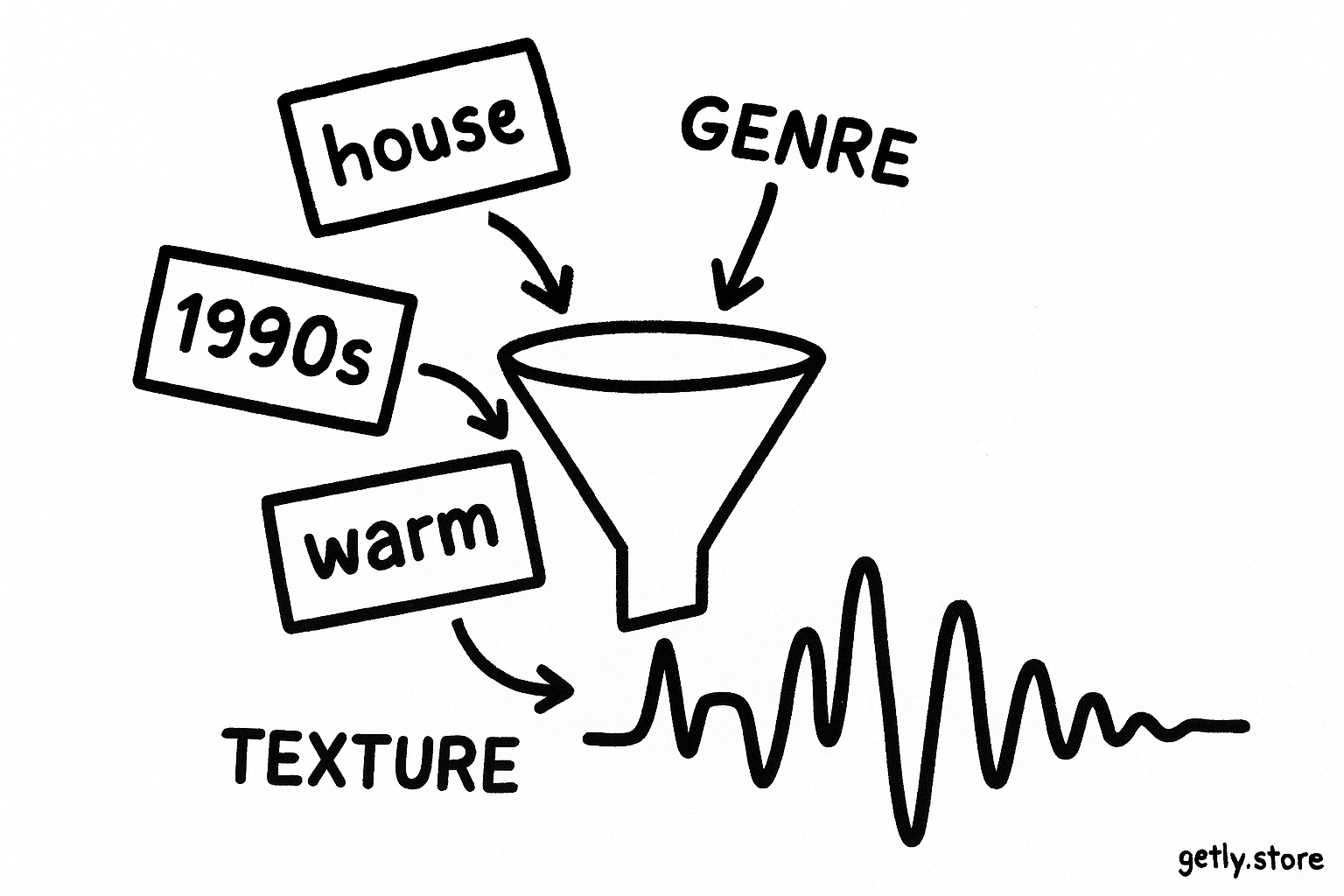
Begin with the broad genre, then narrow it with a period, scene, or subgenre. “Electronic” gives a tool a large search area. “Melodic techno with a late-night club feel” gives it a tighter target.
Use genre terms that describe a recognizable musical language:
- Electronic: ambient techno, melodic techno, drum and bass, future garage, synthwave, house, electro-pop.
- Hip-hop: boom bap, conscious rap, trap, lo-fi hip-hop, alternative hip-hop, jazz rap.
- Rock: garage rock, post-punk, shoegaze, indie rock, pop punk, progressive rock.
- Dance and pop: disco, dance-pop, alt-pop, synth-pop, R&B, funk, neo-soul.
- Acoustic and roots: folk, Americana, blues, bluegrass, acoustic singer-songwriter.
- Film and game scoring: cinematic orchestral, dark fantasy score, minimalist piano, tension underscore.
Add one or two modifiers after the genre. “Warm neo-soul with gospel harmony” works better than a string of six loosely related genres. Each added term should narrow the sound instead of pulling it toward a different audience.
Descriptors such as analog, organic, glossy, raw, minimal, expansive, and lo-fi describe production character. Use them alongside a genre rather than as a replacement for one.
Do
- Pair a broad genre with one specific subgenre.
- Use a production adjective that matches the intended setting.
- Choose a reference era, such as “early-2000s pop-rock,” when the era shapes the sound.
Don't
- Stack unrelated genres into one sentence.
- Use “good,” “catchy,” or “professional” as your main musical direction.
- Name an artist when a genre, era, and sound description can express the idea more clearly.
2. Set tempo with BPM and rhythmic vocabulary
Tempo gives the tool a measurable pace. Write a BPM range when you want flexibility, or choose one number when the track must fit a video edit, dance routine, or DJ set.
- 60 to 80 BPM: slow ballads, downtempo soul, spacious piano, intimate acoustic songs.
- 85 to 105 BPM: boom bap, chill-hop, midtempo R&B, relaxed indie pop.
- 110 to 128 BPM: house, disco, dance-pop, upbeat funk, many club tracks.
- 130 to 150 BPM: drum and bass, energetic pop, punk, fast electronic music.
Genre changes the meaning of a number. A 120 BPM four-on-the-floor house track feels different from a 120 BPM half-time trap beat. Add a rhythmic phrase when the BPM alone leaves room for confusion.
Useful rhythm terms include four-on-the-floor kick, syncopated bass, half-time groove, broken beat, swung hi-hats, straight eighth notes, shuffling percussion, and polyrhythmic drums. Mention the groove before you describe small details such as fills or ghost notes.
Use meter when it matters. “4/4 at 122 BPM with a steady four-on-the-floor kick” gives a dance tool a clearer rhythmic frame. “6/8 at 72 BPM with a rolling acoustic pulse” points toward a different kind of movement.
3. Describe mood through emotion, energy, and setting
Mood prompts work best when you combine three layers: the emotion, the energy level, and the scene. “Sad” tells the tool too little. “Melancholic, low-energy, rainy-night atmosphere with a sense of quiet acceptance” gives it a more usable direction.
Emotion words shape the feeling:
- Positive: joyful, triumphant, playful, hopeful, affectionate, carefree.
- Reflective: wistful, nostalgic, contemplative, tender, bittersweet, introspective.
- Dark: ominous, tense, eerie, brooding, sinister, claustrophobic.
- Energetic: urgent, euphoric, aggressive, restless, explosive, defiant.
Energy words shape movement and intensity. A “restrained” track may leave space around the vocal, while an “explosive” track may build toward dense drums, wider harmony, and a larger chorus. Setting words add visual context: neon city at midnight, dusty roadside bar, sunlit kitchen, or ancient temple at dusk.
Use one main mood and one supporting mood. “Hopeful but wistful” creates tension that a tool can express. “Joyful, terrifying, romantic, angry, peaceful, and mysterious” gives the arrangement too many competing jobs.
4. Specify instruments and sonic texture
Instrument names tell the tool what should carry the musical idea. Texture words tell it how those instruments should feel in the mix.
Give each important instrument a role. Write “muted electric guitar playing sparse offbeat chords” instead of “electric guitar.” Write “sub bass following the kick with short, rounded notes” instead of “bass.” Roles produce stronger results because they connect an instrument to rhythm, harmony, or arrangement.
- Drums: tight, dusty, punchy, brushed, gated, roomy, clipped, live-room.
- Bass: sub-heavy, rubbery, sustained, plucked, distorted, melodic, restrained.
- Keys and synths: glassy, detuned, warm, bell-like, granular, arpeggiated, pad-like.
- Strings and guitars: bowed, pizzicato, fingerpicked, tremolo, jangly, tremolo-picked, overdriven.
- Vocals: close-mic, breathy, conversational, powerful, stacked, harmonized, dry, reverberant.
Limit your main palette to three or four featured elements. Add background details after you establish the core. A prompt that names kick, snare, bass, piano, guitar, strings, brass, choir, marimba, flute, and several synthesizers may produce a crowded result with no clear focal point.
For vocal tracks, specify delivery and arrangement separately. “Low, intimate verse vocal with a wide three-part harmony in the chorus” gives the tool two contrasting instructions that support the song form.
5. Map the structure before you request detail
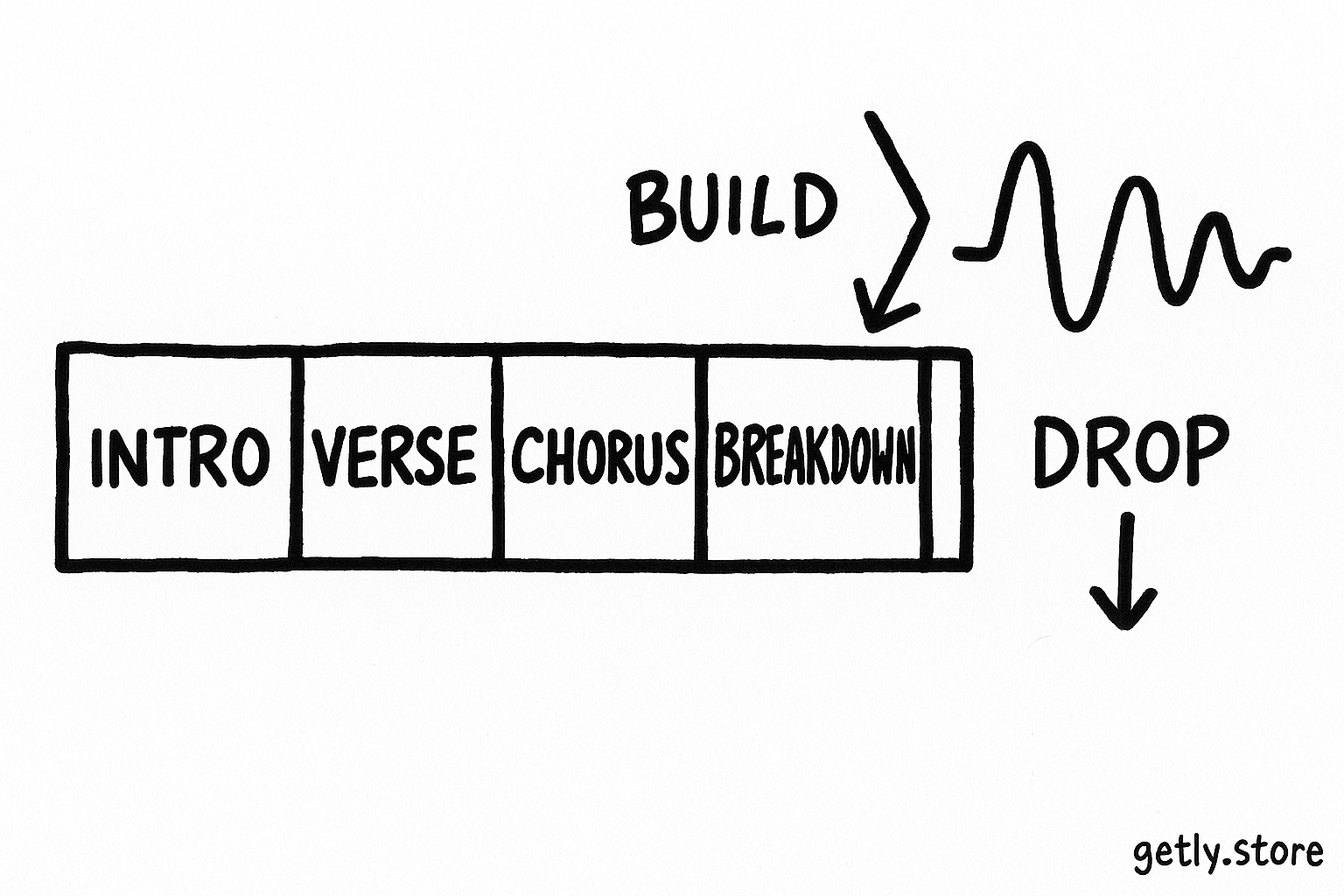
Structure vocabulary helps the tool distribute ideas across time. Name sections in order and describe the change each section should make.
- Intro: establish the chord progression, texture, or hook with limited instrumentation.
- Verse: keep the arrangement lighter while the vocal or main melody carries information.
- Pre-chorus: increase tension through a rising melody, added percussion, or longer chords.
- Chorus or drop: present the strongest hook with fuller drums, bass, harmony, or vocal layers.
- Bridge or breakdown: change the harmony, rhythm, instrumentation, or perspective.
- Outro: resolve the hook, reduce the arrangement, or end with a deliberate stop.
Use approximate durations when the tool accepts them. “Eight-bar intro, sixteen-bar verse, eight-bar pre-chorus, sixteen-bar chorus” gives the arrangement a practical frame. You can also use percentages: “short intro, long first verse, chorus at 25 percent, instrumental breakdown near the final third.”
Describe transitions with verbs and musical actions. Try strip back, build gradually, add percussion, open the filter, double the vocal, drop to bass and drums, modulate upward, or end with a hard stop.
Name the identity
Choose the genre, subgenre, era, and production character.
Set the pulse
Add BPM, meter, and one phrase that describes the groove.
Shape the feeling
Combine one main emotion with an energy level and a setting.
Assign the palette
Give three or four instruments clear musical roles.
Map the sections
List the form and describe how each transition changes the track.
6. Assemble and revise a complete prompt
Put the highest-priority information first. A reliable order follows the way a producer writes a brief:
Format + genre + tempo + mood + instruments + vocal direction + structure + mix character.
For example:
“Create a 3-minute alt-pop song at 112 BPM in 4/4. Use a warm, nostalgic mood with a hopeful lift in the chorus. Build the track around muted electric guitar, rounded bass, crisp live drums, and a soft analog synth pad. Keep the verses intimate with a close, conversational vocal. Add layered harmonies and wider drums in the chorus. Use an eight-bar intro, two verses, two choruses, a short bridge with reduced drums, and a final chorus with an added countermelody. Keep the production warm, clear, and moderately spacious.”
That prompt gives the tool a target without dictating every note. Use a prompt library such as VELUMIZA AI Prompt Library when you want more examples of structured creative briefs, then adapt the language to music.
Revise one category at a time. If the rhythm works but the mood misses, keep the BPM and groove while changing the emotional language. If the chorus lacks lift, request a stronger contrast through added harmony, wider instrumentation, a higher vocal register, or a denser drum pattern.
Save useful phrases in a small prompt bank. Group them under headings such as tempo, drums, vocals, transitions, and mix texture. Your bank will become more valuable when you record the result each phrase produced, rather than collecting adjectives without context.
Common mistakes that weaken music prompts
- Using only genre labels: Add BPM, mood, instruments, and form so the tool can make decisions across the whole track.
- Requesting too many styles: Pick one central genre and use a second style as a subtle influence.
- Confusing mood with story: “A breakup at a train station” supplies a scene. Add “wistful, restrained, 78 BPM” to describe the music.
- Writing production jargon without a musical role: Explain what the sound should do. “Wide reverb on the chorus vocal” gives clearer direction than “cinematic mix.”
- Changing every instruction after one weak result: Keep the successful elements and alter the single category that caused the problem.
- Ignoring duration and form: Name approximate section lengths when the track must support a video, podcast, game scene, or performance.
Prompt template you can reuse
Copy this structure and replace the bracketed terms:
“Create a [duration] [song/instrumental/score] in [genre and subgenre] at [BPM] BPM in [meter]. Set the mood to [main emotion] with [energy level] energy and a [scene or setting] atmosphere. Feature [instrument 1] playing [role], [instrument 2] providing [role], and [instrument 3] adding [texture]. Use [vocal type and delivery] if the track includes vocals. Arrange it as [intro], [verse or theme], [chorus or main section], [bridge or breakdown], and [outro]. Make the transition into the main section [build/drop/change]. Keep the production [two or three texture terms].”
Test the template with one simple brief first. After you hear the result, replace broad terms with specific instructions only where the music needs correction.
Frequently asked questions
How many genre terms should a music prompt include?
Use one main genre, one specific subgenre, and one or two production or era descriptors. This combination gives the tool a focused identity without forcing unrelated styles together.
Should I write an exact BPM or a tempo range?
Write an exact BPM when the track must match a video, dance routine, or DJ set. Use a narrow range when you want the tool to explore small tempo differences.
What mood words work best in AI music prompts?
Combine one emotion, one energy level, and one setting. For example, use “wistful, restrained, rainy-night atmosphere” instead of the single word “sad.”
How do I prompt a stronger chorus?
Describe the contrast you want. Request a fuller drum pattern, wider harmony, layered vocals, a higher melody, added bass movement, or a denser instrument arrangement in the chorus.