 Getly
Getly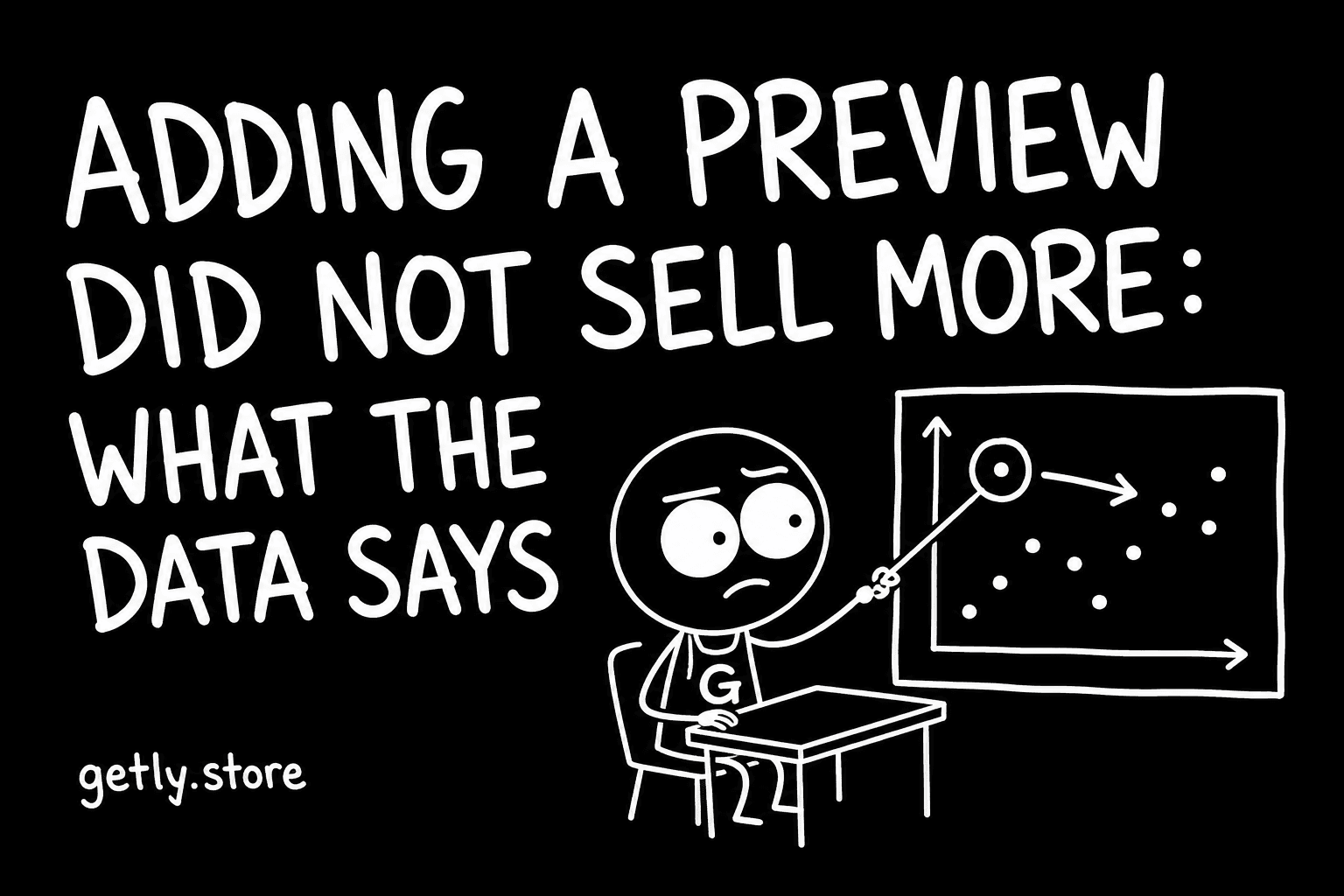
Every piece of advice about selling digital goods says the same thing: let people see what they are buying. It is obviously right, and we had built exactly that — an optional preview asset a seller can attach to a listing, shown on the product page.
Then we measured it, across every active listing on 3 September 2026:
- Listings with a preview asset: 0.21% of views became a paid sale.
- Listings without one: 0.25%.
The listings with a preview converted slightly worse. Not dramatically, not significantly enough to claim previews hurt — but nowhere near the improvement the advice promises, and in the wrong direction for a feature built to help.
The obvious conclusion is the wrong one
It would be easy to read that table as "previews do not matter" and stop building them. That reading throws away the finding.
What was measured is not "does a buyer benefit from seeing the goods". It is "does attaching a file to a field, which renders as an extra item on a page, change behaviour". Those are different questions, and only the second one was ever tested.
Roughly one listing in eight carries a preview asset. On the ones that do, it appears as one more thing in a column of things — under the gallery, near the file list, with no promise about what it contains. A buyer scanning that page has no reason to expect that this particular item answers their actual question, which is almost never "may I see a sample" and almost always "is this any good, and is it what I think it is".
The mechanism is the feature
This is the second time the same lesson has arrived. A while ago we found that the product wizard's publish button was refusing clicks with the reason printed in small grey text off to one side. Sellers clicked it hundreds of times and nothing happened — the mechanism existed, the communication did not, and the fix was not a new mechanism.
So the current preview work is being judged differently. Rather than another optional field, a PDF listing now gets a watermarked excerpt built from the file itself: a labelled block on the product page saying how many pages of how many it will show, opening in place, with real selectable text. No seller has to remember to attach anything, and the buyer is told what they are about to get before they click.
Whether that moves conversion is an open question, and it will be measured the same way — against the listings that do not have it, over the same window, without deciding in advance what the answer should be.
What to take from this if you sell here
Attaching a preview file is not the lever. The lever is answering, above the fold and in words, the question a buyer is actually holding: what is inside, how much of it, in what format, and what it is not.
The most common cause of a refund on a digital product is not a bad product. It is a product that was fine and was not what the buyer thought it was. A sentence saying what your file does not include costs you nothing and is measurably more useful than a sample nobody opens.
And the general form
A feature that exists and is not noticed produces exactly the same data as a feature that does not work. The two are indistinguishable in a conversion table, and they need completely different fixes. Before concluding that an idea failed, it is worth checking whether anyone ever saw it.