 Getly
Getly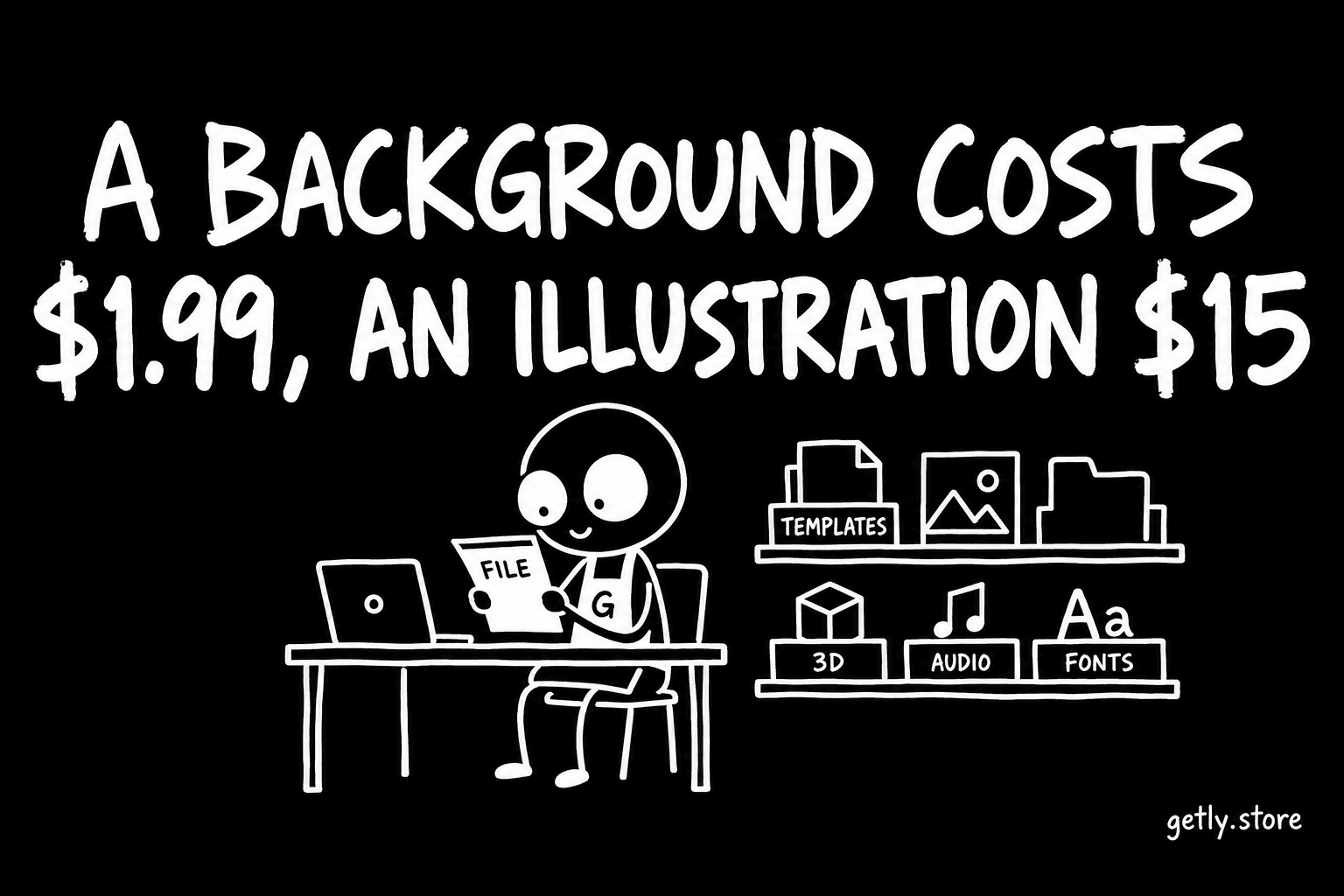
Both are pictures. Both usually arrive as a PNG or a JPG, sometimes in a ZIP. A buyer can drop either one into a slide, a video or a web page. And yet on Getly the two shelves price them as if they were different kinds of goods.
On 26 September 2026 we compared the Backgrounds & Wallpapers shelf with the Illustrations shelf. Here is what each looks like:
| Backgrounds & Wallpapers | Illustrations | |
|---|---|---|
| Active listings | 280 | 124 |
| Median paid price | $1.99 | $15.00 |
| Middle half of prices (25th to 75th percentile) | $1.99 to $3.00 | $5.00 to $50.55 |
| Shops per listing | about one shop for every four listings | about one shop for every two listings |
| Average images per listing | 2.1 | 2.0 |
| Listings with a video | 0.7% | 0% |
The median illustration asks more than seven times the median background. More striking is the spread. Half of all backgrounds sit between $1.99 and $3.00, a band barely a dollar wide. Half of all illustrations sit between $5.00 and $50.55, where the top of the band is about ten times its bottom.
Two different kinds of shelf
Backgrounds behave like a commodity shelf. There are many listings for each shop, prices cluster tightly, and the listings look alike: a couple of images each, almost never a video. When a buyer can find a dozen similar gradients, textures or scenic wallpapers side by side, the price settles where most sellers put it, and most sellers put it very low.
Illustrations behave like a work shelf. There are fewer listings per shop, and prices are spread across a wide range because the products are not interchangeable. An illustration is recognisably someone's hand. A set of character illustrations in one style cannot be swapped for another set in a different style, so a buyer who wants that style compares it with little else.
These are correlations across a shelf, not rules. Nothing here proves that a background would sell at $15 if you drew it by hand, or that an illustration would sell less at $1.99. What the numbers do show is where each shelf's price sits today, and how much room a seller has to stand apart from it.
What the buyer is paying for
It helps to ask what problem each product solves.
- A background fills space. It sits behind the thing that matters: a title slide, a phone screen, a video overlay. Buyers often want "something like this" and are happy with any of several options, which pushes the price toward the floor.
- An illustration is often the thing that matters. It carries a book cover, a brand's character, a sticker, a page of a children's story. The buyer wants that particular image, and their project depends on it.
That difference is the one lever a background seller can pull. A background that is part of a system (matched to a set of slides, sized for specific devices, delivered in several colourways, with a licence that covers the use the buyer has in mind) is no longer a filler. It is closer to a tool, and tools are compared on what they do, not only on price.
Where each seller can stand out
If you sell backgrounds, the shelf is crowded and cheap, and the listings look alike. The easiest way to be different is to show more and say more than the median listing does:
- Show the background in use, not only on its own: behind a slide title, on a phone mockup, in a video frame.
- State the resolution and the aspect ratios included, so a buyer does not have to guess whether it fits a 16:9 screen or a phone.
- Consider a set rather than a single image. A themed pack of matching backgrounds answers a bigger problem than one picture.
- Video is almost absent on this shelf (0.7% of listings). A short clip of the background moving behind content is rare enough to be noticed.
If you sell illustrations, the price range is wide, which means buyers expect to see why one set asks $5 and another $50:
- Show the whole set, not only the best piece. Buyers pricing a set want to see every image they get.
- Say what the files are: vector or raster, pixel size, transparent background or not, layered source or flat export.
- State the licence plainly, especially whether commercial use and merchandise are allowed. On an illustration that is often the deciding question.
- No illustration listing we counted has a video. A short time-lapse or a flip through the set would be the first on the shelf.
Check your own listing against its shelf
You can run the same comparison for your own products. Open your category page and look at the first screen of listings. Note roughly where their prices sit and how many images they show. Then compare your listing:
- Is your price inside the shelf's usual band or outside it? If outside, does your listing explain why?
- Do you show more images than the shelf average, or fewer?
- Does your description say the resolution, the formats and the licence?
A price well above the shelf is fine when the listing shows what earns it. A price at the floor with nothing to set it apart is simply one more option in a crowded row.
What to do today
Pick one listing on an image shelf and add the one thing its neighbours lack: a mockup that shows it in use, the full set laid out in one image, or a line that states size, format and licence. Then look at your price against the shelf band above and decide, deliberately, whether you want to sit inside it or outside it.