 Getly
Getly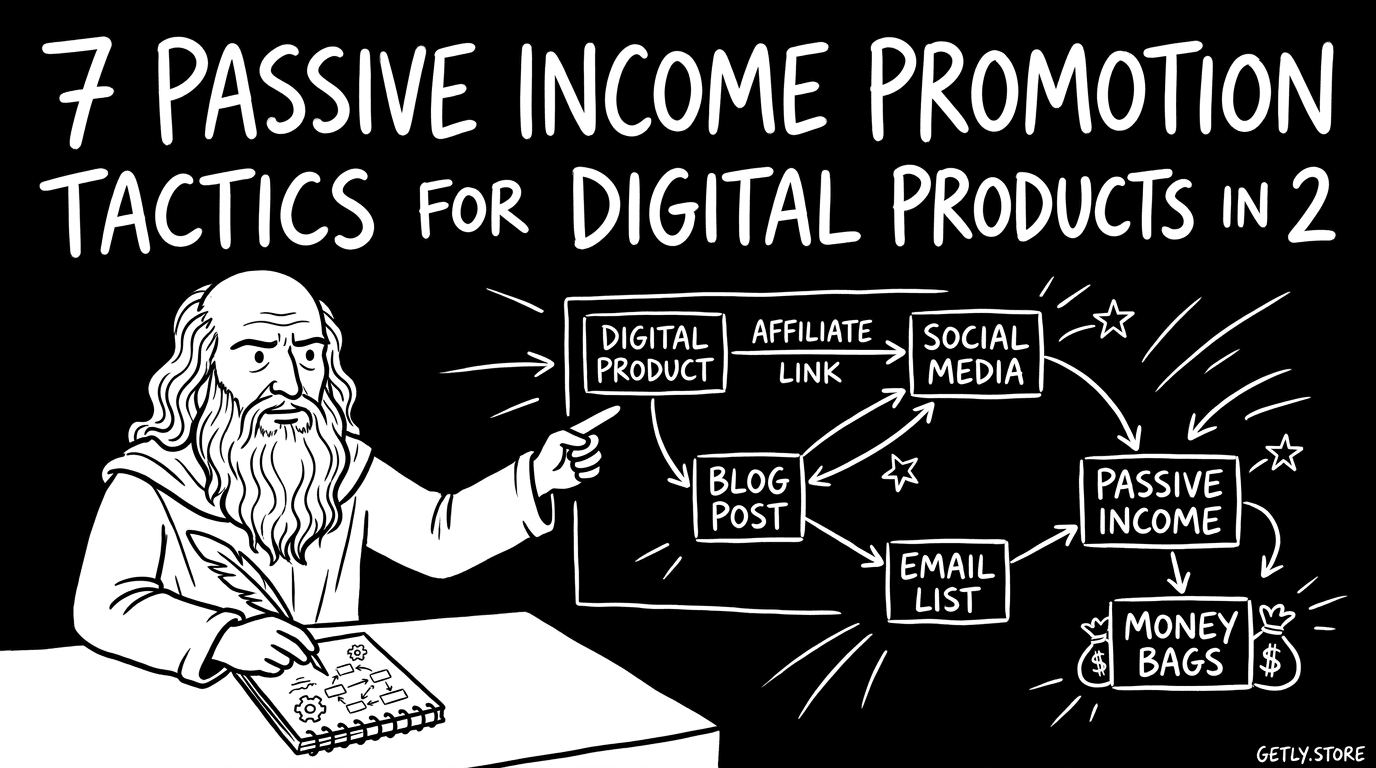
Passive income from digital products does not come from uploading files and hoping for the best. In 2026, you earn when you pair smart affiliate marketing for creators with distribution that keeps working after you sleep. The goal: consistent clicks, consistent conversions, and a promotion system you can repeat.
If you sell templates, presets, video assets, AI tools, or other digital goods, your promotion stack should blend content, partnerships, and conversion hygiene. Below are seven tactics that map directly to how digital product affiliate programs actually perform over time.
- Build a “promote once, profit repeatedly” content system with affiliate links and evergreen landing pages.
- Use product-led affiliate marketing: show outputs first, explain licensing next, answer objections fast.
- Create bundles and multi-license tiers to raise average order value without extra production.
- Run visual and search-friendly discovery using clear keywords and sample previews to improve conversions.
- Track affiliate attribution windows and optimize your cadence so you get credit for delayed purchases.
1) What is affiliate marketing for creators and why it scales
Affiliate marketing for creators means you earn a commission when someone buys your recommended digital product through your affiliate link. The affiliate handles distribution, while the seller handles fulfillment and delivery. This setup scales because you multiply reach without multiplying your workload.
For passive income digital products, affiliates also solve the “distribution gap.” Your audience already trusts the affiliate’s taste, workflow, and recommendations. When you structure offers around outcomes (not features), affiliates can convert people who want a result now.
Pick affiliate-ready products with clear buyer intent
Affiliates convert best when the product has obvious use cases and a clear “before and after.” For example, creators shopping for editing speed, motion presets, or video assets understand value instantly. A few strong examples of digital product promotion angles:
- Motion workflow acceleration: 99+ Alight Motion Preset XML
- Text-to-video creation without face-cam: Product Title AI Text Animation Mastery: Create Viral Videos Without Showing Your Face
- Tooling that fixes a production pipeline: 80% seller retention rewards affiliates and creators, so promote assets that save time or prevent rework
Make the commission math easy to explain
Digital product affiliate programs work when affiliates can explain the offer in one sentence. You want language like “Get the presets, apply them, and publish faster,” or “Use this generator to write product descriptions at scale.” When the message is simple, affiliates spend less time negotiating trust and more time sharing.
Pro tip: Package your affiliate materials like an “explain it in 30 seconds” kit: 1 sentence benefit statement, 1 demo clip, and 3 objection answers (licensing, refunds, and what the buyer receives).
2) How to choose creator monetization strategies for stable passive income
Creator monetization strategies that last combine two loops: a promotion loop (traffic) and an conversion loop (turn traffic into purchases). Passive income digital products fail when creators focus only on traffic or only on the product page.
In 2026, the best systems treat promotion like a funnel. You send people from multiple surfaces into a single buying path, then you keep that path updated with new examples so conversions rise over time.
Use a “content-to-asset” funnel
Match each piece of content to a specific purchase trigger. Here are content-to-asset pairings that work well for creators:
- Post outcomes, not tutorials. Show the final animation, preset result, or texture mapping.
- Link to the exact asset that produces that outcome.
- Teach one workflow step that creates curiosity, then provide the missing shortcut in the asset.
Promote problem-solvers, not generic tools
People buy when they feel a pain point. If your content reduces uncertainty (what they will get, how it fits their workflow, and whether they can use it), you remove friction. That is why creator monetization often favors workflow tools like converters and generators.
- Pipeline bridging: Unreal to Unity Material Converter
- Scaled descriptions: AI Product Description Generator - Bulk GPT Tool
- Correction-focused production packs: Manny Post Process logic corrective joints
Common mistake: Don’t promote broad “AI helps with everything” claims. Digital product buyers compare alternatives fast. Tie your promotion to a concrete output (a conversion, a preset result, a fixed issue, or a publish-ready deliverable).
3) How to use digital product promotion that compounds over time
Digital product promotion that compounds builds evergreen assets: posts, pages, and media that keep attracting the same buyer intent weeks and months later. In 2026, the compounding advantage comes from reusing your best-performing formats across new angles.
Instead of chasing daily virality, create a promotion library around repeatable buyer questions. When your content answers the question once, you can point to the product link forever.
Turn one demo into multiple distribution formats
Pick one “hero output” your audience wants, then create variations:
- Short demo (15–30 seconds) for social feeds
- Before-after reel for conversion-focused platforms
- Step-by-step thread for search and discovery
- Use-case list (“for which videos this fits”) for affiliates
Build a keyword map around purchase intent
Search users phrase intent differently than social users. Use keyword clusters that match the job-to-be-done: “create viral videos,” “without showing your face,” “text animation presets,” “material conversion,” “bulk descriptions,” or “motion preset XML.” These clusters help your affiliate marketing for creators by giving partners clear angles to target.
Pro tip: When you publish a demo, also publish a “what you receive” list. Buyers trust clarity. Affiliates love it because it reduces refund requests.
4) Best digital product affiliate programs for creators who want passive income
The best digital product affiliate programs for creators prioritize buyer clarity and fast trust-building. Affiliates do not win by convincing strangers that a product exists. They win by helping buyers understand how it solves a specific problem.
For your promotion stack, choose offers with strong relevance and easy demonstration. Some products lend themselves to obvious demos, which makes affiliates’ work lighter.
Promote assets with “show, don’t tell” value
Here are promotion-friendly product categories and example angles you can adapt:
- Animation presets: show the timeline applying instantly (for motion creators)
- AI content workflows: show the input, then show the final text animation
- Conversion tools: show the model/material output after conversion
- Production fixes: show the corrected result compared to the old output
Plan for delayed purchases and attribution windows
Many buyers do not purchase immediately after seeing a recommendation. In affiliate marketing, you get credit when the attribution window covers the eventual purchase. Track your affiliate attribution behavior: which topics drive “early curiosity” versus “ready to buy.” Then adjust how often you re-share proof.
- Pick products you can demo in under a minute to help affiliates convert.
- Use buyer-intent keywords so partners can target the right searches.
- Expect delayed buying and reinforce proof with updated examples.
5) How to raise conversions with bundles, multi-license tiers, and proof
Creator monetization strategies improve when you give buyers choices that fit their use cases. Bundles and multi-license tiers raise average order value, while proof reduces refunds. That combo matters for passive income digital products because each conversion compounds.
In 2026, buyers want options: personal use, client work, extended usage, and clear boundaries. When you communicate those options well, affiliates can close deals faster.
Use bundles to reduce decision fatigue
Bundles work because buyers hate hunting for “the next missing piece.” If your offer includes complementary assets, present them as a single outcome package.
- Create a “starter pack” bundle that matches one workflow.
- Create an “advanced pack” bundle for users with higher stakes.
- Share each bundle’s demo separately so affiliates can pick the angle.
Use multi-license tiers to segment audiences
Multi-license tiers help you capture different buyers without splitting your catalog. Affiliates can promote the tier that matches the buyer’s intent, which reduces friction. When you show “who each license serves,” you cut back-and-forth messages.
Common mistake: Don’t hide the licensing differences. If a buyer feels uncertain, they wait. Late decisions often mean affiliate attribution windows expire. Put the license summary near the proof section, not buried in long text.
6) How to promote digital products with smart creator collaboration
Collaboration turns your passive income digital product promotion into a network effect. When you partner with creators who already serve your niche, you gain distribution without building every channel from scratch.
In practice, collaboration works best when you give partners assets they can present quickly. Provide demo files, usage guidance, and promo messaging that matches their audience language.
Run “output swaps” with niche creators
Output swaps work like this: you give a collaborator a small asset and ask for one proof deliverable. They publish it in their style, and you repost with a clear recommendation. This strategy reduces creative overhead for both sides.
- Motion creator swap: apply preset XML and publish the before-after
- 3D creator swap: convert materials and post the comparison
- Marketing creator swap: generate descriptions for a sample catalog and share results
Use direct messaging and structured briefs
Digital goods collaboration stays smoother when you share a structured brief: what to show, how long the demo should be, and which objections you want addressed. That consistency makes affiliate marketing for creators more effective because partners know what to say to convert.
Success pattern: The fastest partner posts include (1) a final screen capture, (2) one “how you use it” step, and (3) a clear “what you receive” bullet list. Buyers trust proof.
7) What conversion hygiene looks like for digital product promotion
Conversion hygiene means your promotion surfaces all answer the same questions in the same order. When a buyer clicks from an affiliate link, they should immediately see proof, what they receive, and how to use it.
This matters for digital product promotion because friction kills passive income. Every unclear page costs you future conversions and forces affiliates to renegotiate trust.
Checklist for a high-converting offer page
Use this checklist when you prepare your product promotion assets and affiliate materials:
- Hero preview first. Show the best result above the fold.
- “What you receive” in 5–8 bullets. Names, formats, files included.
- Workflow fit. Mention the tools it works with and the simplest starting step.
- License summary. Separate tier differences in plain language.
- Objection handling. Refund policy expectations, file compatibility, usage scope.
- Proof section. Include 2–5 example outputs tied to real use cases.
Match your promotion angle to the product format
Different assets require different proof. A generator needs screenshot examples. A preset needs application clips. A recipe blueprint needs a preview of the structure. This matching improves conversions and reduces refund risk.
- Generator proof: show input prompts and resulting copy.
- Preset proof: show application and the timeline change.
- Blueprint proof: show the outline and one sample deliverable.
If you want a practical distribution layer, marketplaces like Getly help creators sell digital goods with straightforward checkout flows, and many creators pair affiliate outreach with marketplace discovery. Their focus on stablecoin and card options also matters for buyers in regions where certain payment rails can feel inconsistent.
When you combine that checkout simplicity with conversion hygiene, affiliates earn faster. That keeps partners motivated, which boosts passive income digital product promotion over time.
- Write promotions around outcomes and reduce uncertainty with clear “what you receive” details.
- Use evergreen demo assets and reuse your best formats across channels in 2026.
- Bundle and tier your offers to lift average order value without extra production.
- Collaborate with niche creators using output swaps for proof-driven distribution.
FAQ about digital product affiliate marketing and passive income in 2026
What should creators promote first for passive income digital products?
Promote the product you can demonstrate fastest and clearly explain in one workflow. Strong candidates include presets, converters, and generators where buyers can see results immediately.
How do digital product affiliate programs usually credit creators?
Affiliate credit depends on the program’s tracking and attribution window. Focus your promotion on reducing time-to-value, then follow up with proof so buyers purchase within the attribution period.
Do bundles and multi-license tiers really increase conversion?
Yes when you communicate them clearly. Bundles reduce decision fatigue, while multi-license tiers help buyers choose the right usage scope without guessing.
What proof formats work best for affiliate marketing for creators?
Video demos, before-and-after screenshots, and short “how to use it” steps outperform vague claims. Affiliates need proof they can copy into captions and briefs.
Which digital product promotion tactics compound the fastest?
Evergreen tutorials and product-led demo posts compound the fastest because search and social feeds keep surfacing them. Update your best-performing demos periodically with fresh examples.
If you want to start applying these tactics today, pick one product, build one demo-based content series, and reach out to a handful of niche creators with a simple output swap brief.
Getly Support