 Getly
Getly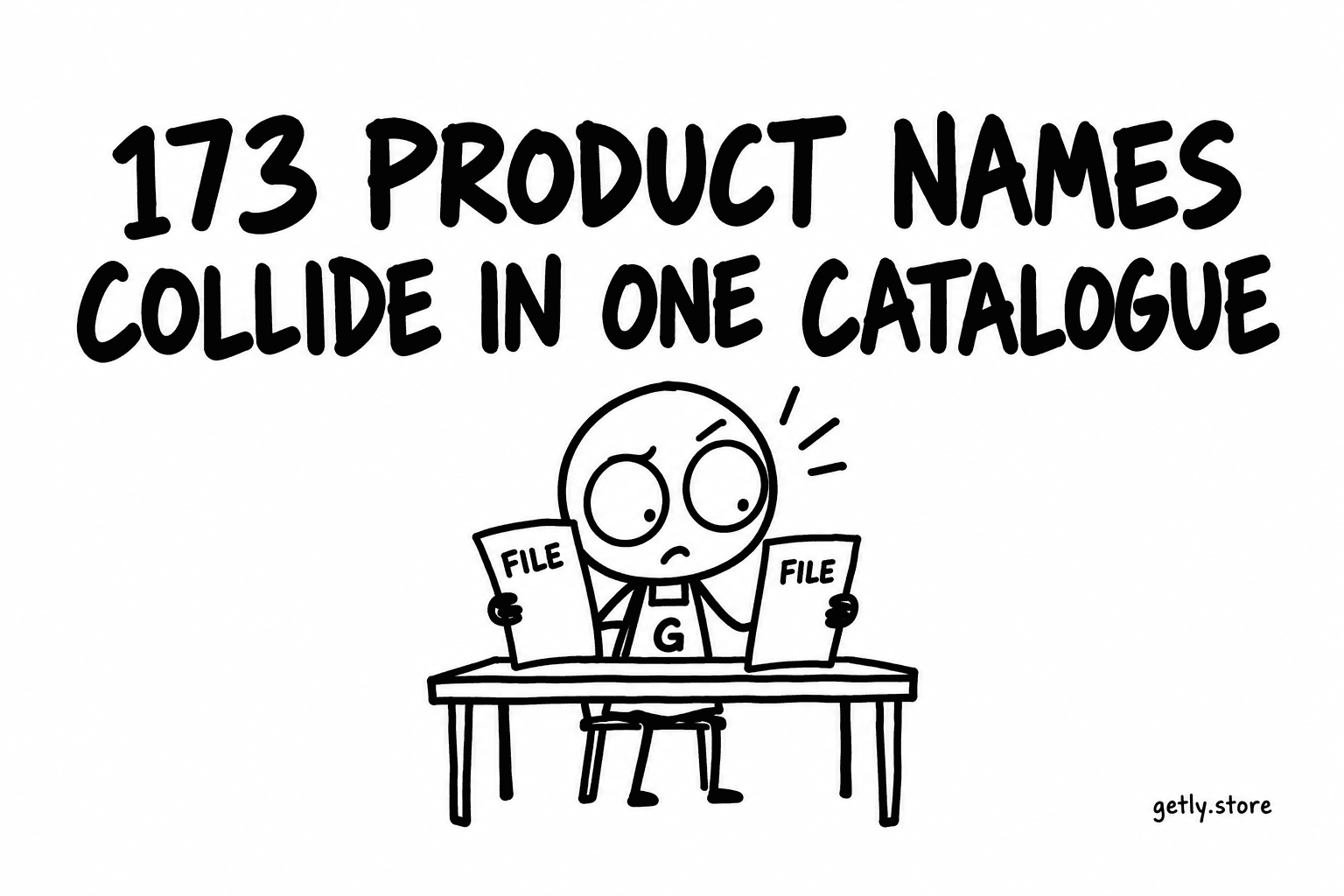
We compared every live product name in the Getly catalogue against every other one. On 14 September 2026, 173 names are used by more than one live listing out of 5,672 total.
Three percent sounds small until you picture the search result. Two rows, the same words, different covers, different prices, both real products by different people. The buyer now has to do forensic work to choose, and the usual outcome of forensic work in a shopping context is that nobody buys.
Where collisions come from
Almost none of them are copying. They come from three ordinary habits.
The category as the title. "Instagram Templates", "Resume Template", "Business Plan" — these describe a shelf, not a product. If your title would work as a category name, it is not a title.
The tool as the title. Naming the software rather than the work produces a small number of possible strings, and everyone using that software arrives at the same ones.
The volume series. "Vol. 1", "Pack 2", "Set 3" — inside one store this is a system. Across a catalogue it is noise, because the distinguishing part is a number a buyer cannot interpret.
The median title is 36 characters
Across live listings the median product name runs 36 characters, and 1,235 of 5,672 run past 60 — long enough that a search engine will truncate them.
Those two numbers bracket the useful range. Under about twenty characters you are almost certainly describing a category. Past sixty you are writing a description and the end of it will be cut off in exactly the place you were hoping to be specific.
The band between them is wide enough to be specific without being cut: what it is, who it is for, and one distinguishing fact.
How to not collide
The test is mechanical and takes ten seconds. Search the marketplace for your intended title before you publish. If something comes back, you have a decision to make while it is still free to make it.
Then add the thing that is true about yours and not about theirs:
- the specific tool version, if it constrains who can use it
- the count — "40 presets" beats "presets"
- the audience — "for photographers" narrows it usefully
- the format, where buyers filter by it
Each of these makes the title longer, and that is fine. The median is 36 characters precisely because the useful additions are short.
Why this matters more than it looks
A colliding title is not just a discovery problem. It is a trust problem. A buyer who sees two identical names cannot tell whether one is a copy of the other, and the safest guess when you cannot tell is to close the tab.
Your title is the only part of the listing that is guaranteed to be read. It survives into search results, into shared links, into the buyer's library afterwards. Spending five minutes on it is the highest-leverage five minutes in publishing a product — and unlike almost everything else on the listing, it costs nothing but attention.