 Getly
Getly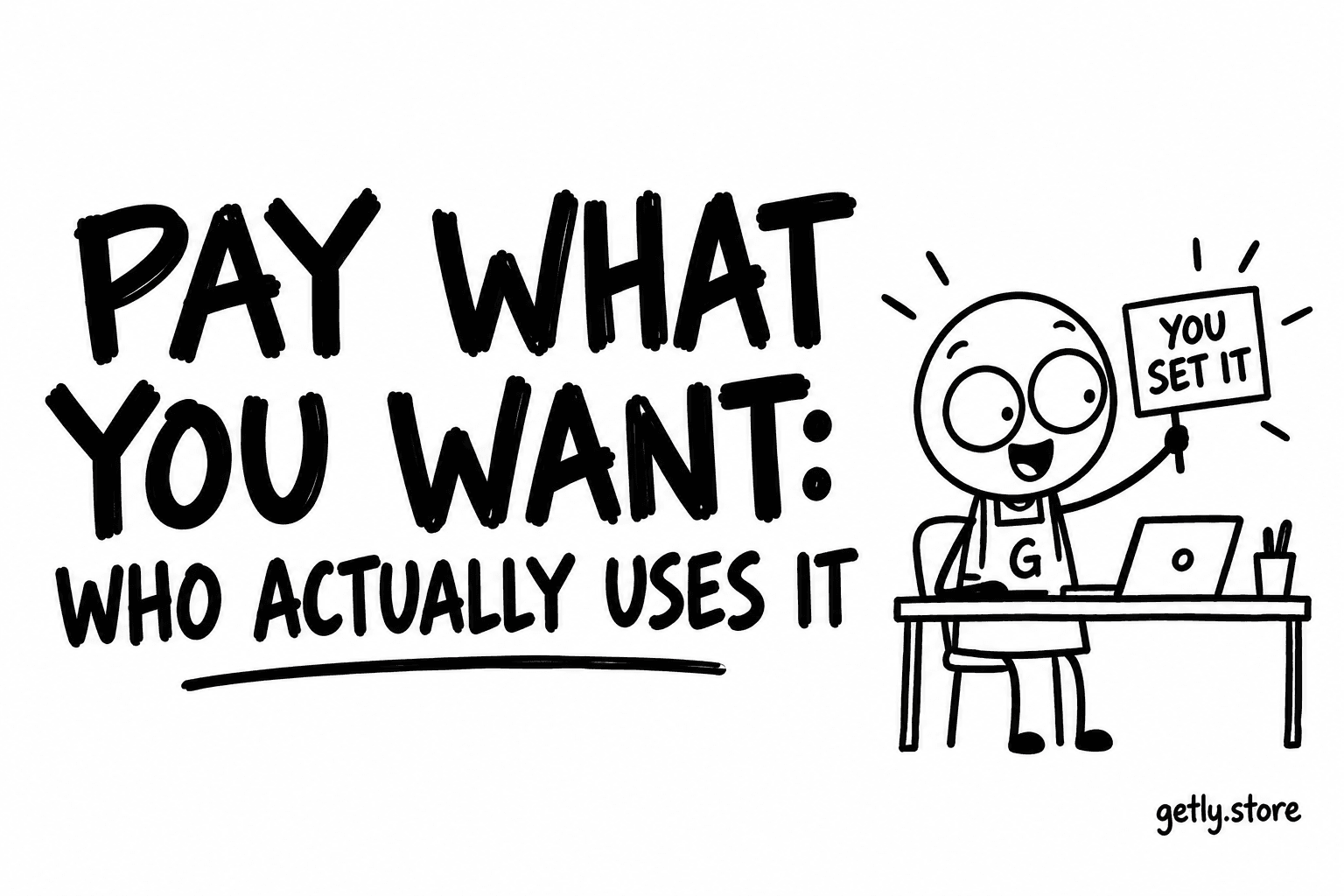
Pay-what-you-want is the pricing model everyone has an opinion about and almost nobody has counted. In the Getly catalogue on 14 September 2026, 448 of 5,672 live listings use it — 7.9%. The other 5,224 carry a fixed price.
Eight percent is a useful number because it is neither marginal nor mainstream. It is a deliberate minority, which means the listings that use it can be compared against the ones that do not.
What PWYW actually is here
On Getly a pay-what-you-want listing carries a minimum, not a suggestion. The buyer can pay the minimum or anything above it, and the seller sets where the floor sits. That makes it a different instrument from the "name your price, including zero" version other platforms use, and the difference changes who it suits.
A floor of zero is a marketing decision: you are trading revenue for reach and hoping some fraction pays. A floor above zero is a pricing decision: you are saying "this is worth at least this much, and I will let people who value it more say so."
Free is rarer than you would guess
Across the whole catalogue, 105 live listings are priced at zero and 5,567 are not. So genuinely free products are under 2% of what is on offer, and the pay-what-you-want group is four times larger than the free group.
That ordering is worth sitting with. The instinct is that "free" and "pay what you want" are neighbours on a spectrum. In practice sellers treat them as opposites: free is used for a sample or a lead magnet, while PWYW is used for finished work whose value the seller genuinely cannot pin down.
Where the model earns its keep
Three situations come up repeatedly in the listings that use it.
Work with a wide range of buyers. A font, a preset pack or a template that a hobbyist and a studio both want has no single correct price. A fixed price either loses the hobbyist or undercharges the studio. A floor plus headroom does neither.
Support and tips. Several PWYW listings are not really products — they are a way for an audience to pay an author who already gives the work away elsewhere. The listing exists so that paying is possible, not so that buying is necessary.
First releases. Setting a floor low and watching what people actually pay is a cheaper way to find a price than guessing and repricing later. The listing tells you the answer instead of you having to model it.
The mistake to avoid
The failure mode is a floor set at zero on a product that took a month to make, combined with no explanation. A buyer who sees "pay what you want, from $0" and no context reads it as "the author is not sure this is worth anything" — which is the opposite of the signal a wide-range product needs.
If you use PWYW, say why in the description. One line is enough: what the floor covers, and who you expect to pay above it. The model works when it reads as confidence, and fails when it reads as hedging.
Across the catalogue the median fixed price is $6.99, with the middle half of paid listings falling between $3.00 and $15.00. That is the range a PWYW floor is implicitly competing with, and it is a reasonable place to start.