 Getly
Getly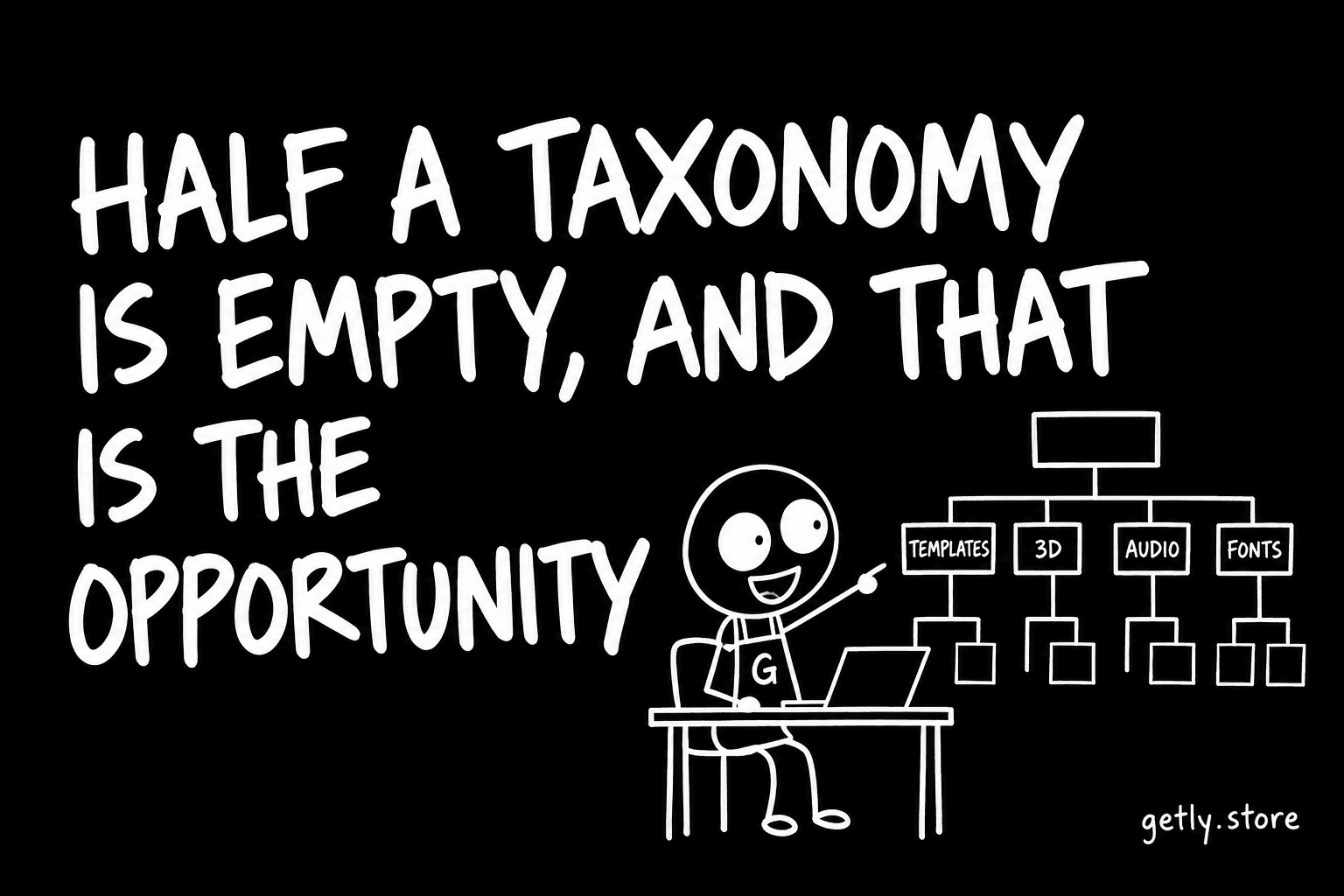
Getly's category tree has 708 categories. On 14 September 2026, live listings existed in 420 of them. The other 288 are empty — no products at all.
The reflex reading is that the taxonomy is too big. The more useful reading is that 288 shelves are unoccupied, and a shelf with nothing on it is the cheapest position a new seller will ever be offered.
Why a marketplace builds more categories than it fills
A category tree is a bet about what people will look for, made before they look. Build it too small and every listing lands in a bucket called "Other", which helps nobody: the buyer cannot browse and the seller cannot be found. Build it generously and some branches stay empty for a while.
The asymmetry favours generosity. An empty category costs a row in a table. A missing category costs every seller in that niche their natural home, permanently, because nobody lists a product in a category that does not describe it — they list it somewhere approximate and the whole branch stays invisible.
Concentration is the real shape
The filled 420 are not evenly filled. The largest single category holds 361 paid listings; several hold fewer than fifty. That distribution is normal for any marketplace and it is what makes the tail interesting.
In a crowded category your listing competes with hundreds of others on price, cover image and title — the three things every competitor is also optimising. In a category with nine listings, being the tenth is itself a position. You are not better than the competition; you are the only result for a specific query.
How to read an empty category honestly
Not every empty shelf is an opportunity, and the difference is worth being precise about.
Empty because nobody makes it. This is the good case — a real niche that happens to be underserved. Someone searching for it finds nothing, which means the first decent listing owns the term.
Empty because nobody wants it. This is the trap. A category can be well-named, well-placed and genuinely dead, and no amount of being first fixes that.
The way to tell them apart is not to guess. Search for the thing outside the marketplace — if people are asking for it in forums, on social platforms, or in the search box of any large store, the demand exists and the shelf is merely unoccupied. If the only place the phrase appears is in category trees, it is a taxonomy artefact.
What this means if you are choosing what to make next
Most advice about picking a niche is about passion or about competition, and both are hard to act on. The category tree gives you a third, concrete input: a list of positions nobody currently holds.
Start from what you can actually make. Then look at where it would sit. If that branch is crowded, look one level down — the specific subcategory is almost always emptier than its parent, and specificity is what search rewards anyway. A listing titled for the narrow thing it is will be found by the people who want exactly that, which at small scale beats being the four-hundredth result for a broad term.
288 empty shelves is not a gap in the catalogue. It is the part of the catalogue that has not been written yet.