 Getly
Getly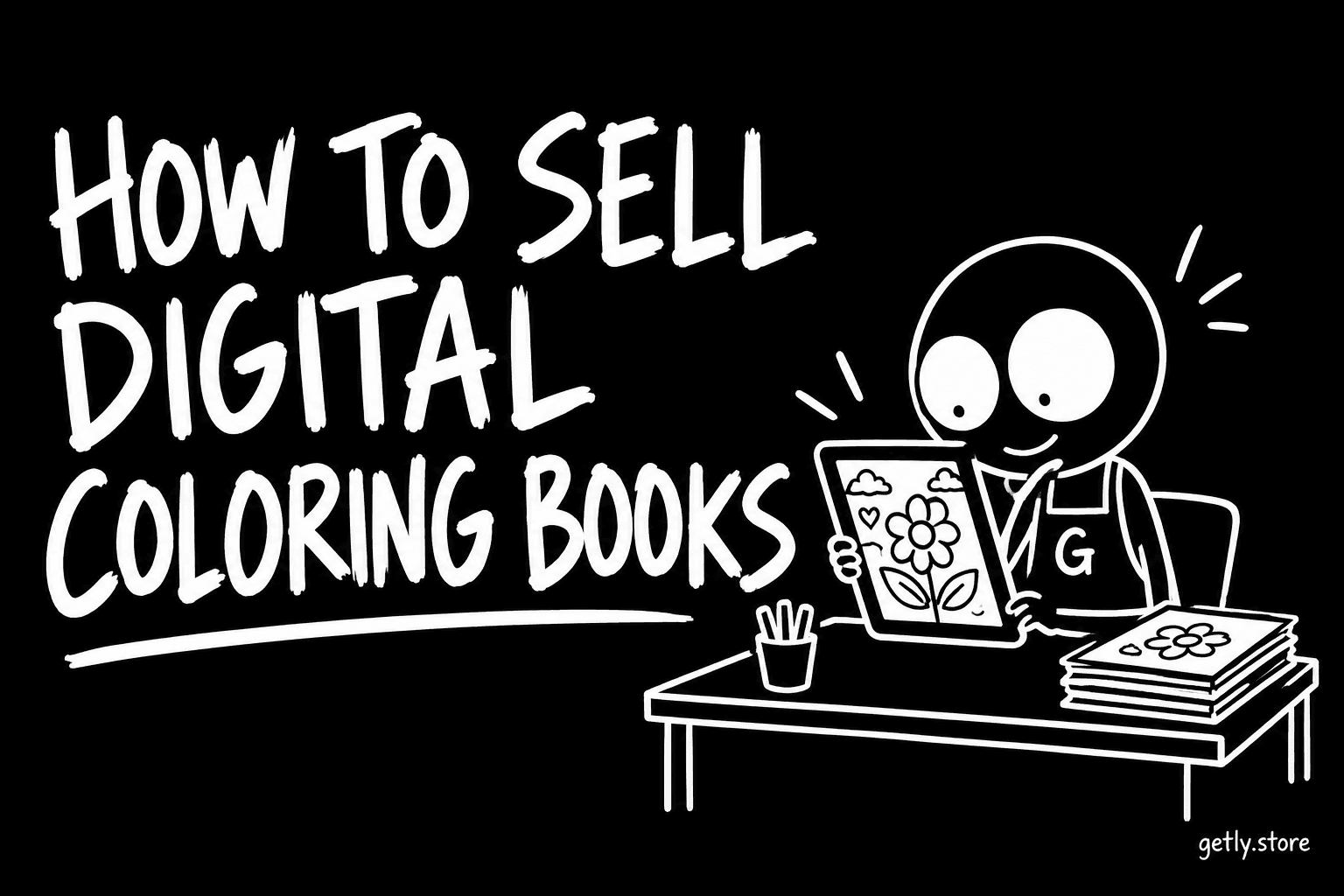
Digital coloring books are one of the most durable small categories in digital goods: cheap to buy, cheap to deliver, and bought by people who will come back for another one. On Getly the category holds 117 live paid listings with a median price of $3.99 as of 14 September 2026.
That price is the first thing to understand about it. At four dollars, the economics are volume economics, and everything below follows from that.
What the category is made of
Almost all of it is PDF. That is not an accident of taste — it is the only format that prints predictably on a home printer and opens on a tablet without the buyer installing anything. Across the whole catalogue PDF is the single largest format, 2,551 files with a median size of 1.3 MB, and coloring books sit squarely inside that shape.
The practical consequence: your product is a print job that happens to be sold online. Page size, margins and line weight matter more than they would anywhere else, because a buyer's first experience of your work is their own printer's output, not your screen.
Three decisions that separate listings
Page count, stated plainly. At this price point, the number of pages is the main thing a buyer is comparing. A listing that says "32 pages" outperforms one that says "a beautiful collection" every time, because the second one makes the buyer do work the first one did for them.
Line weight and complexity. The category splits hard between adult-detail and children-simple, and they are not interchangeable. A buyer looking for something a four-year-old can finish is not served by intricate mandalas, and the listings that do best say which they are in the title.
Paper size. US Letter and A4 are different. If you only ship one, say which. If you ship both, say that too — it is a genuine differentiator that costs you one export.
Pricing against a $3.99 median
The middle of the category is four dollars. You have three honest positions relative to that.
Below it, you are buying attention with price, which works only if you intend to publish often — a single cheap book is a rounding error, a series is a catalogue.
At it, you are competing on the cover image and the page count, which is a fair fight and the one most sellers pick.
Above it, you need a reason a buyer can see before paying. A themed set, a licence that allows classroom or commercial use, or a bundle that replaces four separate purchases. "More pages" alone rarely carries a price above the median, because page count is exactly what the cheaper listings are also advertising.
The licence question, answered once
Coloring pages get reused in ways other digital products do not: classrooms, care homes, waiting rooms, therapy practices. Those buyers need to know whether they may print twenty copies, and most listings in the category never say.
Setting a licence on your listing takes one field and removes the most common pre-purchase question in the category. It also lets you charge differently for the classroom buyer than for the parent, which is the cleanest way out of the $3.99 gravity well.
Getting started
Make one book, price it at the median, and state the page count, the paper size and the licence in the first two lines of the description. Then make the second one. The category rewards a shelf, not a single title — and a shelf is built one four-dollar book at a time.