 Getly
Getly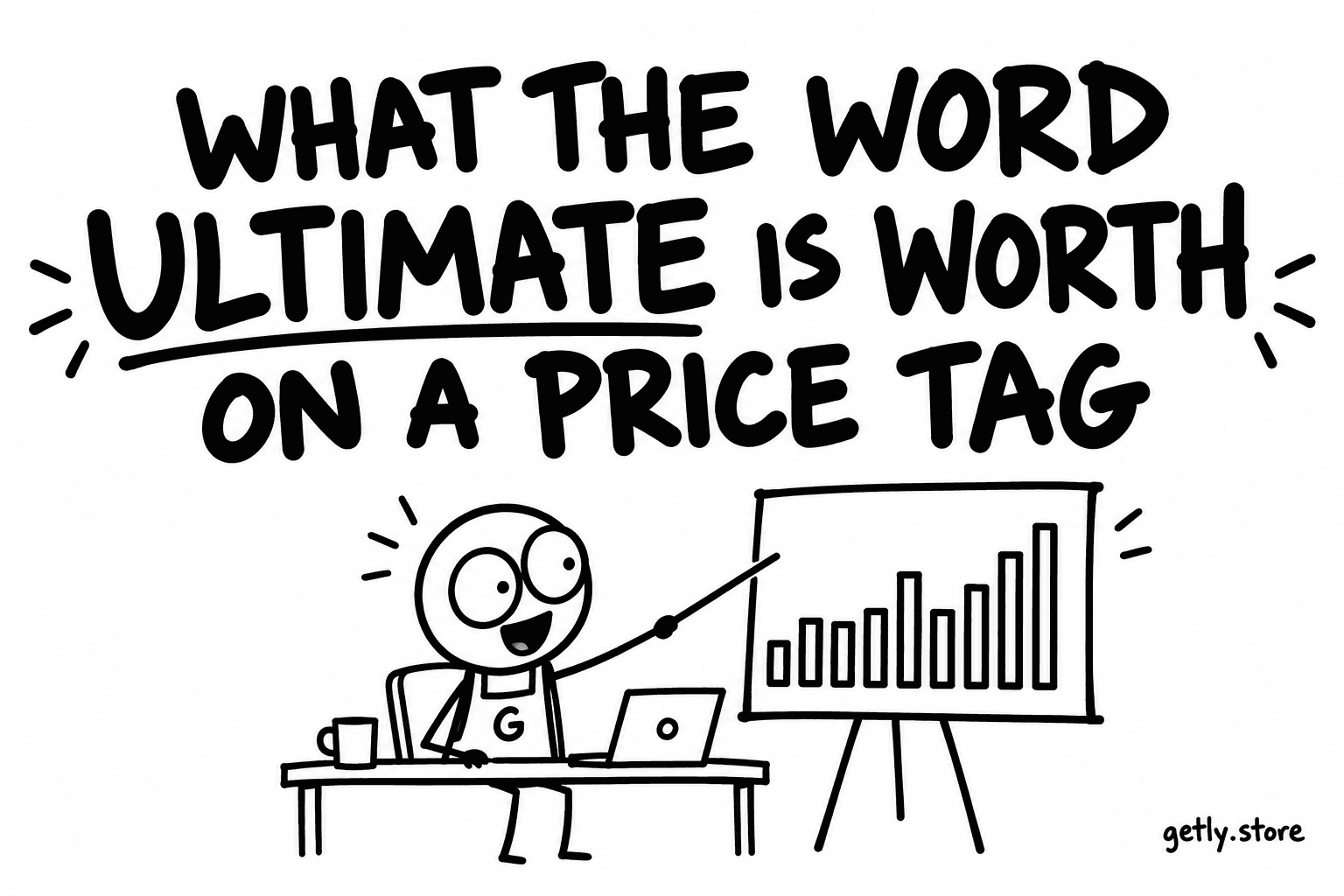
Some words turn up in product titles because they sound like value: ultimate, premium, complete, pro, master. They cost nothing to type. On 26 September 2026 we looked at how often ten of them appear across the 7,143 active listings on Getly and at the median price of the listings that use each one.
The spread is wide, and it does not line up with how grand each word sounds.
Ten words and their medians
Share of all active titles that contain the word, and the median price of those listings, measured 26 September 2026:
| Word in the title | Share of titles | Median price |
|---|---|---|
| complete | 1.64% | $20.00 |
| 2026 | 1.40% | $14.50 |
| master | 0.73% | $14.48 |
| kit | 2.39% | $12.00 |
| pro | 2.23% | $9.99 |
| ultimate | 2.03% | $9.99 |
| premium | 2.86% | $8.00 |
| pack | 3.85% | $7.00 |
| bundle | 3.51% | $5.00 |
| collection | 1.08% | $4.99 |
For a reference point, titles with no digit at all sit at a median of $7.00 on the same day. "Ultimate" lands at $9.99, a little above that line and well below "complete". "Premium", the word that most directly claims a higher tier, has a median barely above the plain title.
Descriptive words beat superlatives
Look at which words sit at the top. "Complete", "master" and "kit" describe something about the product: that it covers a whole subject, that it goes deep, that it is a set of working parts. "Ultimate" and "premium" describe the seller's opinion of it.
We cannot prove from this table that descriptive words cause higher prices, and we are not claiming it. A course that really is complete is a bigger product than a single worksheet, and it would cost more under any title. What the table does show is that the superlatives are not doing the work sellers may hope. A listing does not climb into the "complete" price range by calling itself ultimate.
Why the cheapest words are about quantity
The bottom of the table is interesting in its own way. "Pack", "bundle" and "collection" are the most common of the ten words (pack alone is in 3.85% of titles) and they carry the lowest medians, down to $4.99 for "collection".
A plausible reading, and it is only a reading: these words often sit on shelves where individual items are cheap, such as backgrounds, clip art and wallpaper sets, so a collection of them is still priced as a small purchase. A second reading is that a pack word promises "more" without saying how much, which gives the buyer nothing to anchor a price on. Compare that with titles that state an explicit count ("120 textures"), which sit at a median of $16.00 on the same measurement.
Both readings point the same way. A word that gestures at size is weaker than a number that states it.
What "ultimate" costs you
The word is not free even though it is easy to type. Three costs are worth naming.
- Space. A title has limited room before it is cut off in a grid or a search result. "Ultimate" takes eight characters that could say what the product is for.
- Trust. Buyers read the same superlatives on every marketplace. The word has been worn down to background noise, and on some readers it signals a listing that is selling the title instead of the product.
- Promise. If the product is not in fact the most thorough thing on its shelf, the title has overclaimed. Overclaiming is how a satisfied buyer becomes a disappointed one.
None of this is a rule against the word. Some products really are the most complete option available, and a seller who can back that up in the description is entitled to say it. The point is that the word on its own is not a pricing tool.
A check you can run on your own titles
- List your titles and highlight every word that describes your opinion of the product rather than the product itself: ultimate, premium, best, amazing, perfect.
- For each one, ask what fact would prove it. More pages? More files? A specific use case nobody else covers?
- Replace the adjective with that fact where you can. "Ultimate Budget Planner" becomes "Budget Planner, 12 monthly sheets and a yearly summary".
- Change one listing first, note the date, and compare its views and conversion before and after in your dashboard analytics before you rewrite the rest.
If you keep the word, keep it where the description can defend it. A title that says "complete" should be followed by a description that lists everything included, because that list is what a buyer uses to decide the word is true.
What to do today
Open your three most important listings and read each title aloud as if you were a buyer who has never heard of you. Cross out any word that only tells them you like the product. Put back something they can check: a count, a format, a use. Leave price and images alone this week so you can see what the title change did on its own.