 Getly
Getly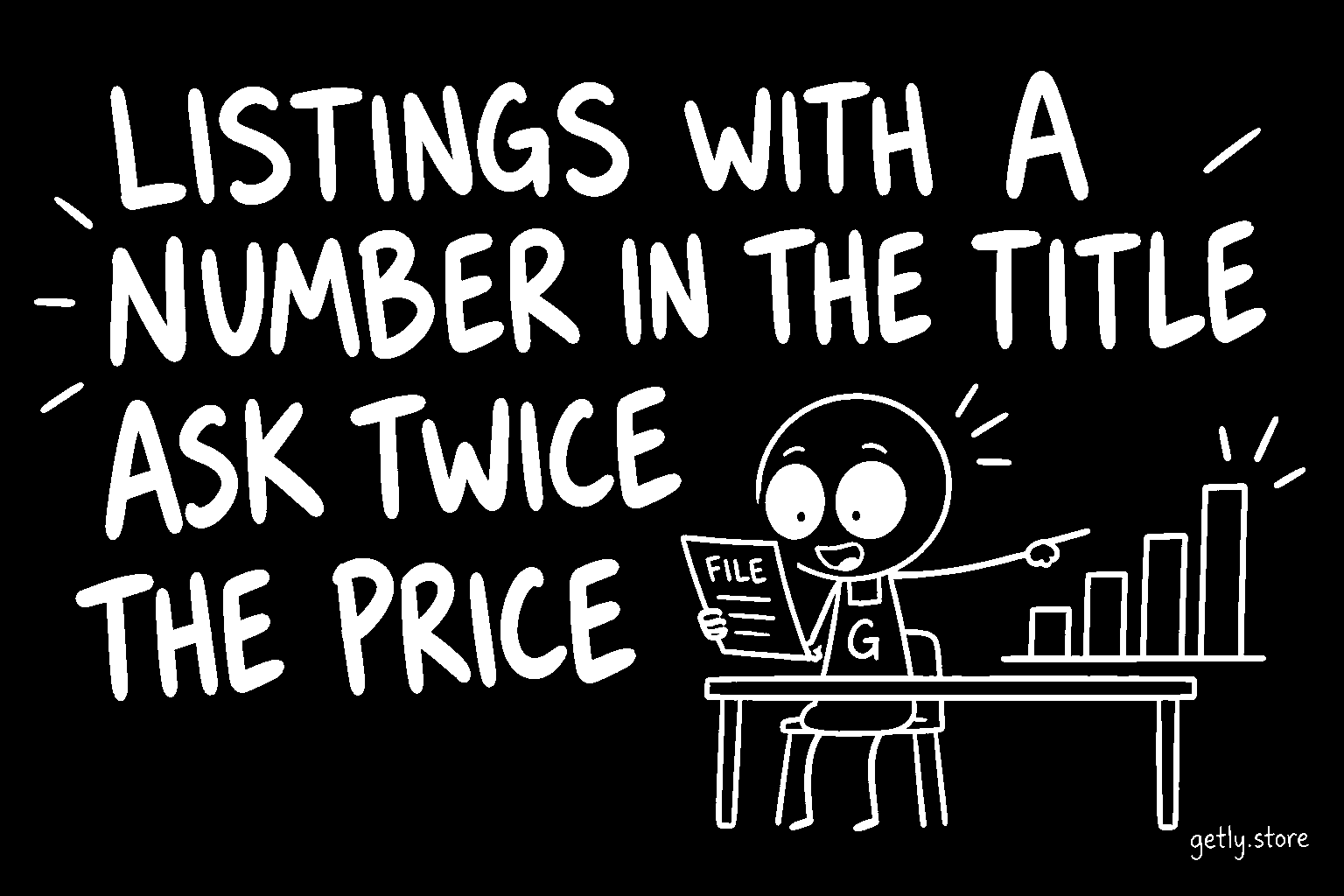
Some product titles tell you exactly how much you are getting: "500 prompts", "120 textures", "48 slide layouts". Most do not. On 26 September 2026 we read the titles of all 7,143 active listings on Getly and sorted them by whether they carry a digit and, more narrowly, whether that digit is a count of what is inside.
The result is one of the larger price gaps we have measured in a title. It is also a correlation, and the difference between those two statements is the whole point of this article.
What the catalogue shows
Here is the measurement, taken on 26 September 2026 across the active catalogue:
- 29.26% of titles contain at least one digit of any kind (a count, a version, a size, a year).
- Titles that state an explicit count of the contents, such as "500 prompts" or "120 textures", have a median price of $16.00.
- Titles with no digit at all have a median price of $7.00.
- Explicit count-claims are rare: 0.78% of titles make one, and the median number they claim is 60.
So a title that names a quantity sits at more than twice the median of a title that names nothing. And almost nobody writes one.
Why this is a correlation and not a lever
It would be convenient to read the table as "add a number, double the price". The data does not say that, and there are at least three reasons to be careful.
The products are different. A listing that can honestly say "500 prompts" or "120 textures" is usually a collection. Collections tend to cost more than a single file, whatever their titles say. The number in the title may simply be a marker of the kind of product that was always priced higher.
The sellers are different. A seller who counts what is inside and puts it in the headline is probably also the seller who writes a fuller description, shows more images and thinks about price on purpose. The title is one visible trace of a more careful listing, not necessarily the cause of anything.
The sample is small. At 0.78% of titles, explicit count-claims are a thin slice of the catalogue. A median over a thin slice moves more easily than a median over the whole shelf.
None of this makes the observation useless. It makes it a hypothesis you can test on your own listing, rather than a rule you can copy.
What a count does for a buyer
Set price aside for a moment and look at the title from the other side of the screen. A buyer scanning a category page sees a grid of names and thumbnails. "Watercolour Flowers" asks them to open the listing to learn what they would get. "Watercolour Flowers, 64 PNG files" answers the first question before the click.
That is the useful part of a count: it replaces a vague promise with something checkable. It also sets a standard the listing has to meet. If the title says 64 files, the download needs 64 files, and the description should say what they are. A count that the buyer cannot verify on arrival is worse than no count.
There is a practical ceiling too. A number only helps when it describes the thing being bought. "Pack 3" or "Vol 2" carries a digit but tells the buyer nothing about quantity, which is why we separated explicit count-claims from digits in general. The 29.26% figure includes every kind of digit; the $16.00 median belongs only to titles that count the contents.
When not to put a number in the title
- The product is one thing. A single ebook or a single template has no count worth stating. Inventing one ("1 ebook") adds length and nothing else.
- The number is small for the category. "5 backgrounds" on a shelf where collections run to dozens can read as thin. Say what the five are for instead.
- The number is padding. Counting duplicates, colour variants of the same file or every size of the same image inflates the figure. Buyers notice when "300 assets" turns out to be 30 assets in ten sizes, and that is how refund requests start.
A check you can run on your own listing
Because the measurement is a correlation, the only honest way to know whether a count helps your product is to try it on your product. Here is a simple way to do that without guessing.
- Open your listing and count what the buyer actually receives. Files, pages, prompts, layouts: whatever unit a buyer would use.
- If the count is meaningful for the category, add it to the title in plain form ("120 textures"), and make sure the description lists what those items are.
- Leave the price alone for now. Change one thing at a time, or you will not know which change did the work.
- Note the date of the edit and compare your listing's views and conversion over the following weeks against the weeks before, in your dashboard analytics.
- Only then consider whether the clearer offer supports a different price.
Getly publishes a listing once it has a file, an image, a category, a name of at least 5 characters and a description of at least 150 characters. A number in the title is never required. It is a choice, and the measurement suggests it is a choice very few sellers have made.
What to do today
Pick your best-selling or most-viewed listing and ask one question: can a stranger tell how much is inside from the title alone? If the answer is no and the product is a collection, write the count into the title, check that the download matches it exactly, and put a list of the contents in the description. Then watch the listing for a few weeks before you touch anything else.