 Getly
Getly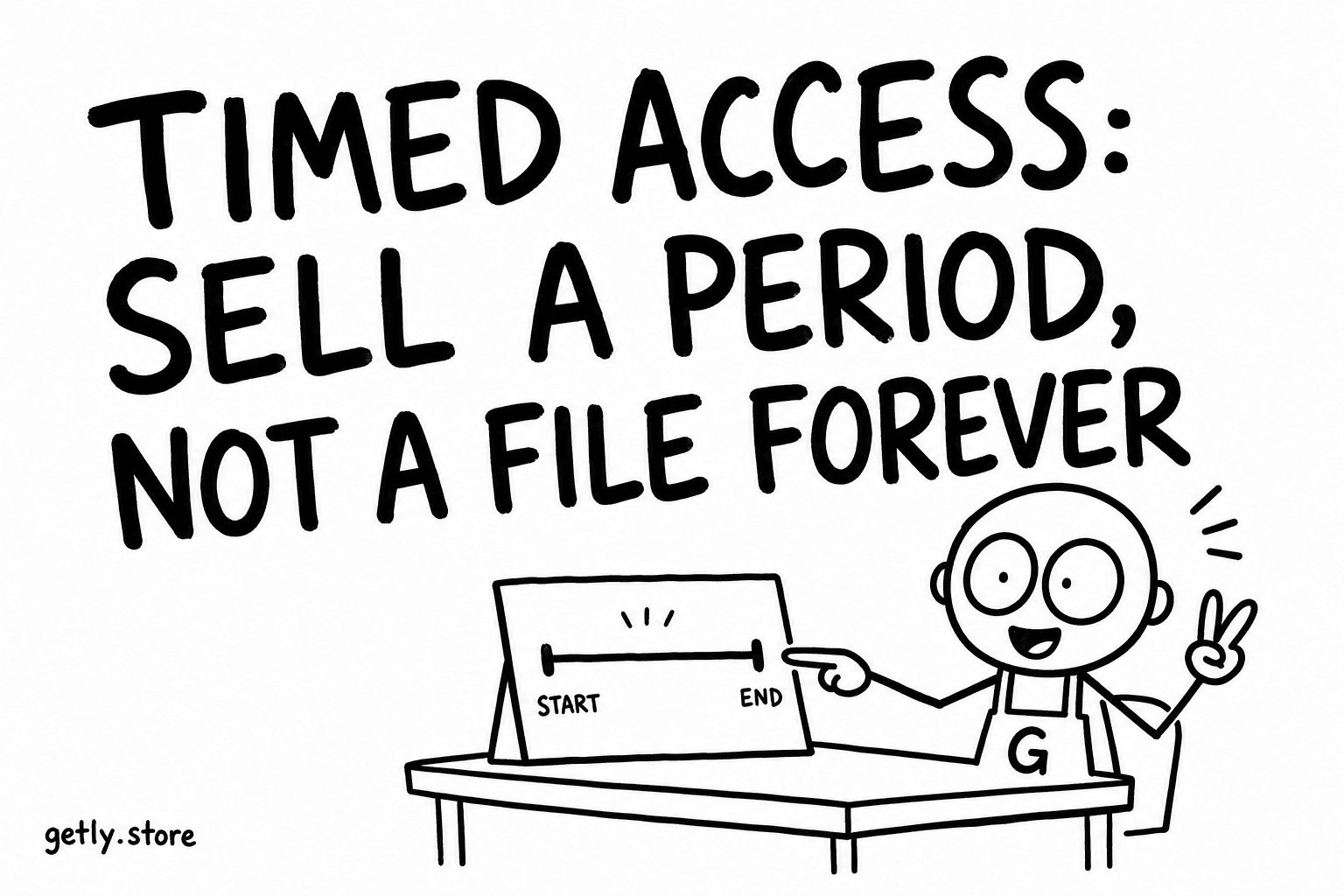
From this week a product on Getly can be sold as access for a period: 1, 3, 6 or 12 months, or any number of days, each with its own price. The buyer picks a term, pays once, and holds access until a date. Nothing renews by itself. When the date passes, downloads and licence keys stop, and if the product lives on your own platform, your system is told by webhook.
Why a period and not a subscription
We already had recurring billing — Member Plans, a monthly fee for everything a store publishes. It has been configured by sellers far more often than it has ever been bought, and the reason is not mysterious: a buyer who wants a twelve-week fitness programme does not want a card on file and a cancellation to remember. They want twelve weeks.
Meanwhile the catalogue was already selling periods without a tool for it. We counted this week: 179 active listings at 69 stores describe themselves as "months of access", a "subscription key", a "Telegram channel", a "Discord community" or a "licence". One seller keeps five tiers of one service — Starter, Standard, Premium, Enterprise, Full Access — as five separate products, because a product had no way to carry variants. A seller who wrote to us the same week put the requirement in one sentence: a one-time purchase that grants access for a fixed period, tracked by the platform, with a webhook when it ends.
How it works for the buyer
The product page shows the periods as a short list — say 1 month for $19, 3 months for $45, 12 months for $129 — with the saving against the shortest one printed beside each. Pick one, pay by card, Apple Pay, Google Pay or stablecoin as for any Getly purchase, and the library shows the exact date access ends. Seven days before that date the buyer gets one email. Buying the term again extends from the current end date, not from today, so renewing early never costs a day.
How it works for the seller
On the pricing step of any product there is now a choice: lifetime access, which is what every product has always been, or timed access. Choose the second and a small table appears: duration, price, an optional crossed-out price, an optional label such as "Season pass". Up to six periods. The catalogue price of the product becomes the cheapest active period, so cards, sorting and structured data say the same thing the page does.
A timed product cannot be published without at least one active period. Periods can be added, repriced or retired at any time; a retired period stays valid for everyone who bought it and simply cannot be bought again. The take is the same as for any sale — 10% on a buyer you brought yourself, 20% on a marketplace sale, less with volume or Getly Exclusive. There is no fee for the feature.
How it works for your own platform
If the thing you sell is hosted elsewhere — a course platform, a members-only site, a bot — two webhook events are all you need. access.expiring arrives seven days before the end, access.expired on the day; both carry the buyer's email, the product, the length of the term and the exact expiry. If you issue licence keys, the key itself reports "expired" to your validation call after the date. The same fields are exposed in the v1 API as accessMode and accessTerms, and the @getly/mcp tools can create and update timed products from an AI assistant.
What it is not
It is not a subscription, and we have deliberately not added an auto-renew switch. A period that quietly renews is the thing buyers have learned to distrust, and the sellers who asked for this asked for the opposite. Member Plans remain for stores that want a recurring fee. Timed access is for everything that is used over time and should end on a date the buyer chose.
The full walkthrough, with the webhook payload, is at getly.store/sell/timed-access.