 Getly
Getly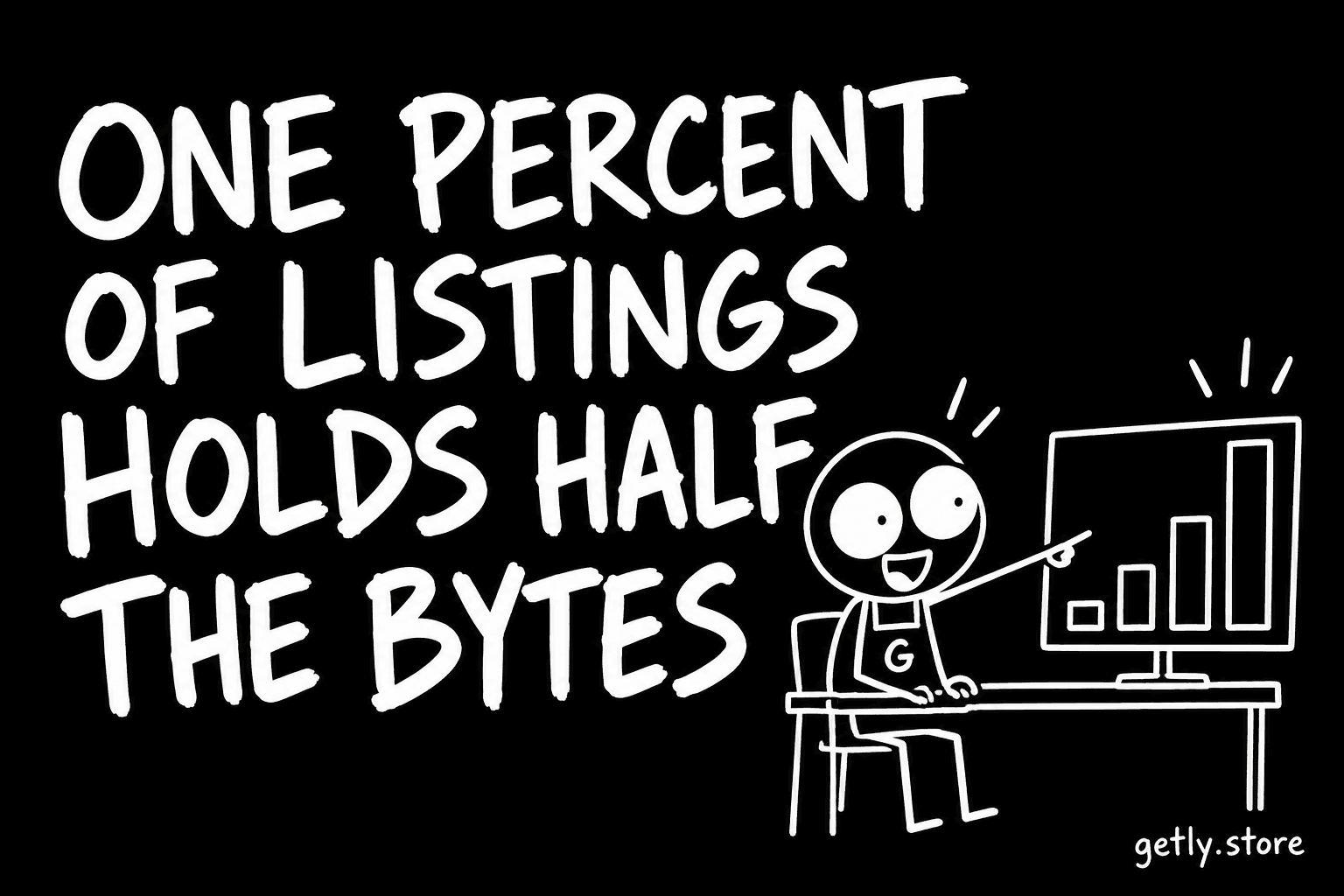
On 19 September 2026 the Getly catalogue delivered 138.5 GB across 9,508 files attached to 6,519 active listings. The median listing carries 1.68 MB. The mean carries 20.26 MB.
The gap between those two numbers — a factor of twelve — is the whole finding. Any sentence that begins "the average digital product is about…" is describing something that barely exists here.
Where the weight actually sits
- The heaviest 1% of live listings — 65 of them — hold 56.65% of every delivered byte.
- The heaviest 10% — 652 listings — hold 88.14%.
- Which leaves the remaining 90% of the catalogue sharing about an eighth of the bytes between them.
Individual files show the same shape more sharply still. The 10th percentile file is 3.2 KB. The median file is 1.33 MB. The 90th percentile is 17.0 MB, the 99th is 237.6 MB, and the largest single file is 1,995.4 MB. From the 10th percentile to the largest is a factor of around six hundred thousand.
And 85.76% of live listings deliver exactly one file, so for most of the catalogue "what the listing weighs" and "what the file weighs" are the same number.
Why averaged advice fails on this shape
When the mean is twelve times the median, the mean is not describing a typical listing. It is describing the 65 heaviest ones with everything else rounded down to nothing. A seller who reads "keep your files around 20 MB" and is sitting on a 300 KB spreadsheet template will conclude they have shipped something thin. They have shipped something completely ordinary: 1.68 MB is the middle of this catalogue, and half of everything is lighter than that.
The same distortion runs the other way. Someone building a 400 MB sample library reads the same 20 MB figure and concludes they must split or compress. They are simply in the 99th percentile, where 237.6 MB is the going rate and the size is a property of the work.
The honest summary is that there is no typical size, and the median is the only number that describes a real listing. Use 1.68 MB when you want to know what a listing weighs, and ignore the mean entirely.
The 99th percentile is a different product
The distance between the median file at 1.33 MB and the 99th percentile at 237.6 MB is not a difference of degree. It is a difference in what is being bought, and more importantly in what happens after the payment goes through.
A 1.33 MB file arrives instantly on anything, including a phone on a train. A 237.6 MB file is a decision. On a metered mobile plan it may cost real money to receive. On a slow connection it takes long enough that the buyer leaves the tab and comes back, and a failure at 80% starts again from zero. The largest file in the catalogue, at 1,995.4 MB, is not a download at all in some places — it is an errand you run when you get home.
That matters because the buyer who is most likely to be on the difficult connection is the buyer least likely to complain. They will just not finish, and neither of you will ever know.
What each end should do
If you are in the heavy tail, say the size on the page. Not in the fine print — in the same paragraph as what the product is. A buyer who knows they are about to pull 240 MB will wait for Wi-Fi and succeed. A buyer who does not know will start it on mobile data and fail. The size is the single easiest piece of information to give and it is missing from most heavy listings.
If you are in the heavy tail, split at a natural seam. Two 120 MB parts recover from a failure independently; one 240 MB archive does not. Split by what the parts are — source files here, exports there — so the split is also an explanation.
If you are in the light majority, do not read your size as a verdict. Sitting under the 1.68 MB median puts you alongside roughly half the catalogue, including a good deal of its most specific and best-priced work. Nobody has ever bought a file for its weight.
Bytes are the one thing about a digital product that is trivial to measure, which is why they get quoted. They are also the one thing a buyer wants to think about least — right up to the moment the download stalls, when it becomes the only thing they are thinking about.