 Getly
Getly
By the end of this guide, you will have a usable ebook outline with a clear reader promise, a dependable chapter rhythm, and a payoff planned for every major idea. You will also know how to test the outline before you spend weeks drafting pages that readers may skip.
Start with one reader promise
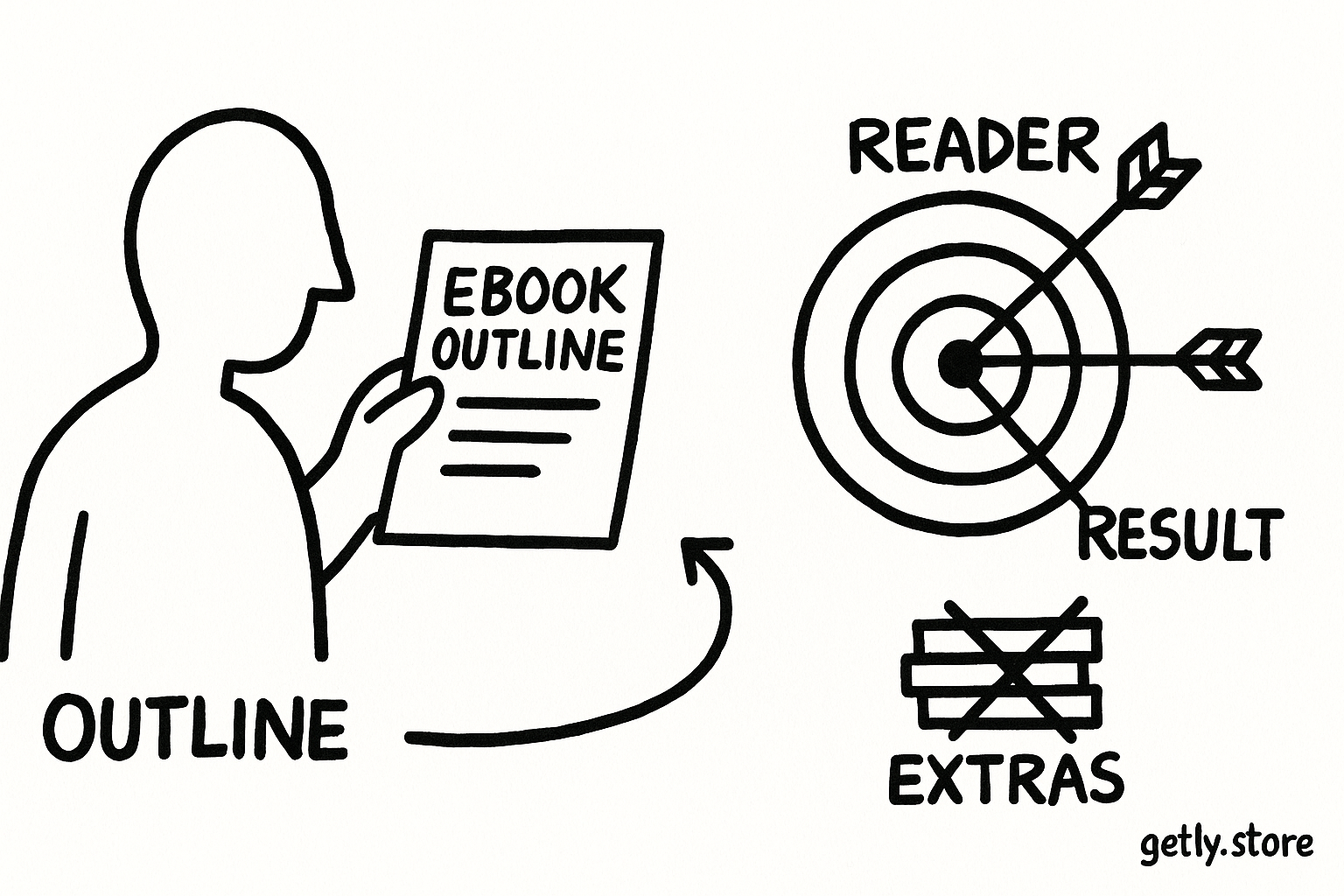
Your outline needs one sentence that tells readers what they will gain. A strong promise names the audience, the result, and the conditions that shape the result.
Use this pattern:
After reading this ebook, [specific reader] can [specific result] by using [method, process, or set of decisions].
For example: “After reading this ebook, first-time freelance designers can price a small project by choosing a service scope, calculating a minimum fee, and presenting three clear options.”
That sentence gives you a filter for every chapter. If a section does not help the reader reach the stated result, move it to a bonus resource or cut it. A broad subject such as “freelancing” can support several books, but a promise about pricing a first project gives the reader a route to follow.
Define the reader’s starting point before you name the result. A beginner who has never sold a service needs definitions and examples. An experienced designer may need decision rules, templates, and edge cases. A single ebook can serve both groups only when you tell readers who should use each section.
Name the reader
Describe the person’s current skill, situation, and immediate problem.
Choose one result
State the visible task the reader can complete after applying the book.
Set the boundary
List the adjacent topics that the ebook will leave for another resource.
Build the book spine before listing chapters
Start with the change your reader must make. Then arrange the decisions that create that change in a sensible order. Most practical ebooks follow a path such as understand, choose, do, check, and improve.
Write each stage on a separate card or line. Under each stage, add the smallest set of ideas the reader needs to move forward. This method keeps your outline focused on progress instead of subject coverage.
Suppose you are outlining an ebook about launching a digital journal. The spine might look like this:
- Understand: choose a narrow audience and a useful journal outcome.
- Choose: select the format, page types, and delivery method.
- Do: create the pages, test the instructions, and prepare the product files.
- Check: ask test readers to complete a small task without your help.
- Improve: revise confusing pages and create a simple launch plan.
The spine prevents a common structural problem: the book teaches tools before it gives readers a reason to use them. It also shows you where examples belong. Place an example after the idea it demonstrates, not several chapters later.
Give each chapter one job. “Explain marketing” describes a subject. “Help the reader choose one launch channel” describes a job. The second version gives you a clear chapter ending and makes unnecessary digressions easier to remove.
You can inspect a range of digital books for structural patterns through ebook collections, but evaluate each example by its reader journey rather than by its cover or length.
Give every chapter a repeatable rhythm
Readers finish practical chapters when they understand the point, see the method, and use the method before they lose context. A repeatable rhythm reduces the mental effort required to work through unfamiliar material.
Use this five-part chapter pattern:
- Orient: state the chapter outcome and explain why it matters now.
- Explain: teach the principle, terms, or decision the reader needs.
- Show: walk through one concrete example from start to finish.
- Apply: give the reader a task, worksheet, or decision to complete.
- Close: recap the result and point toward the next decision.
The pattern does not force every chapter into the same word count. A chapter that teaches one pricing formula may need 900 words. A chapter that guides a product audit may need 2,000 words and several examples. Keep the sequence stable while allowing the depth to match the decision.
Plan a visible action at least once in each chapter. Ask the reader to draft a sentence, compare two options, mark a page, calculate a number, or run a small test. Action gives the chapter a finish line and exposes confusion while you can still fix it.
These proportions give practice more room than setup. Adjust them when your subject demands more explanation, but protect enough space for the reader to do something with the lesson. A chapter full of concepts can feel productive while leaving the reader unable to act.
Run the promise-payoff loop
The promise-payoff loop connects the opening of a chapter to its ending. At the start, make a specific claim about what the reader will learn or complete. During the chapter, deliver the explanation and example that support the claim. At the end, let the reader verify the result.
Write a short promise for every chapter. For example: “By the end of this chapter, you will have a three-part product description that names the buyer, the problem, and the next step.” Then outline only the material that helps produce that description.
Plan the payoff before you draft the chapter. The payoff might be a completed worksheet, a revised paragraph, a decision between two options, or a small experiment. If you cannot name the payoff, the chapter probably contains several ideas that need separate homes.
Connect each chapter’s payoff to the next chapter’s promise. A reader who finishes a product description can move into a chapter about choosing a sales page structure. The previous task creates the input for the next task, so the book gains momentum without relying on dramatic storytelling.
Use open loops with care. You can mention a later decision when it affects the current one, but do not hide basic information to create suspense. Readers trust an ebook that answers the question in front of them before introducing the next question.
Track the loop in a simple outline table with four columns: chapter promise, teaching points, reader action, and payoff. Read the columns from left to right. Any empty payoff signals a weak ending. Any teaching point without a promise may represent a tangent.
Draft, test, and tighten the outline
Write a one-sentence summary for every chapter, then write a one-sentence summary for every major section inside that chapter. Read the summaries without opening your draft. You should see a chain of decisions rather than a pile of related topics.
Next, check the first three chapters. The opening chapter should establish the result and give the reader an early win. The second should deepen the method or handle the next decision. The third should ask for a more complete application. This sequence builds confidence without postponing useful work.
Run a small outline test with two or three target readers. Ask them to answer four questions:
- What result do you expect from this ebook?
- Which chapter would you read first, and why?
- Where would you expect to complete a task?
- Which chapter seems unrelated to the promised result?
Listen for mismatches between your intended journey and the journey readers describe. If readers expect a tutorial but see five theory-heavy chapters, move an exercise earlier. If they cannot tell what changes by the final chapter, sharpen the book promise.
Revise the outline before you polish prose. Moving a chapter takes minutes in an outline and hours after you have written examples, transitions, and exercises around it.
Common outline mistakes to remove
Do
- Give each chapter one reader-facing job.
- Place an example beside the idea it demonstrates.
- End chapters with a task or decision that produces evidence of progress.
- Use the next chapter to build on the previous payoff.
Don't
- Arrange chapters by the order in which you learned the subject.
- Save all exercises for a final workbook section.
- Use several introductions before giving the reader a useful action.
- Add chapters because a topic feels important but lacks a clear payoff.
Starting with background
Creators often open with their history, definitions, or a survey of the field. Readers usually need a task before they need a full account of the subject. Keep background that changes a decision, and move the rest to a short reference section.
Making every chapter the same size
Uniform chapter lengths can create padding around simple ideas and compression around complex ones. Match the space to the reader’s work. Add an example when a decision feels abstract. Cut repeated explanation when the reader can learn through a task.
Ending with a summary alone
A summary reminds readers what you said. A payoff lets them prove what they can do. Replace at least some recap-only endings with a completed artifact, a choice, or a test result.
Adding advanced material too early
Advanced tactics can distract beginners before they understand the basic workflow. Mark optional material clearly and place it after the reader completes the core path.
Finish your outline with a one-page map. Put the book promise at the top, list each chapter promise below it, and add the payoff beside each chapter. That page becomes your drafting plan, your revision checklist, and a quick way to see whether every chapter earns its place.
Frequently asked questions
How many chapters should an ebook have?
Choose the number of chapters based on the decisions a reader must make, not on a target count. Give each chapter one clear job, then divide or combine chapters until the reader can move through those jobs without confusion.
What should every ebook chapter include?
A useful chapter usually includes a clear outcome, an explanation, a concrete example, a reader task, and a closing payoff that points toward the next decision.
What does the promise-payoff loop mean?
The promise-payoff loop starts a chapter with a specific claim about what the reader will learn or complete, then ends with an action or result that proves the chapter delivered that claim.
How can I tell if my ebook outline has too much content?
Summarize each chapter in one sentence and compare every section with the main reader promise. Remove or relocate sections that do not support a reader decision, action, or payoff.