 Getly
Getly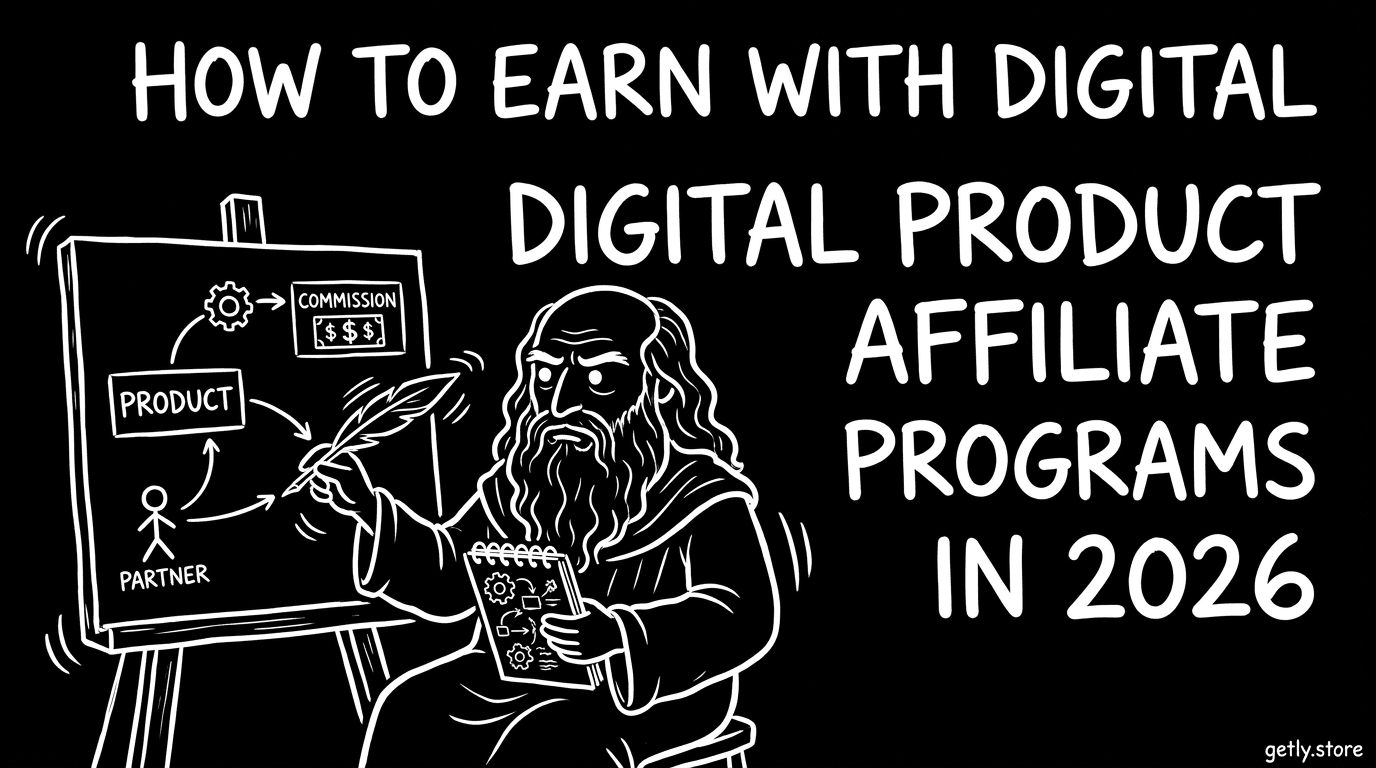
Digital product affiliate programs are one of the fastest ways to turn an audience into income—especially in 2026, where templates, AI assets, and software add-ons sell year-round. The catch: most people promote randomly. This guide shows you exactly how to earn with digital products using proven systems, better targeting, and reliable tracking.
By the end, you’ll know how to choose the best affiliate marketplace for your niche, build a simple funnel, and create content that converts—whether you’re aiming to earn money selling templates or driving software downloads.
- Pick digital product affiliate programs that match search intent (tutorials, tool comparisons, templates for a job-to-be-done).
- Use a repeatable content funnel: problem → solution → demo → value-packed resources → affiliate link.
- Track conversions at the page level and optimize weekly (CTAs, pricing mentions, audience fit).
- Templates and tools often convert faster because they promise immediate results.
- Build trust with “proof” content: screenshots, before/after, mini workflows, and honest limitations.
What is the best affiliate marketplace for digital products in 2026?
The best affiliate marketplace is the one that makes it easy to find relevant digital products, track conversions accurately, and get paid reliably. In 2026, creators expect fast payouts, clear commission rules, and robust link/attribution—because digital sales happen instantly and attribution errors are costly.
When you evaluate a marketplace, focus on three outcomes: relevance (does it have products your audience actually wants?), conversion (do you get assets like banners, landing previews, and descriptions?), and measurement (can you see what’s converting so you can scale?).
What to look for when choosing an affiliate program
Use this checklist to filter options quickly. If an affiliate program fails even one, your earnings potential usually drops because your marketing becomes harder to optimize.
- Niche match: products align with your content theme (design, video, AI prompts, 3D, productivity).
- Clear commission: percentage, flat rates, cookie window (or equivalent attribution rules).
- Conversion assets: landing-page copy, thumbnails, demo videos, and spec sheets.
- Tracking quality: dashboard-level visibility for clicks and sales.
- License flexibility: tiered licenses often increase average order value (AOV).
- Payment reliability: consistent payouts in multiple methods when possible.
Where affiliate marketing income usually comes from
Affiliate income is typically driven by two content types: (1) intent content (reviews, comparisons, tutorials) and (2) problem-solution content (workflows, checklists, “how to” guides). In digital products, problem-solution content is especially powerful because you can show results immediately.
To make it concrete: if your audience wants to earn money editing, they don’t just want “a recorder”—they want better capture quality, a specific workflow, and a tool that reduces friction. That’s why tool-focused affiliates can earn steadily even without huge traffic spikes.
Pro tip: Don’t start by chasing “highest commission.” Start by chasing “highest match.” A 20% commission on a product your audience actively searches for often beats 50% on something nobody needs yet.
How to earn with digital products using affiliate funnels
To earn with digital products, you need a funnel that turns attention into action. In 2026, the winning funnels are short, visual, and built around immediate outcomes—because most buyers are tired of vague promises.
Your goal is to guide users from “I have this problem” to “I want this exact outcome” to “this product is the fastest path.” That means content that demonstrates the solution, not content that just describes it.
The simplest funnel that converts
Start with a lightweight structure you can repeat every week. This is the core loop for digital product affiliates:
- Entry: search-friendly blog post, YouTube tutorial, or short-form video around a specific problem.
- Bridge: show why existing tools/content fall short (without trashing competitors).
- Solution: demo your recommended product or template with a mini workflow. >
- Value add: include a checklist, prompt pack, or step-by-step instructions.
- Call to action: offer the affiliate link at the moment users feel confident.
Examples of funnels by product type
Digital products vary, and your funnel should reflect how people buy. Here are practical patterns you can copy.
| Digital product type | What buyers need | Affiliate content that works |
|---|---|---|
| Templates (e.g., planners, workbooks) | Instant results & easy setup | Before/after screenshots, “print & use” walkthrough |
| Software/tools (e.g., screenshot/video capture) | Quality, speed, workflow fit | Short demo clips, feature breakdown with use cases |
| AI resources (prompt engineering, cheatsheets) | Better prompts & fewer mistakes | Prompt examples, “copy/paste” sections, troubleshooting |
| 3D pipelines & assets | Compatibility & fewer failed exports | Pipeline tutorial + export test footage |
If you want to earn money selling templates, lean into “printable, downloadable, ready now” content. People want to see what they’ll get, how it looks in real life, and how long it takes to use.
Success story pattern: Affiliates often win by creating a single “hero” tutorial that ranks (or gets shared), then updating it monthly with better examples and fresh use cases—turning one post into a compounding lead source.
How to promote digital product affiliate programs without feeling spammy
The fastest way to limit affiliate marketing income is to promote like a billboard. In 2026, audiences respond to helpful, specific recommendations with proof. That means your affiliate link should be the natural next step, not the main event.
A good rule: if your post removes the affiliate link and still helps someone solve the problem, you’re doing it right. Then the link becomes a resource, not an interruption.
Content angles that earn trust
Use angles that show expertise and reduce buyer risk. These angles tend to outperform generic “best tool” posts.
- Workflow-first: “Here’s how I use it in my process.”
- Problem-first: “Stop doing X—do this instead.”
- Comparison with criteria: “If you care about A, choose B.”
- Use-case targeting: “For creators making explainer videos,” not “for everyone.”
- Limitations: “Works best when…” (buyers appreciate honesty).
Where to place your affiliate CTA
Your CTA placement affects conversions because it matches user confidence levels. In affiliate content, confidence rises after proof and falls if you ask too early.
- After your first demo screenshot/clip: show the outcome first.
- Near the “decision section”: include bullet reasons to buy.
- In a recap block: “If you want X, click here.”
Common mistake: Adding a link at the top “just because.” If you do that, users haven’t learned why your recommendation matters yet—so they bounce or ignore the CTA.
How to earn money selling templates: the template playbook
Earn money selling templates by targeting high-frequency needs and showing exactly what the customer will receive. Templates win because they compress time-to-value: download, print, fill, and get results.
In affiliate marketing, the best templates are the ones you can “preview” convincingly—through screenshots, walkthroughs, and quick examples that mirror the buyer’s situation.
Choose templates with clear buyer jobs
Pick template niches where people already search with urgency: productivity, learning, scheduling, compliance checklists, and creative workflows. The more specific the job, the more likely it converts.
For example, a “Daily Planner” template fits daily organization pain, while a kids’ workbook fits parents who want structured learning. Likewise, specialized safety resources (like driver-focused materials) attract people who need readiness, not inspiration.
Make template content irresistible with proof
Templates need visual proof more than explanations. Show the design, the layout, and the outputs.
- Include 3–6 screenshots (cover, interior page, example filled-in page).
- Show real-life use: “I printed this on A4/Letter” or “filled one week in 2 minutes.”
- Add instructions: how to customize, how to print, and what’s included.
- Offer a starter pack bonus: a mini checklist or example filled page (even if the template doesn’t include it).
To tie this to digital product affiliate programs: when you promote a template, emphasize outcome, completeness, and ease of use—not just “it’s a planner/workbook.”
Here’s a natural affiliate angle using a product example: if you’re building productivity content, you can highlight a planner-style template and show how it structures a week. If your audience is education-focused, a kids’ workbook angle works best when you include a lesson plan sample and a “what to do next” section.
Some templates and niche digital assets also translate well into “micro content” like Pinterest pins or TikTok overlays, which can drive steady affiliate clicks over time.
How to structure affiliate marketing content that ranks in 2026
Affiliate marketing in 2026 rewards content that’s both searchable and demonstrable. Ranking isn’t just about keywords—it’s about satisfying intent better than the top results.
To earn with digital products through affiliate content, build a topic cluster around a single pain point and create multiple “entry doors” that funnel back to your best conversion page.
Position Zero patterns for affiliate content
Featured snippets and AI summaries often pull from the first 40–60 words, lists, and comparison tables. Use these structures to help your pages get cited.
- Direct answer opener (1–2 sentences under the heading).
- List of steps (5–8 items) for “how to” queries.
- Comparison table for “best tool for X.”
- Proof section with screenshots, tests, or short demos.
- FAQ for objections (price, setup, compatibility, time to results).
Pick topics that match conversion intent
Not all “how-to” content converts equally. Choose topics where users are already close to buying, like tool comparisons, setup guides, and “best for” workflows.
- Review intent: “Pro vs free,” “best for beginners,” “what to choose.”
- Workflow intent: “how to capture,” “how to export,” “how to build a pipeline.”
- Outcome intent: “increase output,” “reduce failures,” “save time.”
For instance, a screenshot/video capture tool review can earn better affiliate conversions if it includes a side-by-side clip, a setup checklist, and common troubleshooting (audio sync, capture region, file formats).
If you want to link naturally to relevant tools, consider content around workflows and proof. For example, a tutorial on screencasting can naturally reference a capture system like Pro Recorder - Professional Screenshot & Video Capture System when you demonstrate how to record and export quickly for tutorials.
How to track affiliate marketing income and optimize in 2026
Tracking is what turns affiliate marketing income from guesswork into a system. In 2026, the winners don’t just publish—they measure, iterate, and expand what works.
Your optimization goal is simple: increase conversions per visit by improving relevance (audience fit), clarity (value proposition), and friction (page speed and CTA timing).
Metrics that actually matter
Start with these metrics. You don’t need a complex analytics stack to make meaningful improvements.
- Click-through rate (CTR): link placement and CTA clarity.
- Conversion rate: how well the page matches intent.
- Revenue per visitor: combines conversion and AOV.
- Top landing pages: where visitors actually come from.
- Refund/return signals (if available): indicates mis-targeting or unclear expectations.
Weekly optimization routine
Use this routine to improve results without burning out.
- Monday: review CTR and conversions by page; shortlist the bottom 20% and top 20%.
- Tuesday: update the intro to match the query more directly (reduce fluff).
- Wednesday: add proof (new screenshots, demo, examples) where objections likely occur.
- Thursday: rewrite CTA text to be outcome-based (“download to start X”) instead of generic (“check it out”).
- Friday: test one change per page and log results.
Pro tip: If conversions are low, don’t immediately change the product. First check whether your traffic matches the promise on the page. Mis-targeted keywords are the #1 hidden killer of affiliate performance.
How to scale digital product affiliate programs with bundles & audiences
Scaling digital product affiliate programs in 2026 is about expanding reach without lowering relevance. Bundles, multi-license tiers, and audience repurposing help you increase revenue per click while keeping your marketing focused.
When you promote bundles, you reduce buyer hesitation because customers see “more value for the same purchase.” And when you promote to multiple micro-audiences, you can reuse content while changing the angle.
Bundle strategy that increases AOV
Bundles work best when you explain the “why together” logic. Don’t just say “bundle exists.” Show a complete path: step 1, step 2, step 3.
- Explain workflows: “If you do A, you need B next.”
- Highlight compatibility: list formats, export pipeline steps, or setup requirements.
- Show end-to-end results: include a final output screenshot or demo.
Audience scaling with content repurposing
Once a page converts, scale it via formats: turn it into a checklist post, a short video script, and an email series. This keeps your cost to acquire visitors low.
To make this practical, here’s a natural example in the 3D/creative tooling space: if your audience is into shaders, materials, or stylized rendering, you can publish a tutorial around a toon/anime shader pipeline and reference AnimeForge Pro - Ultimate Anime & Toon Shader System when you show the shader result and workflow setup.
Scaling also means building “audience proof.” When you demonstrate outputs consistently (not just features), you turn viewers into buyers. In digital goods, that proof is everything.
blockquote>“The affiliate content that wins in 2026 is the content that helps people do the work—fast.”
- Choose affiliate programs by niche match, not just commission rate.
- Build a repeatable funnel: problem → demo → value add → outcome-based CTA.
- For templates, conversions improve when screenshots and “use in real life” proof are included.
- Use tracking and weekly iteration to raise conversion rate, not just traffic.
- Scale with bundles and repurposed content to increase AOV and reduce costs.
FAQ: digital product affiliate programs in 2026
How do beginners start with digital product affiliate programs?
Start with one niche and one audience intent. Create 1–2 pieces of content that solve a specific problem (tutorial, review, comparison) and include a clear demo or proof. Then track clicks and conversions weekly and improve the content that performs best.
What is the easiest way to earn money selling templates?
Promote templates where buyers can immediately visualize the result. Use screenshot-heavy posts, show a filled example, and include setup/printing instructions. Templates convert well when your content reduces uncertainty and time-to-value.
How do I increase affiliate marketing income without more traffic?
Improve conversion rate by refining your value proposition and CTA timing. Add stronger proof (before/after, workflow clips, checklists) and tighten your intro to match the search intent. Weekly iteration on your top pages is usually more effective than publishing more from scratch.
Which digital products convert best for affiliates?
Digital products that offer immediate outcomes—templates, capture tools with fast setup, AI cheat sheets with copy/paste examples, and niche software with clear compatibility—tend to convert better. The common factor is reduced buyer risk: users can quickly see what they’ll get.
What tools should I use to track affiliate results?
Use your affiliate dashboard for baseline reporting, then connect it to basic analytics for page-level performance (CTR, time on page, and conversion rate). If you can’t measure conversions reliably, you can’t optimize—so fix tracking early.
Conclusion: build a system, not a random affiliate habit
If you want to earn with digital products in 2026, stop thinking in one-off promotions and start thinking in repeatable systems: pick the right affiliate marketplace, build intent-driven content, prove outcomes, and optimize weekly with real metrics.
When your content reliably matches a buyer’s job-to-be-done, affiliate marketing income becomes far more predictable. If you want a place to explore digital assets across categories, browse the marketplace inventory and choose products that align with your next content topic.