 Getly
Getly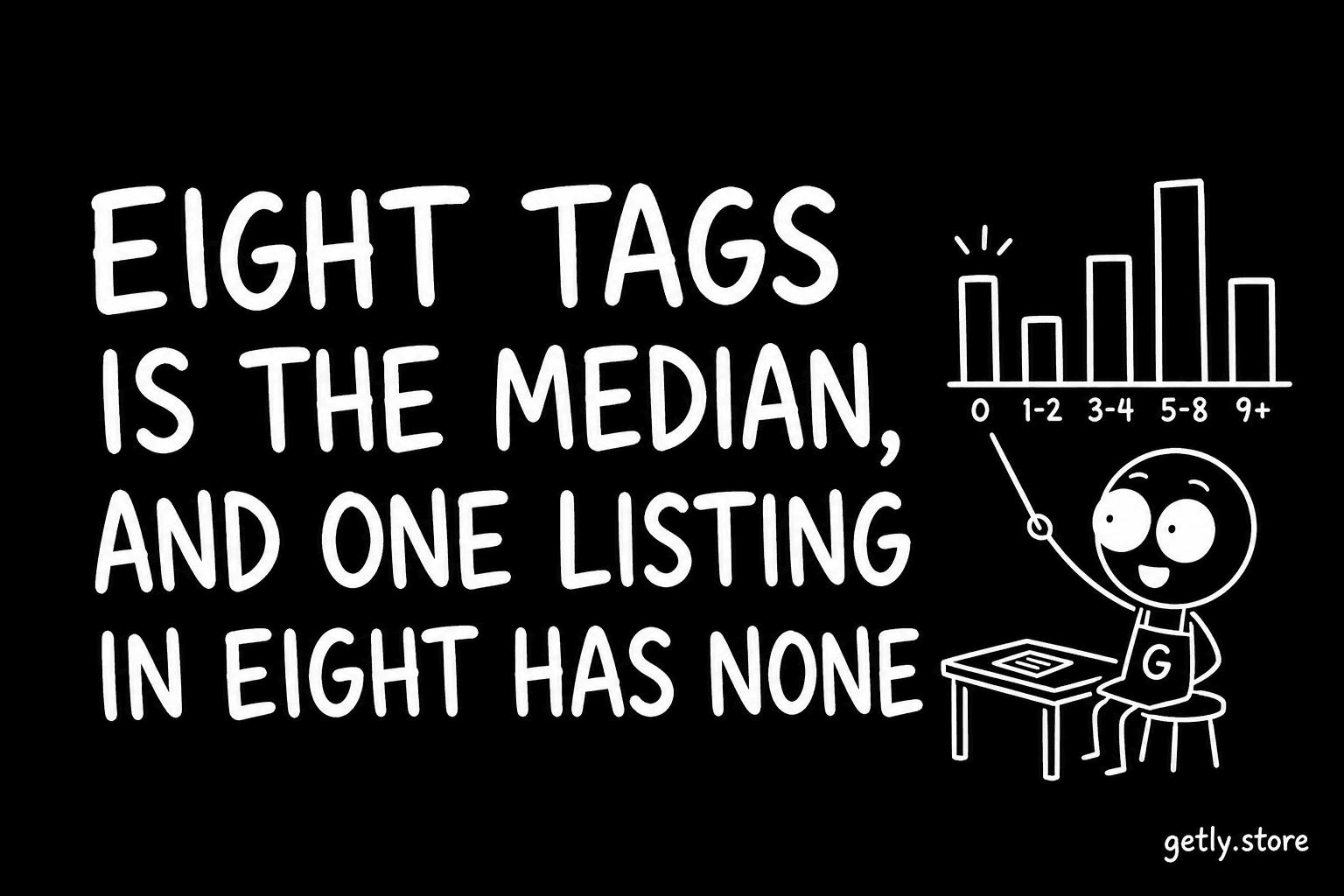
Tags are the part of a listing sellers either ignore or overthink. We measured how the catalogue uses them this week, across 4,885 active products, and then looked at what the search engine actually does with them.
The distribution
- Median 8 tags per listing; 90th percentile 10, which is the cap.
- 13.3% of listings have no tags at all.
- 19,043 distinct tags across the catalogue. 15,297 of them — 80% — are used by exactly one listing.
- 187 listings carry a tag like "digital download", "digital product" or "digital" — a tag true of every product on the site.
The most common tags are two sellers, not the market
The top of the frequency table looks like this: nature, stl, 3d-print, pla, stock, olympus, macro, digital art, ai prompts, digital download, ebook, productivity, insect, automation. Read it as a market and you would conclude the catalogue is about macro photography of insects and 3D printing. It is not. "nature", "olympus", "macro", "insect" and "stock" belong to one photographer with a large catalogue tagged identically; "stl", "pla" and "3d-print" belong to one seller of print files. Two stores account for eight of the fourteen most common tags.
This is the general lesson of tag statistics on a marketplace with a long tail: frequency measures who uploaded the most, not what buyers want. Do not copy the popular tags. They are popular because someone else used them a lot.
What a tag does here
Search on this marketplace works on one combined text per product — the name, the short description, the description and the tags — with fuzzy matching, so "tshirt" finds "t-shirt" and a typo of one letter still lands. A tag therefore adds a word to the searchable text. That is all it does, and it is enough: a tag is the one place you can put a word that does not fit naturally into a sentence of your description but that a buyer will type.
Three consequences follow. A tag that already appears in your title or description adds nothing. A tag that describes the entire site — "digital download" — adds nothing, because it matches everything equally and therefore ranks nothing. And a tag used by exactly one listing is not a failure; it is the case where a tag works best, because when a buyer types that word, yours is the listing it finds.
Which words are worth the slot
The software. "canva", "figma", "notion", "procreate", "blender", "excel". Buyers search by the tool they own far more often than by the kind of thing they want.
The format. "svg", "png", "pdf", "docx", "stl". Especially when your title does not say it.
The use. "wedding", "resume", "invoice", "etsy shop", "youtube thumbnail". The occasion or job the buyer has, in the words they use for it.
The synonyms. If your title says "planner", tag "agenda" and "organizer". If it says "e-book", tag "guide" and "workbook". Fuzzy matching handles spelling; it does not handle a different word.
What is not worth a slot: "bestseller", "premium", "high quality", "2026", your store name, and anything already in the title. Eight specific words beat ten vague ones, and the 13% with no tags at all have left the one free field on the listing that is written purely for the search box.