 Getly
Getly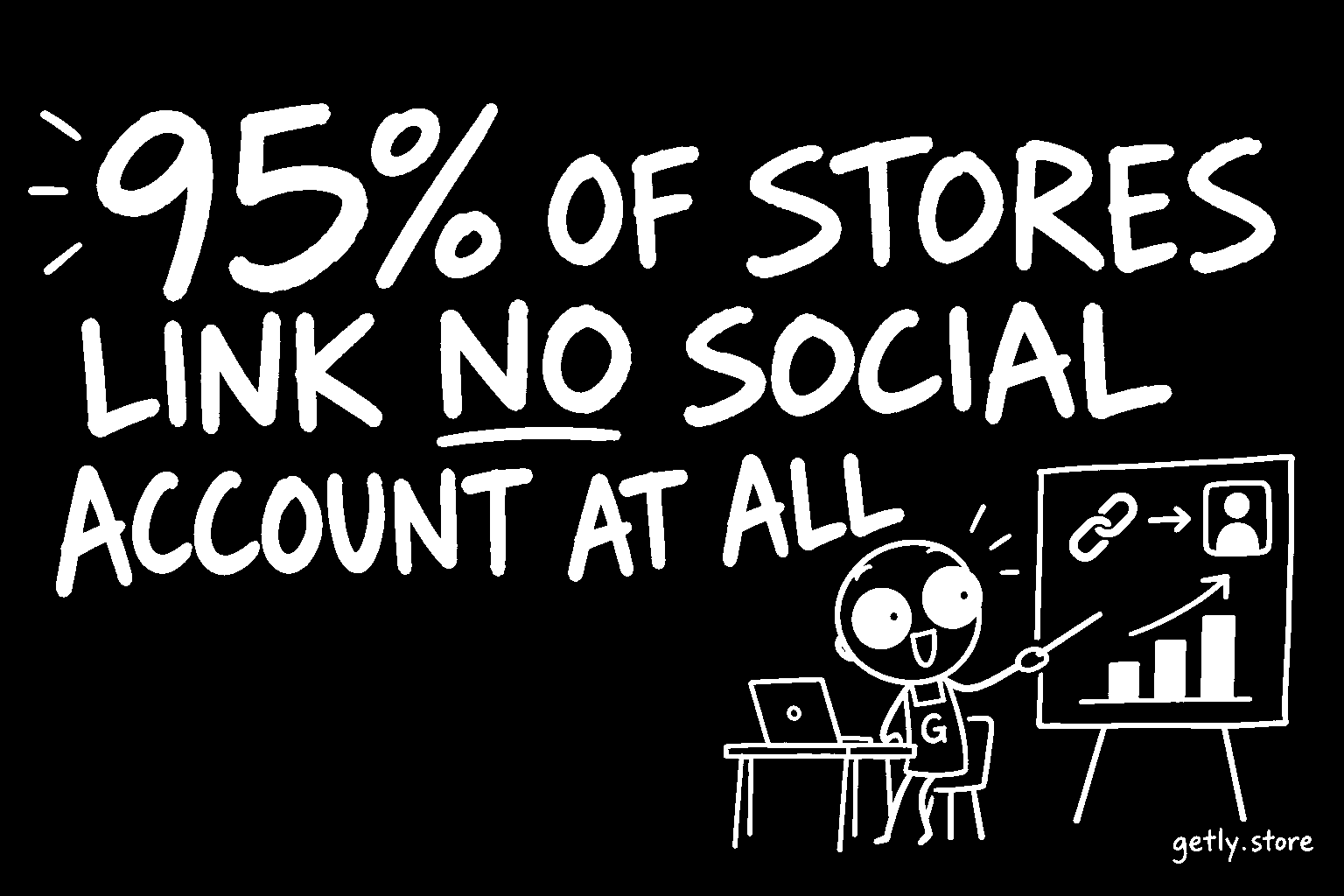
Getly stores can list social profiles — the usual set, plus a website. On 14 September 2026, 5% of live stores list even one — a single store in twenty.
Ninety-five percent of stores present themselves to a first-time buyer with a name, a logo if they uploaded one, and nothing else that can be checked.
What the link is actually doing
Not marketing. Verification.
A buyer looking at an unfamiliar store is running one calculation: is there a person behind this, or is this a page that will stop existing after it takes my money. They cannot audit your files and they will not read your terms. What they can do in five seconds is click through to a profile and see whether it has a history.
A profile with posts going back a year answers the question. An empty field leaves it open, and an open question at the moment of payment resolves as "not today".
The bar is lower than sellers think
The instinct that stops people filling this in is usually "my following is too small to show anyone". That misreads what the link is for.
Nobody is counting your followers. They are checking that you exist. A profile with two hundred followers and regular posts about the work you sell is a stronger trust signal than a profile with fifty thousand followers and nothing relevant on it — and infinitely stronger than no link at all.
The same logic applies to a personal site, a portfolio, a public repository, a shop on another platform. Anything that shows continuity does the job.
One format detail worth knowing
When we added social links, a large share of the values sellers had entered were bare handles rather than URLs — "@yourname" instead of the full address — because the settings form asks for a handle. For platforms where a handle maps unambiguously to one profile URL, we build the link. For the ones where it does not, we leave it out rather than guess and send a buyer somewhere wrong.
If you want to be certain your link resolves, paste the full URL.
Pair it with the description
The other field almost nobody fills is the store description — 87.8% of stores have none or fewer than fifty characters. The two work together and neither works alone.
The description says what you make and who it is for. The link lets a sceptical buyer confirm that a real person has been making it for a while. A store with both reads as a business. A store with neither reads as an experiment, which is a fair reading, because for most of them it is.
The part that makes this worth doing today
Most marketplace advice asks you to do something your competitors are also doing, so the benefit erodes as everyone adopts it. This one does not. Ninety-five percent of stores have not filled this field, and the reason is not difficulty — nothing forces it.
Two minutes in your store settings puts you in the five percent that can be checked.
What counts as a link
A social profile, a personal site, a portfolio, a public repository, a channel — anything that shows continuity of work. The field is called social links, but its job is narrower than that: it lets someone confirm that a person has been doing this for a while.
A shop on another platform with reviews works too, and is arguably the strongest option: it shows not just existence but a history of transactions.