 Getly
Getly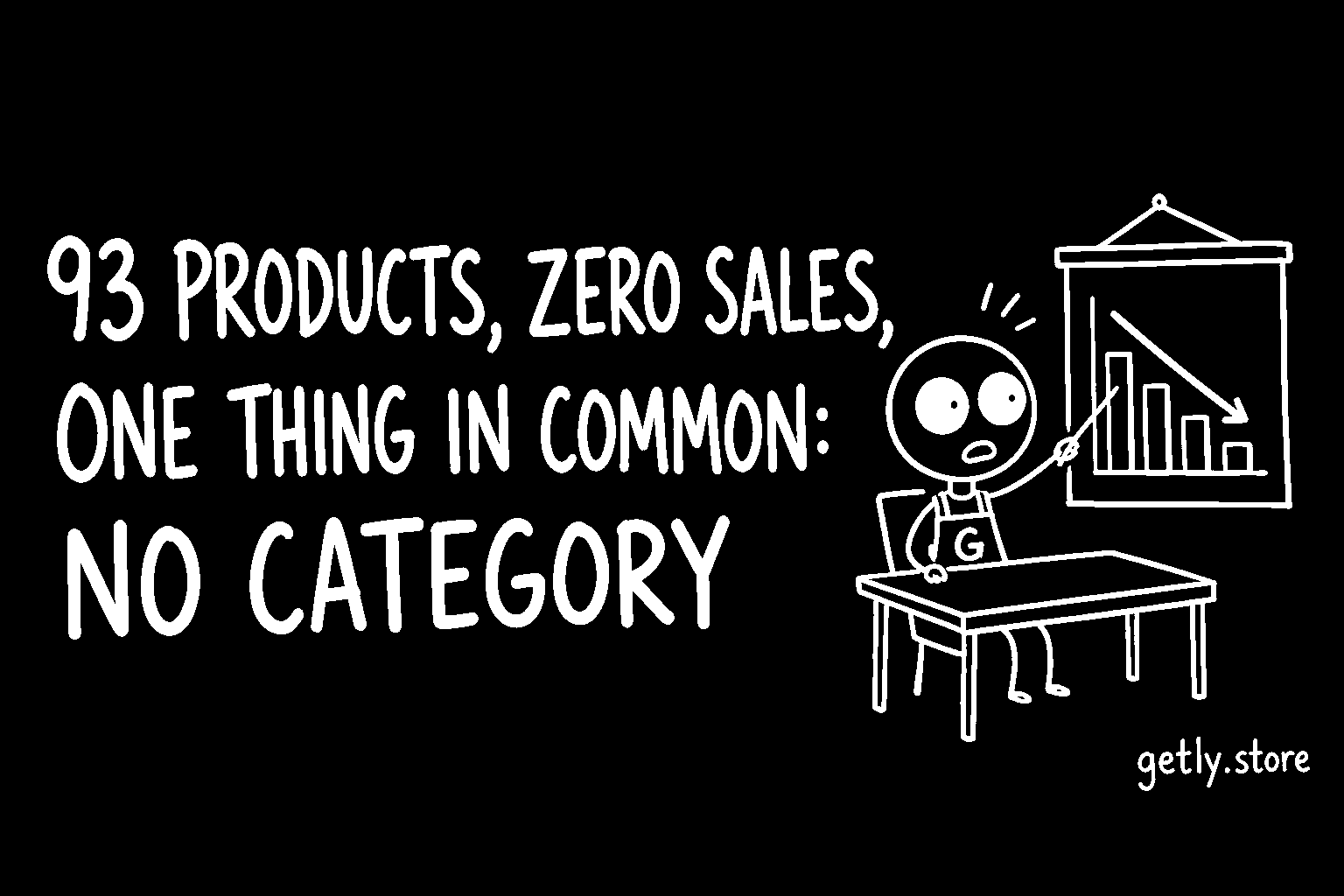
Earlier this year we found 93 live products on Getly with no category set. Every one of them was publicly listed, purchasable, and correctly priced. Between them they had made zero sales and zero downloads.
Not fewer than average. Zero. It is the cleanest natural experiment this catalogue has produced, and it is worth understanding before you file your next product.
What a category actually does
A category is not a label, it is an address. Without one, a product is missing from:
- Every category page. There are 701 of them, and they are how people browse rather than search.
- Its breadcrumb trail, which is both a navigation aid and a signal search engines use to understand what a page is about.
- Category-scoped filtering, so a buyer narrowing "e-books under $10" never sees it.
- A specific product type in the Google Shopping feed. An uncategorised product goes out under a generic classification, competing against everything instead of its actual peers.
What remains is the direct URL and the site search. That is a product that can only be found by someone who already knows it exists — which, for a new seller, is nobody.
How they got that way, and what we changed
None of those 93 sellers chose to skip the category. All of them arrived through the v1 API, where categoryId was accepted without being checked at all. A missing field created a product with no category; a category slug instead of an ID reached the database and came back as a 500 on our side. Across the whole catalogue, 437 uncategorised products came in that way.
That is fixed, and the fix is worth describing because it explains what is and is not required now. A category is a requirement to publish, not to create. You can still make a draft with nothing but a name — the Gumroad, Etsy and Envato importers depend on exactly that, and breaking them would have banned a perfectly normal way of working. But a product cannot go live without a shelf to live on, through any path: the seller dashboard, the API, bulk activation, scheduled publishing, or admin approval.
The 253 products already sitting uncategorised were classified and given one.
Picking the right one when several fit
With 701 categories, plenty of products could plausibly sit in two or three. Three rules that hold up:
File by what it is, not by who it is for. A meal-planning printable is a printable planner, not a "health and fitness" product. Buyers browse by the shape of the thing they want to download.
Prefer the specific over the safe. A leaf category with 80 listings puts you in front of people who came looking for exactly that. A broad parent category with 800 puts you on page four. The narrower shelf is almost always the better one.
Check the price on the shelf before you commit. Category medians on Getly range from $1.99 for wallpapers to $27.00 for illustrations. Filing a $25 product into a $2 category is not just a discovery decision — it puts your listing next to a row of products that make yours look overpriced by comparison.
The mismatch problem, honestly stated
We check whether a product's file matches the category it claims, and the results were not flattering: about 12% of categorised active products are filed in a vertical they do not belong to. In software categories specifically, 199 of 243 listings contained no code file at all.
The check flags rather than blocks, deliberately. A genuine disagreement about whether a Notion template is "productivity" or "business" should not stop a sale, and an automated classifier is not the right thing to make that call. But if a product is filed where nobody looking for it would look, the flag is a hint worth taking.
The thirty-second version
Set a category. Choose the narrowest one that honestly describes the file. Glance at what the neighbours charge before you finalise your price. It is the cheapest thing on the entire list of things that affect whether a product gets found — and the 93 listings above are what the alternative looks like.