 Getly
Getly
Every file attached to a Getly listing gets read — not scanned for viruses, read: what format it really is, how many pages, whether the text is selectable, what the image dimensions are. The point is to put facts on a product page that the seller does not have to type and cannot get wrong.
Across roughly 5,000 files, here is what that turned up.
1. The catalogue runs on documents
| Format | Files |
|---|---|
| 2,247 | |
| PNG | 1,458 |
| JPEG | 1,267 |
| WebP | 30 |
PDF is not just first, it is larger than either image format alone. Whatever else this marketplace is, it is mostly people selling documents — and the tooling should follow that rather than the more glamorous categories.
2. The file name is a claim, not a fact
Format detection reads the first bytes of a file, never the extension. That is not pedantry: a renamed executable arriving as bundle.zip used to pass, because the block list worked on names and the name is the one thing an attacker fully controls. Sixteen bytes of signature closed it.
The same principle catches honest mistakes. A file saved as .png that is actually a JPEG is common, and it matters to a buyer who needs transparency.
3. Sellers promise transparency they do not ship
Measured across the wizard: 21 of 29 listings whose description promised PNG or transparency were delivering JPEG — twelve different stores. Not one of them was being dishonest. They exported from a tool that defaults to JPEG and never checked.
The product wizard now compares what the description says against what the files are, in the browser, and says so before publish. It never blocks: a mismatch is a hint, not a verdict, and there are legitimate reasons for one.
4. Our own reader was wrong for months
The least flattering finding. Facts were read from the first 512KB of a file, on the reasonable-sounding theory that everything needed lives in the header. True for an image. False for a PDF, whose pages are recorded throughout the file.
So a 6.9MB book with 295 pages was listed as 10 — because exactly ten page markers fell inside the window we looked at. 1,426 listings carried a page count taken that way, every one of them understating the file. A seller had to write in twice before we found it.
They have all been recounted, and the rule now is that a page count is only shown when the whole file could be read. Where it cannot, nothing is shown — a confident wrong number is worse than a blank.
5. Most files are fine
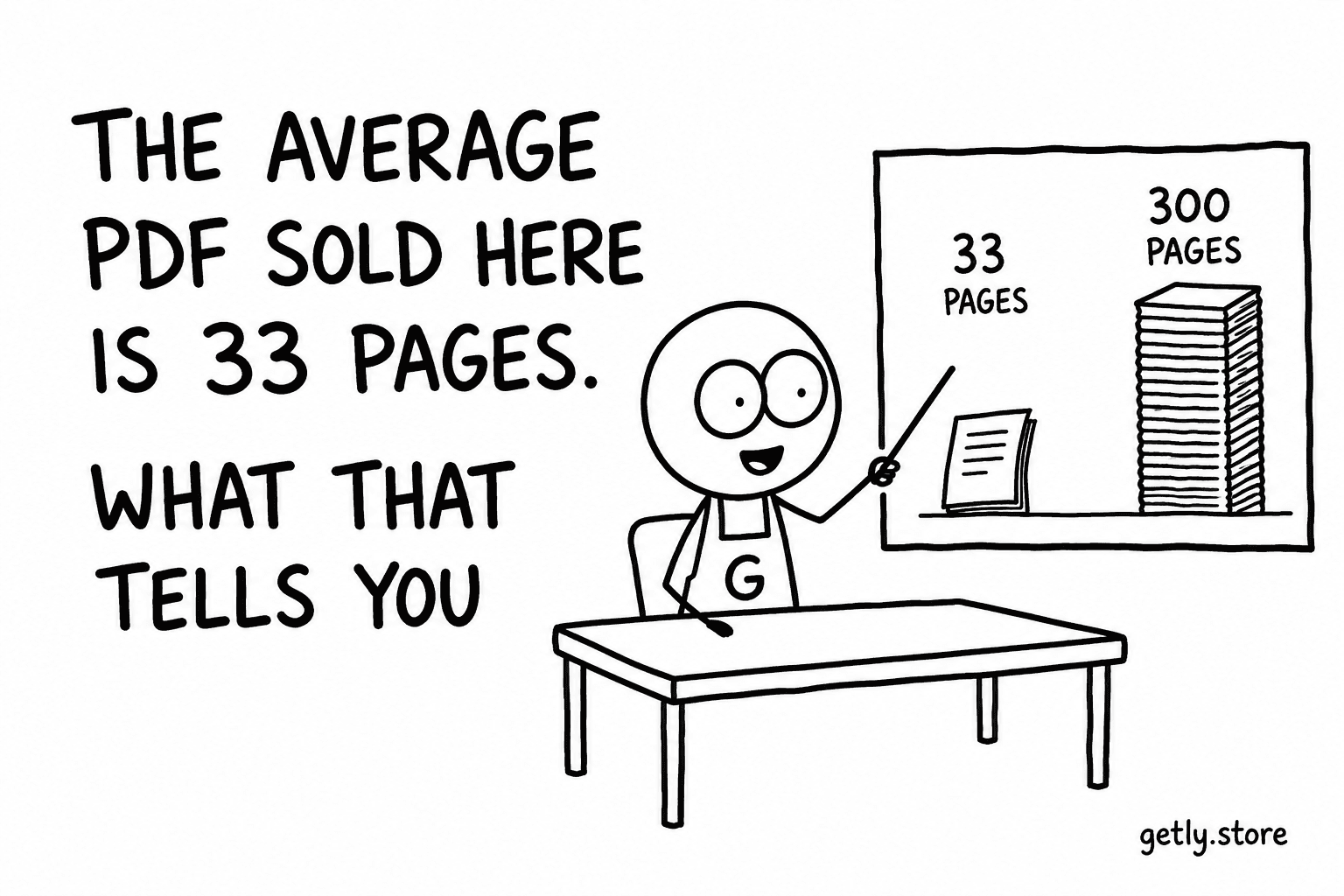
It would be easy to write a piece like this as a list of everything wrong with what sellers upload. That is not what the data says. The overwhelming majority of files are exactly what their listing claims, in a sensible format, at a sensible size. The average PDF is 33 pages and opens correctly. The images are the dimensions they say.
Which is the argument for reading files in the first place: not to catch people out, but so the honest majority get facts on their product page automatically, instead of having to write "50 pages, text is selectable, A4" and hope a buyer believes them.